They say time heals all things, but Star Trek just proved that to be a lie, and in the process rewrote one of Voyager‘s most popular characters as a villain – somewhat by accident. We’ve seen general consensus on certain Star Trek characters shift over time before, of course, with Wesley Crusher’s legacy being honored recently, and some fans being a lot more forgiving of Neelix over time. Hell, the entire cast of Enterprise is now treated with way more reverence than they ever were before it was cancelled. The difference this time is that Star Trek just wrote in a narrative reason for perception to change.
Videos by ComicBook.com
In the latest episode of Starfleet Academy, Robert Picardo’s EMH – The Doctor – was forced to explore old wounds when SAM (Kerrice Brooks) was deactivated, and his willingness to mentor her as a father became the only way to save her. As a result, SAM was reborn, The Doctor finally gained a name that mattered (“Dad”), and his centuries-long pursuit of true human understanding was delivered. Admittedly, his gaining a holographic daughter might not be the most straightforward way to come to that conclusion, but crucially, the Doctor was looking for emotional reason, not necessarily a Data-like understanding of humanity. But in his happy ending, we also got a pretty shocking reveal of the trauma he’d faced for 800 years, thanks to a Voyager crewmate.

Star Trek Just Made B’Elanna Torres A Villain (By Accident)
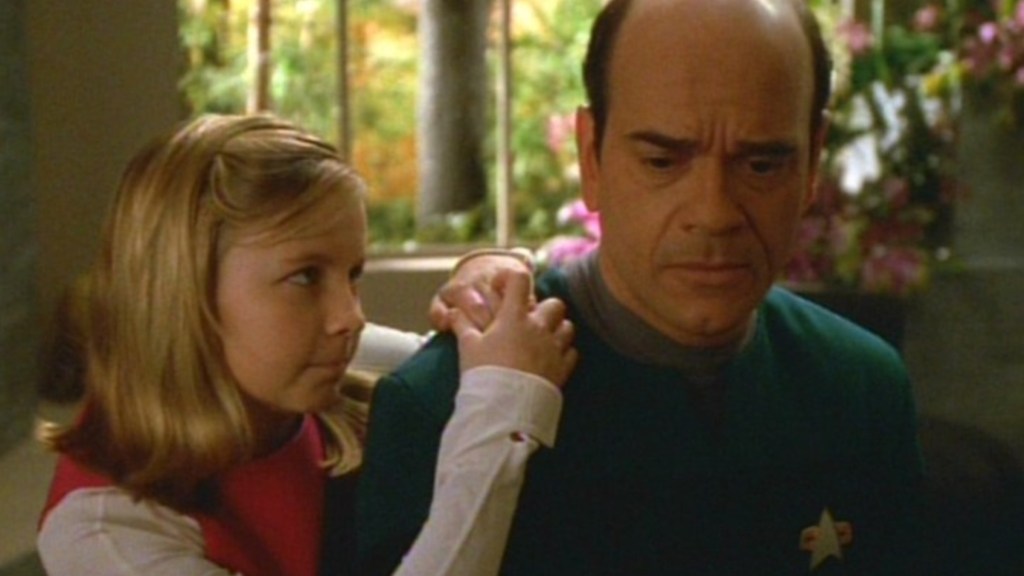
Starfleet Academy‘s “The Life of the Stars” effectively became a belated sequel to Voyager‘s “Real Life”, in which The Doctor creates a holo-family for himself. We know this because the EMH mentions the family – his “wife” Charlene, “son” Jeffrey, and “daughter” Belle – as The Doctor reveals his resistance to connecting with SAM so far was because she reminded him of his daughter. He then also reveals that he’s basically lived the last 800 years failing to deal with the trauma caused by his lost family in “Real Life”, and has consciously chosen not to connect with anyone because of that pain. He says it himself, his emotional distance is self-preservation: “The only thing that allows me to bear my infinity is not having to love anyone.”
And when you consider what actually happens in “Real Life”, you begin to realize just how “The Life of the Stars” retroactively makes B’Elanna Torres the villain of The Doctor’s story. When The Doctor shows her his family, she is outraged at how perfect the life he’s created for himself is and “helps” him introduce a more realistic algorithm to the program. That immediately ruins his family dynamic in a completely unnecessary way, in order to teach The Doctor that life isn’t a Stepford Wives fantasy. Except that’s exactly what his holo-family is, and The Doctor’s fantasy is completely harmless. The result of Torres’ “improvement” to the holo-program is a rebellious son, a disaffected wife, and a daughter who dies thanks to massive brain trauma during a parrises squares game. Her reasoning? “No one has a family like this – this is a fantasy! You’re not going to learn anything from living with these… lollipops.””
In the name of almost spiteful education, Torres put The Doctor through trauma so bad that he ended the program, unable to face the death of his daughter. And rather than it being a throw-away lesson – which Tom Paris underlines by admonishing the EMH for turning his back on the bad side of family life (which he claims is necessary to balance the good) in the true value of life – it ended up haunting The Doctor and compromising his ability to form normal relationships for close to a millennium. All because Torres didn’t believe his fantasy was a good enough teaching environment. She couldn’t have foreseen it, but she could have known The Doctor’s lack of true emotional maturity would not have reacted typically, and I think that’s an unforgivable oversight that doomed her crewmate to horrific trauma.
What do you think? Leave a comment below and join the conversation now in the ComicBook Forum!
Most Viewed
-
Image Courtesy of Netflix -

Courtesy of ENGI / Kadokawa / Sentai Filmworks -
Image Courtesy of Studio Bones