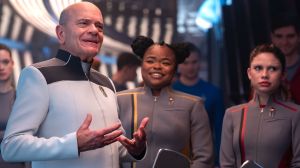
Star Trek’s latest series seems to be finding its way with critics and fans alike. With strong scores on sites like Rotten Tomatoes, the latest series in the franchise is offering Trek fans a new perspective never seen before: What it is to be an actual cadet training for a career in Starfleet.
Videos by ComicBook.com
That has turned out to be the primary selling point of Star Trek: Starfleet Academy: Getting to see a young cast of characters trying to learn what the values and legacy of Starfleet are all about, at a time when both have nearly faded from the collective memory of the galaxy. But did you know that this show is one that Star Trek has been trying to launch for years? As you can read below, Starfleet Academy has one of the longest and most convoluted origin stories of any franchise TV show.
Star Trek VI Was Almost An Academy Story

Leaving aside the literary lore about Starfleet Academy, the institution started appearing in films as early as Star Trek II: The Wrath of Khan, and almost became the subject of Star Trek VI.
The 25th anniversary of the Star Trek franchise happened in 1991; to prepare for the event, longtime Star Trek movie writer and producer Harve Bennett re-teamed with David Loughery, his co-writer on Star Trek V: The Final Frontier, following that film’s release in 1989. The pair went to work on the story for a film that is widely known as Star Trek: The First Adventure, but also went by the tentative titles of Star Trek: The Academy Years, and Starfleet Academy, which had been pitched to Bennett by Star Trek producer Ralph Winter, during development on Star Trek IV. The film would’ve been a prequel to the original Star Trek TV series. It would’ve explored how a hotheaded young earthling from a farm (James T. Kirk) and a stoic half-Vulcan (Spock) met at Starfleet Academy and bilt the iconic friendship we know and love.
“We had already locked in the Star Trek IV storyline with the whales and I said, ‘You know, I have a great idea, let’s do a prequel’ in the middle of this reception for his daughter. I suggested we develop a series of films to be another franchise, another tent pole that we could open,” Winter explained in The Making of Star Trek VI. “We could do a prequel and find out how Kirk and Spock met at the Starfleet Academy. When we were doing Star Trek V, we got the studio to approve work on the script. It is an excellent story, but it has been misperceived.”
The real appeal for the studio and producers, was that the Starfleet Academy movie would’ve required the role of William Shatner’s Kirk and Leonard Nimoy’s Spock to be recast. That would’ve cut down on the ballooning salary costs for the two actors, who (at that point) held a lot of leverage as the faces of both the original TV series, and moive franchise. Star Trek IV: The Voyage Honme earned $133 million (second highest of the film franchise to that point); after that, the cost per film started to jump by $10 million, and the studio saw an easy alleyway to bringing that number back down.
Details of the script have leaked on the Internet for years, but some of the more infamous tidbits include rumored casting like John Cusack and Ethan Hawke for the younger Spock and Kirk (respectively); a villain who is both a fellow Starfleet cadet and the prince of a world based around slave labor, who becomes a rival to Spock, in particular; McCoy being an older cadet and Kirk’s roomate, dealing with a famiy tragedy; an older, warship version of the USS Enterprise, and a subplot wherein Kirk and Scotty end up pioneering Dilithium-based warp technology while saving the Enterprise and defeating the bad guys.
It was a prototype for the kind of prequel films that would later become regular staples of Hollywood in the 2000s. Instead, Shatner and Nimoy and the rest of the TOS cast got paid for Star Trek VI, which didn’t earn as much at the box office, but was praised by critics, earning two Oscar nominations for Makeup and Sound Efects, as well as a Saturn Award for Best Science Fiction Film.
Starfleet Academy Got Many Adaptations Before The TV Show
When the concept for Star Trek VI became The Undiscovered Country, the concept for Starfleet Academy got recycled into any number of other media formats. A 1997 Starfleet Academy CD-Rom computer video game set in the original series (TOS) era also led to a tie-in paperback novel; in the 1990s, a series of Starfleet Academy YA books set in The Next Generation era characters was released, as was a Marve Comics series (1996 – 1997) centered around the Deep Space Nine character Nog. Even DC gave the concept a nod in “Starfleet Academy!”, the second annual issue of its 1980s Star Trek TOS comic series.
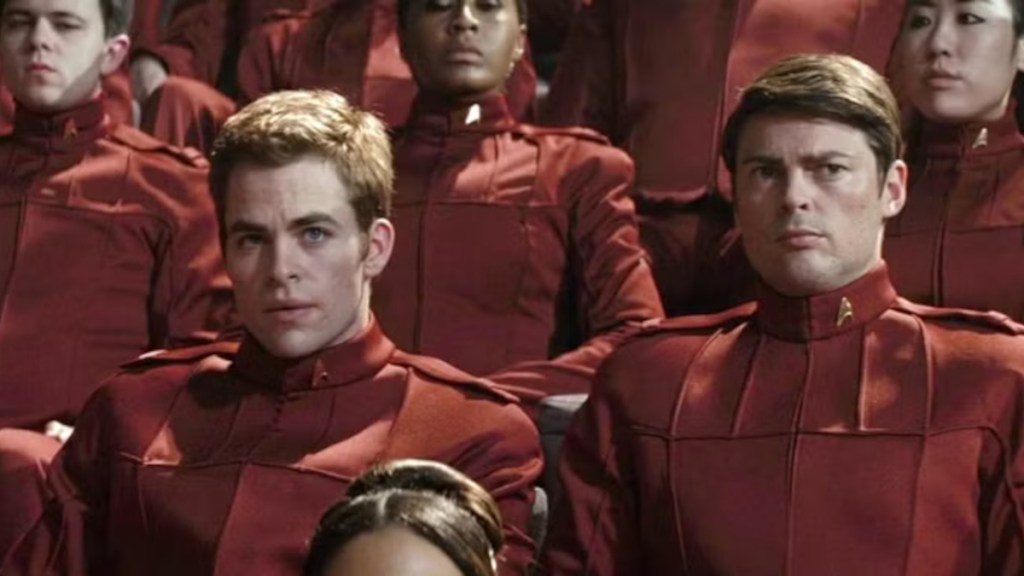
There were rumors that a Starfleet Academy TV series was pitched to Paramount in the late 2000s, but ultimately, it was J.J. Abrams who took the framework of the original pitch and reworked it into the first act of his Star Trek (2009) film. That reboot (set in the new “Kelvin Timeline”) saw Kirk and Spock begin as cadets at Starfleet Academy who clashed with one another, but by the end of the film, they became inseprable friends and teammates. Abrams’ film had to brush through that story arc quickly, but a series of 2010s tie-in novels helped flesh out the story, detailing how Kirk met and bonded with many of the Enterprise crew at school, beore his run in with Spock.
Star Trek: Starfleet Academy has now taken the concept to a bold new place, building off of the storylines of Star Trek: Discovery. That series jumped the Star Trek timeline ahead to the 32nd century, where an event called “The Burn” saw the galaxy’s supply of Dilithium spontaneously explode, killing warp travel, setting galactic culture back decades, and bringing an end to Starfleet. Thanks to Discovery‘s crew ending the era of The Burn, the new characters of Starfleet Academy are entering their era just like Kirk and Co., going the training to prepare them for a universe that needs to be re-explored, and bonds between cultures that need to be re-forged, or struck for the first time.
Star Trek: Starfleet Academy is streaming on Paramount+.
Most Viewed
-
Image Courtesy of Netflix