Modern viewers tend to associate superweapons with Star Wars, but Star Trek has quite a few that make George Lucas’ look tame. There’s a simple reason for this; as (ostensibly) peaceful as the Federation may be, Starfleet tend to stumble across countless races who are far more malevolent. Beings like the inhabitants of the Q Continuum possess almost infinite power in their own right, but many of the more dangerous threat are actually technological in nature.
Videos by ComicBook.com
To be fair, there are quite a few we’ve never really seen in action – largely because their effects would be catastrophic. The Borg, for example, have so-called “multikinetic neutronic mines” that can instantly assimilate vast sectors of space, but they’ve never actually been seen at work, and it makes no strategic sense for them to go unused, which makes these doomsday weapons a little suspect. But these eight superweapons are both confirmed, and terrifyingly dangerous.
8. Omega 47

Let’s start with Star Trek‘s newest doomsday device, unleashed in Starfleet Academy Season 1. Omega molecules are dangerously unstable, and unsafe detonation leaves subspace shredded, making warp travel through a given area impossible. By the late 32nd century, Starfleet itself had figured out a way to weaponize Omega 47 using mines that could essentially box in entire galactic empires. These mines may not (quite) match the destruction potential of other superweapons in this list, but they’re truly devastating.
Warp travel is the secret to galactic civilization. Omega 47 mines essentially make an entire region of space impossible to traverse, effectively removing given planets, races, and civilizations from the rest of the galaxy. Ironically, the Federation’s attempt to weaponize Omega molecules backfired when they were stolen by pirate king Nus Braka, who sought to use them against the Federation itself.
7. The Metreon Cascade

Now let’s turn to the Metreon Cascade, a terrifying superweapon created by the Haakonian scientist Ma’Bor Jetrel. This is a planet-killing weapon that creates unstable metreon isotopes, resulting in a huge explosion; it was used on the planet Rinax, a moon occupied by Haakonian enemies. More than a quarter of a million died, and untold thousands ultimately perished of metron radiation. Here’s how the effect was described:
“Hundreds of fires, and there’s nothing there – just smoldering ruins and the stench of seared flesh. But in the distance, in the middle of all that emptiness, from out of this huge cloud of billowing dust, he can see bodies moving, whimpering, coming toward him. They’re monsters – their flesh horribly charred, the color of shale.”
6. The Genesis Device
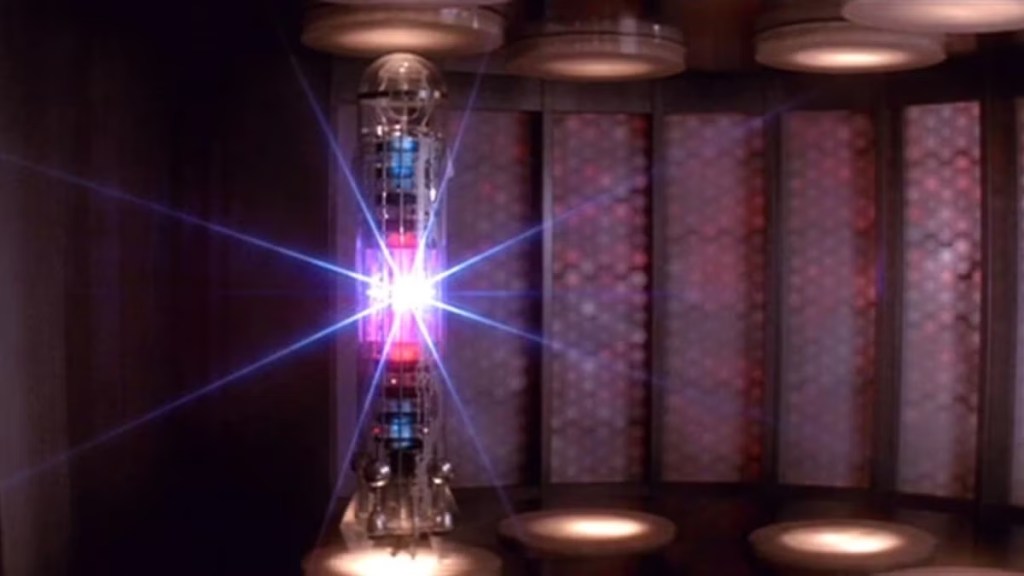
Now let’s move to the Genesis Device, a potential superweapon coveted by Khan Noonien Singh. The tragedy of the Genesis Device lies in the fact that it should have been benign technology, a force of creation rather than one of destruction. It was designed to convert all matter on an uninhabited planet, establishing a new M-class world in its place. Khan, however, rightly deduced that it could be used to literally erase existing M-class civilizations from the galaxy, converting inhabited worlds just as easily.
5. The Planet Killer
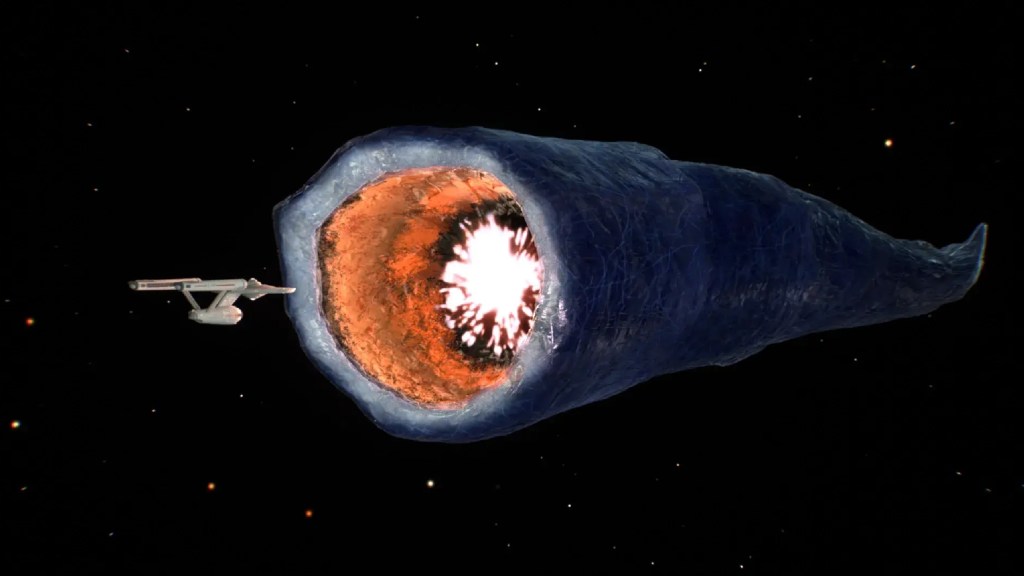
Now let’s move to the Planet Killer, a doomsday device with a particularly on-the-nose name given to it by Spock himself. Believed to originate from another galaxy, this was an automated, self-propelled superweapon that fired a concentrated antiproton beam to reduce entire worlds to rubble. Even more shockingly, the planet killer then turned the remains of a world into fuel. Kirk speculated it was so destructive that it could only have been created for use if war had already consumed a galaxy.
4. Trilithium Missiles
Star Trek: Generations introduced another chilling superweapon – but almost as an afterthought, a means to an end. Dr. Tolian Soran perfected a missile system that used trilithium, designed to detonate inside a star and stop all nuclear fusion. The result would be an instant supernova that destroyed every planet in a star system. Ironically, Soran didn’t have conquest as his goal; he simply planned to use these detonations to change the course of a cosmic energy phenomenon that he coveted. The same technology was later used by the Changelings in Deep Space Nine, when they attempted to destroy the Bajoran sun.
3. The Tox Uthat

Now let’s move to the Tox Uthat, a superweapon invented by a scientist named Kal Dano in the 27th century and hidden in the galaxy’s past in a desperate attempt to keep it from his enemies. The Tox Uthat is a small crystal that can be used to stop nuclear fusion in a star, triggering an instant supernova; it’s essentially a hand-held version of Soran’s trilithium missile, but with repeat use making it even more dangerous. Picard destroyed the Tox Uthat to prevent it falling into the wrong hands.
2. Red Matter

Red Matter first appeared in the J.J. Abrams Star Trek relaunch, an alternate timeline kicked off when Spock and some Romulan survivors traveled back in time. Red matter can be used as a fuel source, but its power makes it dangerously unstable, given a single drop is enough to consume a planet or turn a star into a black hole. In truth, red matter was more of a plot device in the Abrams films than a well-thought-through technology, and Star Trek hasn’t exploited this since.
1. Annorax’s Time Weapon
The greatest superweapon of all, though, is surely a temporal device created by a Krenim temporal engineer named Annorax. Encountered by the crew of the USS Voyager, it was able to push any object out of spacetime – creating a whole new timeline where said object never existed. It could be used to erase anything from spaceships to entire races, but the effects were utterly unpredictable, because history cannot be tampered with in such a cavalier manner. In the end, Voyager managed to erase the superweapon itself from existence.
What do you think? Leave a comment below and join the conversation now in the ComicBook Forum!