Star Trek is defined by certain staples that distinguish it from other sci-fi works, and spaceship designs are definitely one of them. The spaceships of Star Trek are now iconic, from the original USS Enterprise (NCC-1701) to the Enterprise-D of Star Trek: TNG. The late 1990s and 2000s offered greater variation, with Deep Space Nine making a space station junction its primary setting, to Voyager making the Intrepid-class starships famous during its impromptu seven-year voyage.
Videos by ComicBook.com
The new series Starfleet Academy has once again thrown some game-changing innovation into the franchise formula with the introduction of the USS Athena, which is truly a ship like no other. The “Academy-class” starship is a Starfleet academic institution (complete with an entire campus), as well as a massive starship that is capable of lifting off and landing in any terrestrial location, allowing cadets to get firsthand experience in the exploration and study that comes with Starfleet. As we’ve also learned in the backhalf of Starfleet Academy’s first season, the Athena is also capable of some pretty impressive maneuvers when pressed in battle – including the last-resort maneuver of the “saucer separation,” which has become an iconic tradition in Star Trek.
After the Starfleet Academy penultimate episode, “300th Night,” we can’t help but wonder about the other times Star Trek has wowed us with a saucer separation sequence. Read below for all the instances that we could find – and let us know if there are any more to add!

The USS Enterprise-D
The first and still most famous saucer separation sequences were conducted by the USS Enterprise-D in Star Trek: The Next Generation TV series, as well as the first of its film installments, Star Trek: Generations.
The first saucer separation blew fans’ minds and was seen in the two-part premiere, “Encounter at Farpoint”. When Jean-Luc Picard (Patrick Stewart) and his crew encounter the godlike entity “Q” for the first time, they get into a high-speed warp chase to escape the entity. When outrunning Q clearly becomes impossible, Picard makes the high-stakes decision to separate the saucer and stardrive sections of the Enterprise, so that only a small group of officers can face Q and possibly engage in battle, while the majority of the civilian crew and officers to escape in the saucer section.
Saucer separations would be mentioned throughout Star Trek: TNG, and used at times in strategic missions, like when Lt. Geordi La Forge (Lavar Burton) took temporary command of the Enterprise and separated the ship to fight an entire planetary weapons system (“Arsenal of Freedom”). One of the most famous examples of the Enterprise splitting in two halves was when the ship used it as a tactical move to distract and fight the Borg Cube vessel. The Enterprise crew feigned an all-out assault on the Borg while staging a high-stakes rescue of Captain Picard, who had been assimilated into the Borg collective as “Locutus” in the classic two-part finale to Season 3, “The Best of Both Worlds”.
Finally, the Enterprise-D had to do an emergency separation in the film Star Trek: Generations after the warp core in the stardrive section got breached and was about to explode. The crew fled into the saucer section, only to still find themselves in peril when the stardrive section’s explosion disabled the saucer and propelled them into planetary orbit. That spelled the end of the Enterprise-D, whose saucer protected the crew until it met its bitter end, crash-landing on the planet Veridian III.
USS Prometheus

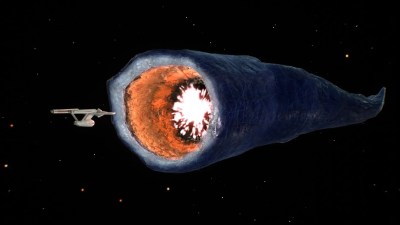
The USS Prometheus was a starship that Starfleet developed in the 24th century. An evolution of the Enterprise‘s saucer separation technology, the Prometheus introduced a line of starships bearing the same name, which introduced a new form of Starfleet technology: multi-vector assault. In multi-vector assault mode, the Prometheus could split into three sections: a stardrive section, a top deck, and a middle section that becomes its own sleek attack vessel. The Romulans hijacked the Prometheus, giving them a deadly weapon to turn against Starfleet, but the ship was accidentally discovered and intercepted by the USS Voyager, in the Star Trek: Voyager episode, “Message in a Bottle”.
USS Discovery

The titular ship of Star Trek: Discovery was a Crossfield-class starship that housed the experimental technology known as the “Spore Drive,” which let the ship instantly “jump” (read: teleport) from one location in space to another. That technology became crucial when Discovery faced the threat of the Breen Empire in the Series Finale episode “Life, Itself”. A Breen dreadnaught outclassed the starship in every way, so the Discovery crew came up with a bold plan: separate the ship and use the space between them to create a spore drive jump net that transports the Breen to the far edges of the galactic frontier, where it will take decades before they can return. It was one last Star Trek staple for Discovery to tackle before it ended, and it was fittingly epic.
USS Athena
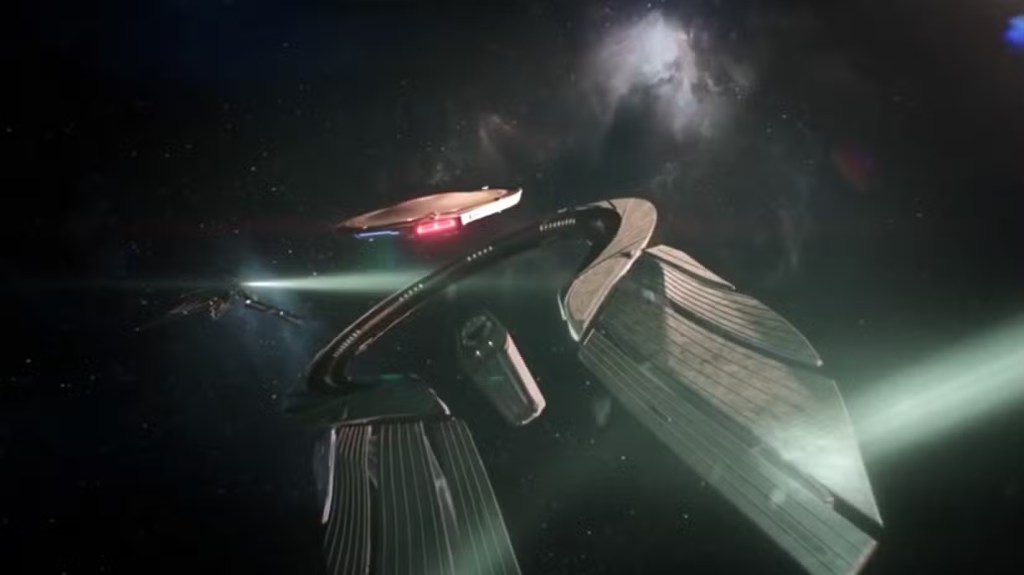
Starfleet Academy has taken things back around, as the USS Athena gets caught in the trap of Nus Braka (Paul Giamatti) and the marauders of the Venari Ral Empire. While attempting to rescue some AWOL cadets who snuck into Venari space, the Athena (piloted by a skeleton crew) was ambushed and caught in a three-way tractor beam snare. After successfully beaming the wayward cadets (and one long-lost ally) onto the ship, Captain Nahla Ake (Holly Hunter) separated the saucer section of Athena so that they could warp away and escape.
As you can see, Star Trek has used saucer separations for combat, escape, or multi-faceted mission objectives, inspiring new forms of ship technology along the way (multi-vector attack). The future is still wide open (pun) for the series to continue evolving the ways in which it happens, as well as the context for why it happens.
For now, Starfleet Academy is streaming on Paramount+. Discuss the latest episode with us over on the ComicBook Forum!
More TV Shows
-

Image Courtesy of DC Studios -

Image Courtesy of Ace Books -

20th Television Animation