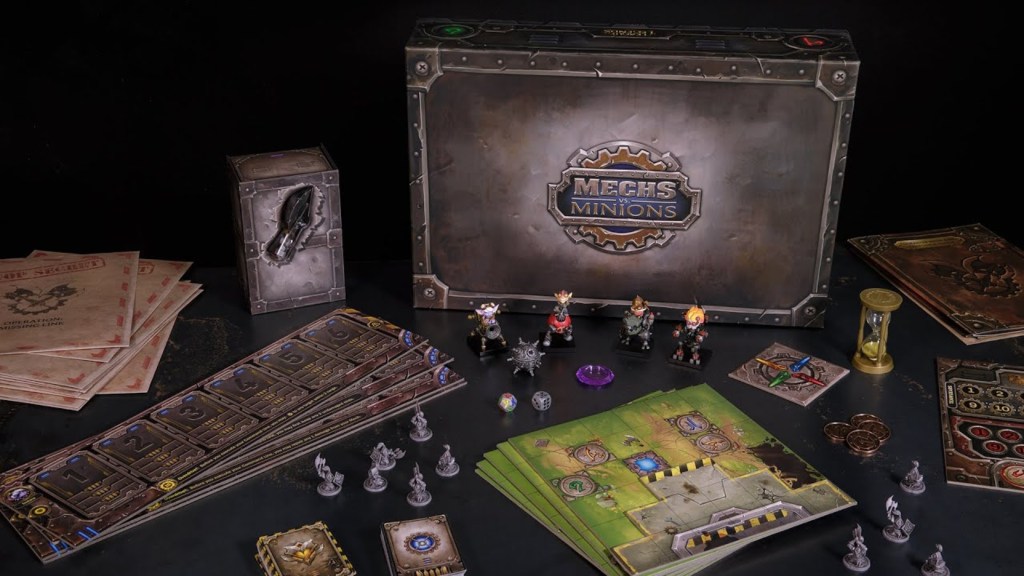
While Riot Games is always going to be best known for League of Legends, the company has had a lot of success in expanding its game portfolio. Even beyond other hits like Valorant, the company has found great success in shifting the universe of Runeterra to the TCG and tabletop space. This includes Mechs vs. Minions, a deceptively deep strategy game brought to life ten years ago that remains a fan favorite among board game enthusiasts.
Videos by ComicBook.com
To celebrate the tenth anniversary of Mechs vs. Minions, Riot Games has teamed up with Incredible Dream to release a new anniversary edition of the game. This includes a relaunched version of the original game, as well as a new Mechs vs. Minions: Bandle City Edition that features some fun updates that nevertheless remain faithful to the original game. During an interview with ComicBook.com, Riot Games Senior Game Design Manager Stone Librande, Riot Games Game Design Manager Frederick Ernst, and Incredible Dream CEO and Co-Founder Jane Chung Hoffacker sat down to discuss the history of the game and what the new refresh is like.

CB: Looking back at the earliest ideas for the game, why were the Yordles the right corner of Runeterra to play with in Mechs vs. Minions?
Stone Librande: The original game that I made for my sons was Mechs vs. Zombies. It was made to help teach them programming. You’re programming robots. If they do something weird or bump into a wall, that’s your fault as a programmer. When we were figuring out characters to put into it… with Rumble and his mech or Corky and his airplane, we were able to say these are Yordles and they’re just testing their crazy inventions. The game does have a bit of polarity to it. When things go wrong, it matches really well with the Yordle culture.
Frederick Ernst: That actually informed a lot of our decisions as to what champs to use for the four mechs. We wanted that chaos and that silliness. When we were considering using one of the robotic Champions that we’ve got in League, like Blitzcrank, it didn’t make sense to us. Blitzcrank wouldn’t be running around smacking into walls and spinning in circles mindlessly. That seemed wrong for the character, but if you said Ziggs has made a robot, I think the assumption is that things are going to go crazy right from the start.
Stone: It lets you get away with a lot more interesting fictions to play with than if we tried to ground it in an apocalyptic situation. This is so much more lighthearted and goofy. Jane and the team have done such a good job of making this relaunch gorgeous. The old version was more metal and rusty; this new one is much more like the forests around Bandle City. It’s a lot greener and more alive. It pops!
The rest of our interview with the Mechs vs. Minions team continues below, including why Riot Games has never made a direct board game adaptation of League of Legends, the biggest surprises of the game, and what the future might hold for Mechs vs. Minions.
What was the key to adapting the world of League of Legends into an effective tabletop experience?
Stone: Besides the mechs, the zombies in the original game became minions. League of Legends players have a nice attachment to the minions, and they know what they do. They’re stupid. They run in a straight line and stand there until they are blown up. That was just a really good fit for us. What’s the zombie equivalent in League of Legends? Minions. When fans play the game, they feel like it’s something they’re used to; mowing down waves of minions is something that happens all the time. You don’t feel bad about squishing because they’re infinite. You know another wave is coming.
Frederick: When I joined the project, the core was based on Stone’s original game. It was mostly in place, but we got a lot of questions from folks internally at Riot. If we’re going to do a League of Legends board game, why isn’t it on Summoner’s Rift? Why aren’t there three lanes? Why are we doing something else entirely? We really felt like trying to cleave too closely to League of Legends was going to be disappointing. That game has a particular pace and expectation that we can’t really replicate in a board game.
What we tried to do was distill what a game of League of Legends is about and try to translate that. It’s about teamwork, overcoming insurmountable odds, the power fantasy of starting weak, ending up with god-tier levels of destructive power. With this, it’s about making do with an imperfect situation that you don’t have complete control over. Those are the touch points we found that we could have leverage over and that had a thematic correspondence to League of Legends. It’s about capturing the experience of League without trying to replicate it. That gave us fresh license to have more freedom.
Stone: You can try to simulate a video game mechanically and can make sure it’s got all these pieces, because the video game has all of these pieces — and then you play that game and it feels like a computer should be doing this for you. Instead of saying we’re going to try to simulate the mechanics of the game, we’re going to try to capture the feel. When you try to capture the feel, it puts a whole different emphasis on what the player is going through in their head.
We’re not trying to just make pieces move around mathematically; you’re trying to get that joy of what it’s like squishing a lot of minions in a short amount of time, and that feels really good, and that’s where you connect to the feeling of League of Legends. 10, 15 years ago, we had a prototype [for a League of Legends board game]. There were little champions, there were lanes, and there were minions that would slide up and down the track. We tried to do that. It never saw the light of day for lots of different reasons, but it was something we attempted. It’s not that we ignored that idea; it’s just that we found other ways to express the fun of League of Legends, like Mechs vs. Minions.
Jane, the team at Incredible Dream is responsible for updating the game ten years after it debuted. What were some of the big lessons of the original version that you and the team kept in mind with this revised take?
Jane Chung Hoffacker: With Incredible Dream, we really did not want to retouch the original game design. We felt that the design itself was really great, and it did all the things that Stone and Rick were mentioning. It really captured the feeling and the essence of League of Legends without being League of Legends. We didn’t want to change that. It was already a top 100 board game. Why mess with something that people love? We wanted it to still be the game that people have spent ten years in love with.
I think the main thing was getting it back into print. We wanted to get it back into people’s hands, so we mostly looked through Reddit comments and Board Game Geek comments, looking for the pain points and areas that could be more clarified. We worked through that, and we sent it through to Stone and Rick to review those revisions. Other than that, it was just more of a modern glow-up than anything else.
I’ve got to ask — if this relaunch does very well and there are chances to introduce expansions of this game, what would you want to see?
Stone: The original game was a competitive game, but then we shifted to something more cooperative. I think there is room for expansion or some sort of thing that introduces some competitive rules. Here’s what it’s like to play it when you’re fighting each other instead of all working together on the same team, even though it goes a little bit against the spirit of what we ended up shipping. I would be really interested in seeing that.
Frederick: One of the things that we tried to play around with in the original release was a user-generated mission app, where we could see what folks created with little puzzles and challenges. I would love that. I think Jane has been thinking along those lines as well.
Jane: No comment [Laughter]. In terms of what we can share today, I think the first thing is we want to really make sure we stick the landing in terms of making sure that this relaunch is great. The community has been waiting for this. The game has been out of print for five years. People have been looking for this game for years, so we first and foremost want to just focus on making sure it’s a great relaunch that people are really excited and happy with the game.
We want to make sure people who didn’t get a chance to play it yet will finally get their chance. Hopefully, it’ll be more accessible to them as well. I think from there, we would see just kind of a community reception. We want to see how Riot, Stone, and Rick are feeling about things. We obviously would love to continue working with Riot. They’ve been a wonderful partner.
What has been the biggest surprise of this process?
Stone: This game was originally just designed to teach my kids how to program. At the time, they were 8 to 12 years old. I made the game for them, with that initial vision. I was trying to make a game for kids that they can play really quickly, and they can play with their family. It would be easy enough to learn and fun to play, but there’s kind of a lesson going on. Then, to see it out in the real world, where people have come to me and told me they played it with their kids and that their kids really enjoy the game, that was just amazing. That it can have that connected thread to my earliest ideas for it is just amazing.
Frederick: It’s the longevity. When we were making this game originally, we really didn’t know how it was going to be received. We didn’t know if League players would have any interest in a board game. We didn’t know if board game players would have any interest in a League game. We really weren’t sure if this was going to be something that lasted or something that amused people for a year or two and then kind of went away.
While prepping for this interview, I saw people are leaving comments even just six months ago, people talking about playing the games and introducing them to new players, and really enjoying it. That was really heartening. Stone mentioned that the game was originally to teach his kids to program. Well, my son just graduated from high school, and in his senior year, he took a game design class, and the first assignment they had was a robot programming exercise that Stone released that was very clearly inspired by or drawing from Mechs Vs. Minions. This game not only lasted, but Stone’s attempt to teach his kids programming also taught my kids programming.
Jane: For me, there were two big surprises about Mechs vs. Minions that made me really want to bring it back. The first one was that I was doing a lot of game conventions, and I would see this game still out on tables. I had to go back and look up if it was out of print, because people were still playing it. Even now, when you go to a convention, you’ll still see it on tables.
I had never played it when it originally came out, so after I saw it at conventions, I was like, ‘I must get my hands on it.’ It was hard to find, but I found it used, and it came in a big shipping box from Chewey [Laughter]. I remember playing it with my family, and I wasn’t sure at first if I would like it, because of how chaotic it is.
That was the other surprise; my family had a lot of fun with the strategy component of it. You’re planning things out, but it just doesn’t go that way. So, you have to adjust. There’s just so much fun to it. I understand why people love it. I wanted to make sure more people got the chance to experience that.
Do you love Mechs vs. Minions? Have you been dying to play it but never got the chance to? Let us know about your experience with the game in the comments and on social media — and keep an eye out for GenCon, where the game is set to have a bigger preview.
More Gaming
-
Image Courtesy of Kwalee -
Image Courtesy of Sony Interactive Entertainment