Silent Hill has solidified itself in the modern gamer imagination as one of the key horror franchises. The sense of tension and terror baked into every story, coupled with the rich emotional elements that help it stand out from the competition, highlight how it manages to stand out from other horror games out there. Even within that series, though, formula could have been a real killer.
Videos by ComicBook.com
While the first three games in the series are undisputed classics of the genre, they all largely felt the same gameplay-wise. Not so much with Silent Hill 4: The Room. Controversial at the time of release for how it messed with the formula and experimented with gameplay mechanics, those unique elements helped it stand out from the rest of the series. Especially with the benefit of the last twenty-two years of hindsight, Silent Hill 4: The Room‘s embrace of experimentation has become a key aspect of the franchise’s future.
The Room Reinvented The Silent Hill Formula
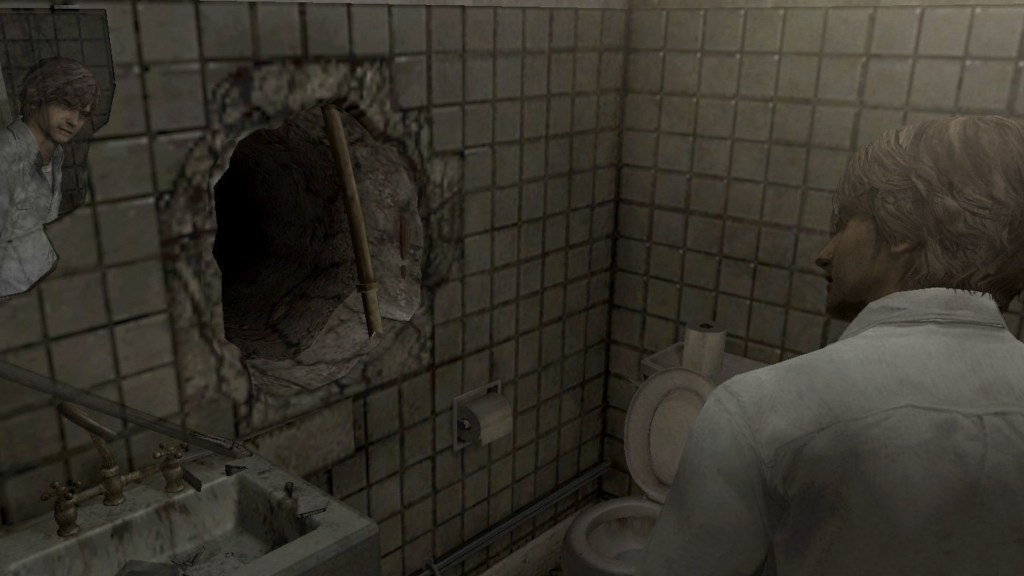
Debuting in Japan on June 17, 2004 before making the leap to North America and Europe in September of that same year, Silent Hill 4: The Room was a crucial and creative entry in the series that still doesn’t get the credit it deserves for opening up the franchise’s future. The game focuses on Henry Townshend, a citizen of the small city of Ashfield. One day, Henry finds himself trapped in his apartment with no way to escape save a mysterious hole that appears in his apartment wall. After going through it and discovering that the murders he’s witnessing in that space are happening in real life, Henry is forced to investigate the killings and a long-dead serial killer named Walter Sullivan — whose spirit remains tethered to the world and is trying to finish the ritual he began years ago to resurrect his “Mother.”
Developed alongside Silent Hill 3, Silent Hill 4: The Room was the more experimental of the two. Silent Hill 3 was built on the legacy of the previous games and played very similar to those titles, while Silent Hill 4 experimented with the formula. Returning to Henry’s apartment can restore his health and allow players to save their game, but it also gradually reveals that there are ghosts of Walter’s previous victims still trapped there that can steadily target and damage Henry as the game progresses. Combat heightens the tension by giving the player far fewer firearms and more breakable objects to defend themselves with, items that notably lack any sort of use against the ghosts.
At its core, the developers at Konami and Team Silent were interested in subverting expectations regarding gaming, from the combat mechanics to the very notion of a base location where players could calm down and heal. Making Henry’s apartment not only a target of possession but eventually a dangerous space to inhabit keeps the player on their backfoot as they race to keep Walter from completing the 21 Sacraments. Earning solid reviews and good sales, Silent Hill 4: The Room‘s unique elements earned it just as much debate among fans as it did accolades and has helped keep the game from achieving the sort of legacy that the original three entries or the P.T. demo did.
The Room Is One Of Silent Hill’s Most Important Games

That’s a shame, because Silent Hill 4: The Room is a great showcase for what the franchise would become down the line. Far more experimental in its gameplay mechanics and world-building, The Room proved that Silent Hill wasn’t necessarily defined by a single town but by a sense of atmosphere and supernatural focus. Without The Room laying the groundwork for Silent Hill to get more ambitious and unique in its storytelling, we may have never gotten the shift to Japan in Silent Hill f or the other locations that have popped up in the series.
The subversion of the typical combat highlighted how Silent Hill‘s underlying mechanics could be reinvented for each entry, more reflective of the narrative and the characters than any one underlying approach to gameplay. Silent Hill 4 had a tighter, singular narrative like Silent Hill 2 but proved that you could do that outside the typical confines of the town. The Room proved the series could take both a more grounded approach with the serial killer murders and a more openly supernatural angle with the ghosts. This opened the door for both elements to come more into play in future games. Even the underlying gameplay tweaks introduced the idea that Silent Hill shouldn’t be afraid to mess with basic mechanics and try something new.
The possessed apartment is still one of the creepiest settings from any entry in the series, especially for the way it deteriorates around the player as the game progresses. It’s foreboding even when it should be breaking the tension, keeping the tenor ever-present even as the player figures out the clues and realizes how little time they have left to stop Walter. Silent Hill 4: The Room experimented with the series in ways that have remained impressive over twenty years later — but the biggest impact that game had on the series would be felt in every subsequent entry. While Henry and Walter might have been trapped in that apartment, it opened the door for the franchise to reach its true potential.
More Gaming
-

Image Courtesy of Dreamworks -

Image Courtesy of Electronic Arts -

Image Courtesy of Electronic Arts