It’s a game almost nobody has ever heard of, but it’s possible we wouldn’t have any video games without it. Tennis for Two is probably the most important game ever made, and there’s a good chance you’ve never seen it, never heard of it, and never played it. That’s because it was invented all the way back in 1958, and it’s the very first video game. Most people incorrectly believe that Atari’s Pong is the first video game, but that’s not true. Pong is an important game, to be sure, but it’s hardly the first. Pong was the first commercially successful game to demonstrate the viability of commercializing games, but it came decades after Tennis for Two.
Videos by ComicBook.com
If you’ve read my articles on ComicBook, you know that I’m a big fan of retro content, video game preservation, and history. I’m actually a historian and an old-school gamer, so that all fits. I also get annoyed when people say “Pong is the first video game,” so I wanted to write this feature discussing the real deal, as few people I’ve met have ever heard of it. Tennis for Two is a very simple little game, but what it represented in 1958 was the beginning of something far greater. Imagine your life without video games … nothing on your phone, nothing on consoles … nothing. Not great, right? Well, thank Tennis for Two for not living in that nightmare of a world.
Tennis for Two Is the World’s First Video Game
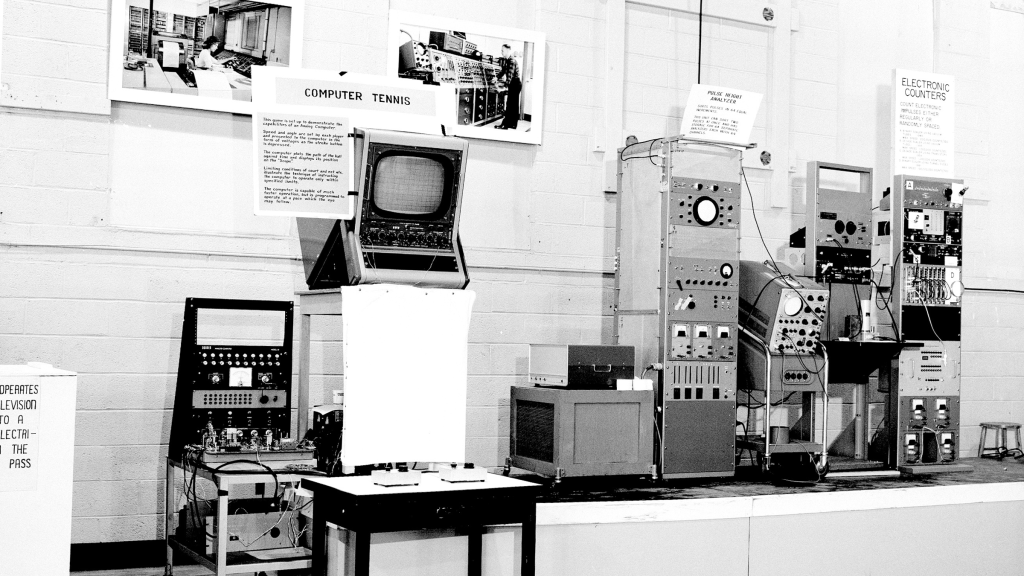
Tennis for Two was developed as a display piece for the Brookhaven National Laboratory’s public exhibition to showcase the institution’s Donner Model 30 analog computer. It featured a DuMont Lab Oscilloscope Type 304-A, which had a circular screen similar to those found on radar systems. William Higinbotham designed the game over three weeks and displayed it on an oscilloscope using two custom-made aluminum controllers. The game is simple, as it features a horizontal line representing the floor, a central vertical line representing the net, and a moving light that represents the ball.
Gameplay involves rotating a knob on the controller to angle the shot, then hitting the button to fire. The game featured physics that controlled the gravity of the ball, so you could hit it in such a way as to bounce it within or out of bounds, making for some dynamic gameplay. The game was a hit throughout the three-day exhibition, as nobody had ever seen anything like it. Higinbotham created the game using a small analog computer, with the system’s resistors, relays, and capacitors generating curves on the oscilloscope’s cathode-ray tube to display what he desired.

The display screen was only 5 inches in diameter, but by 1959 it had been scaled up to 17 inches. It even included different versions, allowing players to experience tennis on the Moon or on Jupiter, which affected the gravity settings that determined how the ball interacted with the game’s physics. This was impressive, as no one had ever coded anything quite like it. Still, after the exhibition and subsequent upgrades, the system was boxed up and largely forgotten for several years. In the decades since, Brookhaven has recreated the original device and shown it to the public, honoring Higinbotham’s creation and his impact on gaming.
Why Tennis for Two Matters
Now, I do have to add a caveat that some don’t see Tennis for Two as a literal video game. This is because an oscilloscope doesn’t create a video signal. There were also rudimentary entertainment systems that preceded it. Still, in the grand scheme of things, Tennis for Two is the first proper game to use a screen for an interactive game between multiple players. It’s the first real video game to show how computers could be used to program entertainment, and that makes it one of the most important programs in the history of computing. Without it, who knows how gaming might have developed, if at all?
Were you aware of Tennis for Two before reading this article? Leave a comment below and join the conversation now in the ComicBook Forum!
More Gaming
-

Courtesy of Wizards of the Coast -
Image Courtesy of Kwalee