I love a good science-fiction movie that gives you something to think about after the explosions stop. The 1980s had plenty of them, from Blade Runner to The Terminator. But there’s one movie that seems to get remembered for all the wrong reasons. It’s violent, occasionally ridiculous, and has a giant metal man who shoots criminals in the face. What’s not to love? Yet there’s considerably more going on beneath all that mayhem. In fact, I think one of the decade’s most entertaining sci-fi movies also happens to be one of its sharpest social satires.
Videos by ComicBook.com
Paul Verhoeven wasn’t exactly interested in making another straightforward action movie. He had something much nastier in mind. His vision of the future was full of corporate greed, television sensationalism, and people who had apparently decided that everything was better when somebody could make money from it. There’s also a surprisingly heartbreaking story hiding underneath the mechanical armor. And that’s why I think RoboCop deserves another look.
RoboCop Was Much More Than a Violent ’80s Action Movie
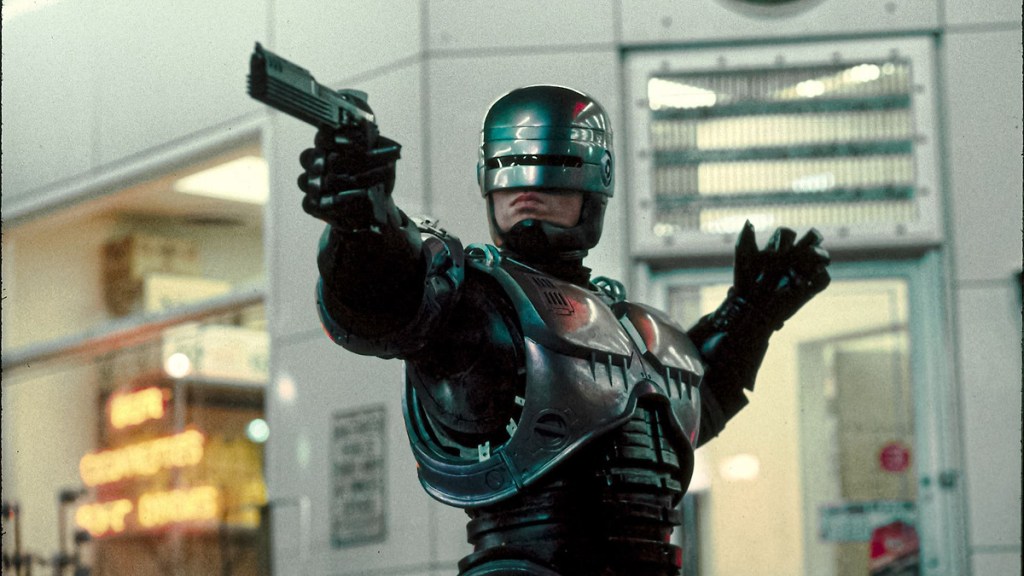
Released in 1987, RoboCop introduced audiences to Alex Murphy, a Detroit police officer who gets brutally murdered by a gang led by Clarence Boddicker. His remains become the foundation for a new crime-fighting machine developed by Omni Consumer Products. The company wants to take over Detroit’s police force and sees Murphy’s transformation as a wonderful business opportunity. There’s just one little problem. Murphy hasn’t entirely disappeared. Memories of his former life begin returning, and the supposedly obedient machine starts looking rather inconvenient for the people who built him. Peter Weller does some terrific work here. He manages to make a character covered in metal feel like a real person struggling to understand what happened to him. That’s not exactly easy when most of your face is hidden behind a futuristic helmet of a RoboCop. Check out this trailer and see for yourself.
Of course, Verhoeven also makes sure there’s plenty of outrageous fun along the way. The commercials for bizarre products and the news reports about increasingly ridiculous disasters give the movie a wonderfully nasty sense of humor. Then there’s the infamous demonstration of ED-209, which goes spectacularly wrong during a corporate presentation. It’s one of the funniest scenes in the entire movie. But there’s a reason these moments work so well. Verhoeven isn’t just throwing random jokes into an action film. He’s showing us a society where corporate executives treat human lives like another line on a balance sheet. The violence is deliberately excessive, and the humor makes the whole thing even more uncomfortable. RoboCop wants you to laugh.
Why RoboCop‘s Story About Humanity Still Gets Overlooked

The thing I find most interesting about RoboCop isn’t actually the political satire. It’s Murphy himself. Before the company turned him into a walking weapons platform, he was a husband, a father, and a police officer who thought he was doing something worthwhile. Now he’s expected to follow instructions and protect a corporation’s interests. His memories don’t fit neatly into that arrangement. Watching Murphy slowly recover pieces of his identity gives the movie an emotional center that plenty of action films would have ignored. There’s a particularly effective sadness to his attempts to remember his family. He can still recognize fragments of his old life, but he can’t simply return to it. That’s a pretty bleak idea for a movie that also features a giant robot shooting people during a boardroom presentation. Weller deserves a lot of credit for making both sides of the character work.
It’s also worth remembering that RoboCop wasn’t universally dismissed when it arrived. Roger Ebert gave it a positive review in 1987 and recognized the unusual combination of comedy, philosophy, and social commentary. Other critics struggled more with its mixture of genres and graphic violence. That confusion has largely disappeared as the movie’s reputation has grown. Yet I still think people sometimes focus on the wrong things when discussing it. The film’s corporate satire feels remarkably relevant, but its story about a man fighting to reclaim his humanity is what gives it staying power. Verhoeven would explore similar ideas in Total Recall and Starship Troopers, but there’s something especially effective about the way he brings them together here. RoboCop may have been built like a big, noisy action movie. Underneath all that steel was a much sadder story. And that’s the part I think deserves more attention.
And what do you guys think? Is this series really misunderstood? Let us know in the comments!