Over almost two decades, the Marvel Cinematic Universe has adapted hundreds of characters from the comics, from headlining Avengers to heroes obscure enough that even dedicated readers had to look them up. When it comes to adapting villains, though, Marvel Studios has a universally recognizable bad track record. For every bad guy (or gal) whose presence genuinely elevated the films around them, such as Thanos (Josh Brolin) and Killmonger (Michael B. Jordan), there are a dozen antagonists who were only forgettable obstacles in the MCU. The problem was compounded throughout the Infinity Saga by Marvel Studios’ pesky habit of killing villains in their first appearance, which meant that a badly written villain rarely got the chance to become a better one.
Videos by ComicBook.com
Fortunately, the Multiverse Saga can help some of the worst MCU villains be redeemed. Avengers: Doomsday, arriving December 18, 2026, and Avengers: Secret Wars, set for December 17, 2027, are built around the premise that alternate dimensions and divergent timelines can pull any character back into the story—including ones the MCU has already killed. Beyond those two films, Secret Wars is expected to reboot the universe entirely, which means some villains could return not as properly reimagined versions, free from the choices that diminished them the first time.
5) Malekith
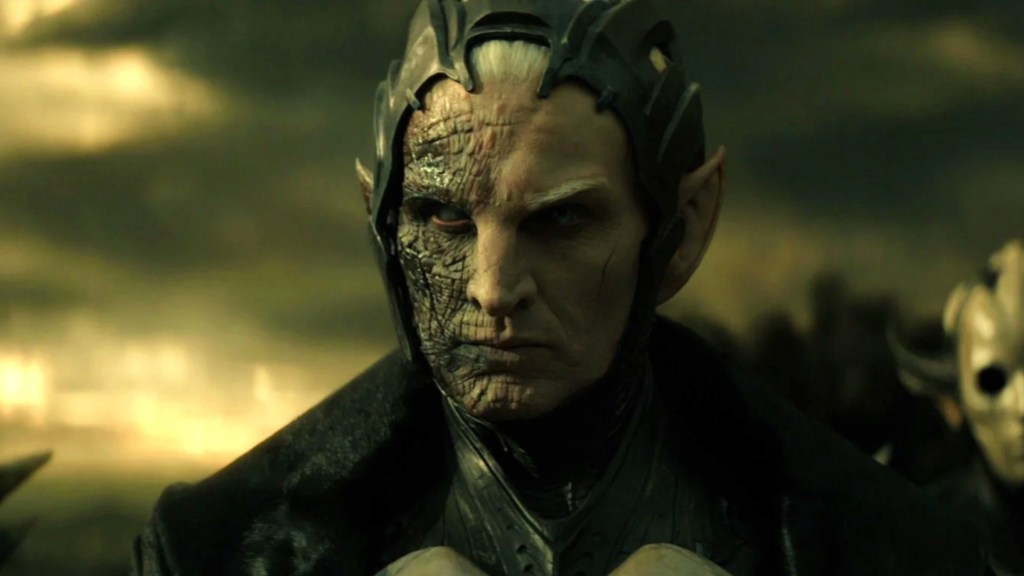
Christopher Eccleston brought genuine menace to Thor: The Dark World in 2013, and the film wasted nearly all of it. Malekith, the leader of the Dark Elves, is one of Thor’s most dangerous comic book adversaries, often depicted as a sadistic warlord whose slow-burning campaign across the Nine Realms culminated in Jason Aaron’s fan-favorite War of the Realms event, a storyline ambitious enough to anchor an entire MCU phase. Sadly, the MCU version had none of that depth. Malekith’s motivation was reduced to plunging the universe into darkness, a goal the film never gave him enough screen time to make felt, partly because late reshoots prioritized Loki at the expense of scenes that developed the Dark Elves. The result was a villain who killed Thor’s mother and nearly destroyed the universe while feeling, somehow, like a secondary concern.
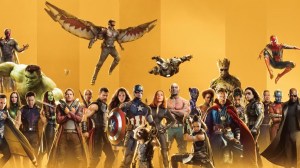
Maliketih was crushed by his own warship at Thor: The Dark World‘s conclusion, a death as unglamorous as the character’s treatment throughout. Still, when the MCU resets, Marvel Studios can introduce a version of the villain to act as a cunning manipulator, uniting the Nine Realms’ worst powers to wreak havoc across the lands.
4) MODOK
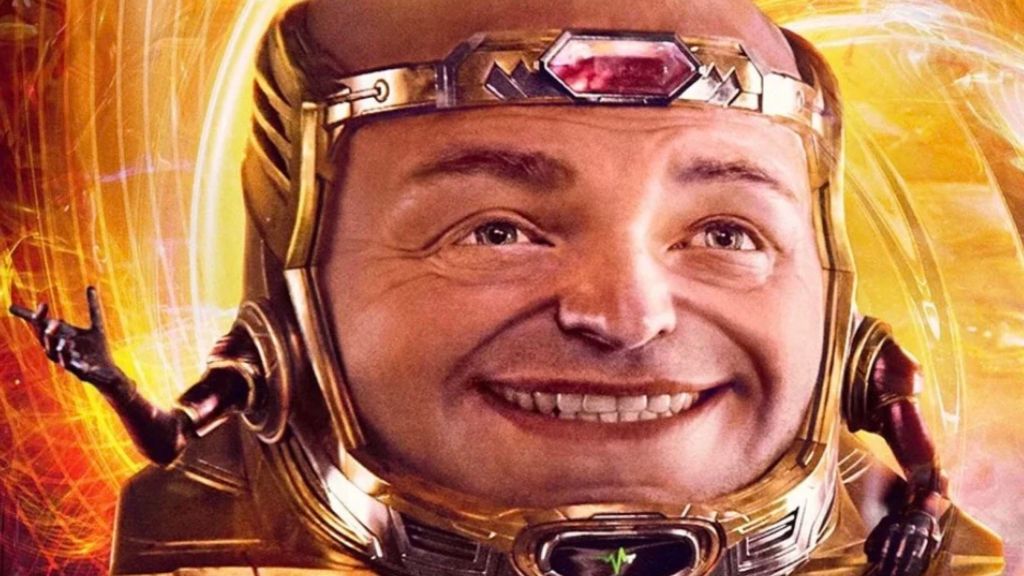
The MCU’s version of MODOK arrived in Ant-Man and the Wasp: Quantumania in 2023 with two problems that compounded each other. The first was a creative decision to make the character a twisted continuation of Darren Cross (Corey Stoll), the generic corporate villain from the original Ant-Man, who had survived being shrunk into the Quantum Realm and was rebuilt by Kang (Jonathan Majors) into a floating mechanical monstrosity. The second was the film’s inability to commit to what MODOK actually is.
In Marvel Comics, MODOK is a former AIM technician named George Tarleton whose body was grotesquely mutated to house a weaponized intelligence. Above all, he is a genuinely disturbing figure whose absurdity and menace exist simultaneously without canceling each other out. Quantumania opted instead to treat MODOK primarily as a punchline, undercutting what little emotional weight his arc carried by ending his story with jokes in his dying moments. Thanks to multiversal shenanigans, the MCU can still introduce a comic-accurate MODOK, one whose body horror is played straight, and whose intellect makes him a credible strategic threat.
3) Taskmaster
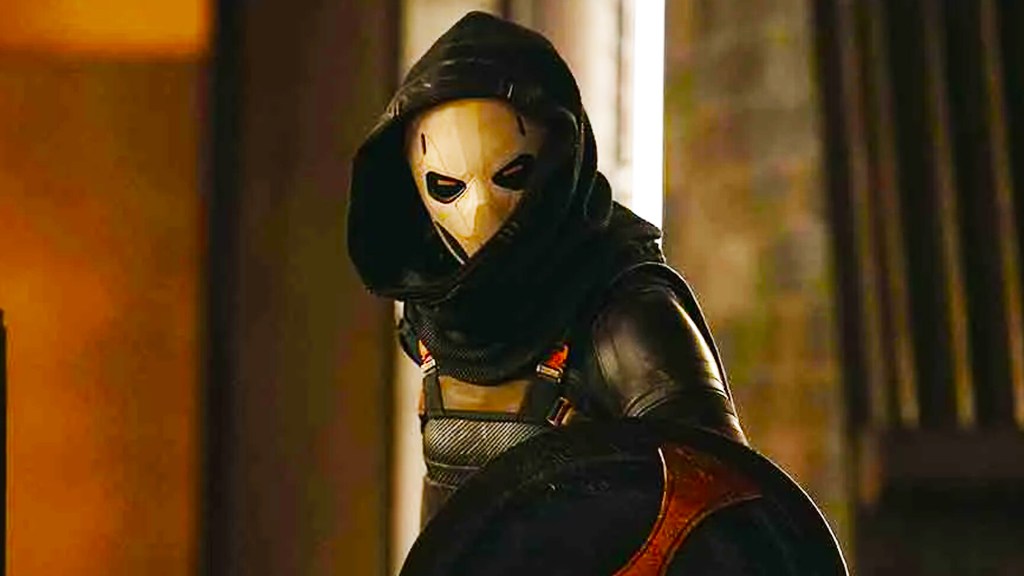
In Marvel Comics, Taskmaster is Tony Masters, a mercenary with photographic reflexes that allow him to replicate any fighting style after a single observation, a gift that comes at the cost of his long and short-term memory. That tragic premise made Taskmaster one of Marvel’s most distinctive villains for over four decades of comic book publication. The MCU’s Black Widow replaced him entirely with Antonia Dreykov (Olga Kurylenko), General Dreykov’s daughter, a mind-controlled operative with no dialogue, no agency, and no personality. Even her photographic reflexes were delivered by a brain implant rather than being an innate ability. The change made thematic sense within Black Widow‘s story about the Red Room stripping women of their free will, but it meant that a character built around wit and professional pride became a silent automaton.
Taskmaster’s situation was worsened further in Thunderbolts*, when Antonia was killed by Ghost (Hannah John-Kamen) in the film’s opening act before she had spoken more than a handful of lines across her entire MCU existence. During Secret Wars, or after it, the MCU should introduce Taskmaster as a scheming mercenary who trains villains for hire and matches wits with heroes who can’t predict what he’ll do next. Marvel Studios can even bring Kurylenko back to play a new version of the character after she has been so disrespected in the MCU.
2) The Leader
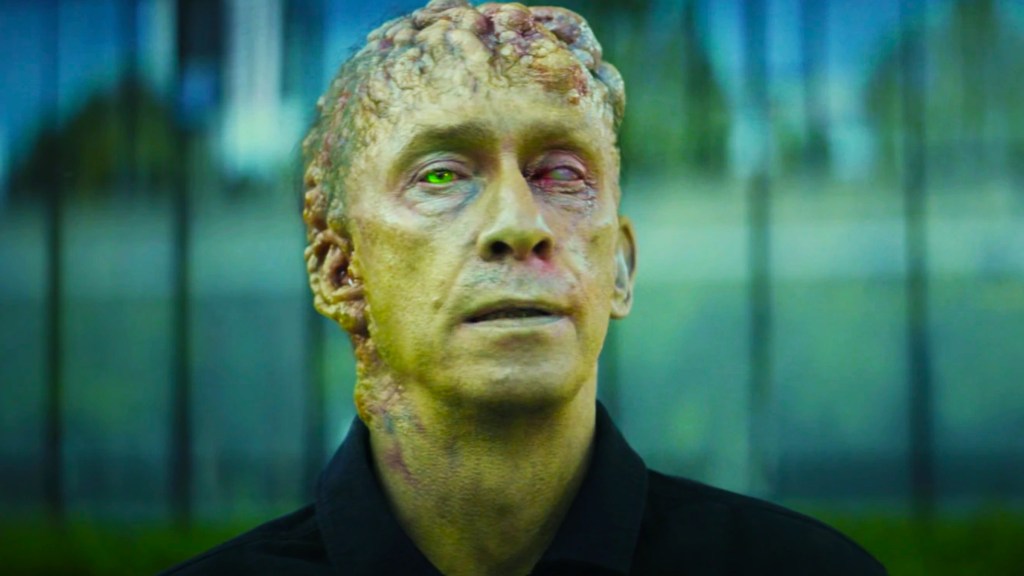
Samuel Sterns (Tim Blake Nelson) has now appeared twice in the MCU, and both times the franchise has underused what is, in the comics, the Hulk’s most formidable intellectual adversary. Stern’s transformation was teased at the end of The Incredible Hulk in 2008, when Banner’s gamma-irradiated blood dripped into an open wound on his head. Then, after 17 years of silence, Captain America: Brave New World finally brought him back in 2025. The movie reveals Sterns had become a radiation-mutated schemer pulling President Ross’s (HarrisonFord) strings from the shadows, a plan whose logic collapsed under scrutiny and whose execution lacked the grandeur the character demanded.
Captain America: Brave New World refused to let Sterns be the physically imposing Leader in the way the comics demand, and kept him small in every sense that mattered. The good news is that Sterns is still alive, imprisoned in the Raft alongside some of the MCU’s most dangerous individuals. Sterns even appears in a post-credits scene, warning Sam Wilson (Anthony Mackie) of an incoming multiversal threat. That setup points directly toward Doomsday or Secret Wars, where a Leader with access to the Raft’s population could finally function as the strategic threat he’s always been in the comics.
1) Kang the Conqueror
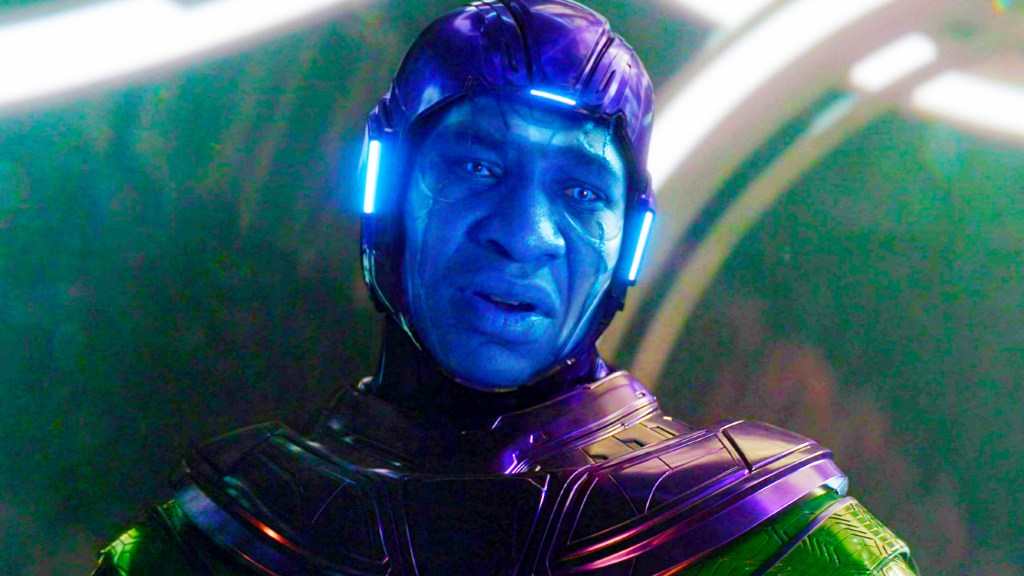
No villain on this list carries more unfinished business than Kang. Jonathan Majors built toward the character across multiple MCU projects—first as He Who Remains in Loki, then as the Conqueror himself in Ant-Man and the Wasp: Quantumania—positioning Kang as the successor to Thanos and the central threat of the entire Multiverse Saga. Then, Majors was fired following an assault conviction, Marvel pivoted to Doctor Doom (Robert Downey Jr.) for Doomsday and Secret Wars, and the Kang storyline was abandoned mid-sentence.
In the comics, Kang is one of Marvel’s most complex antagonists, a time-traveling conqueror from the 31st century who is simultaneously a descendant of Reed Richards, a past and future version of several other characters, and a man whose greatest enemy is himself across divergent timelines. The MCU barely scratched that surface. On the contrary, the Conqueror’s appearance in Ant-Man and the Wasp: Quantumania made him seem weak and desperate, until he is killed in the stupiest way possible. Secret Wars, which in the comics involves Kang as a key player in multiversal collapse, is the logical place to revisit the character, whether through a recast, a variant, or the long-rumored return of Majors himself, whose conviction was complicated when his accuser dropped the lawsuit. A properly realized Kang, built around the comics’ vision, could be the most significant villain rehabilitation in the MCU’s history.
Which Marvel villain do you most want to see the MCU take another shot at? Leave a comment below and join the conversation now in the ComicBook Forum!
Most Viewed
-

Image Courtesy of MAPPA -
Image courtesy of Tor Books/Macmillan -
Image Courtesy of DC Studios