Starfleet Academy episode 4 brings the entire Klingon race to the brink of extinction. Set at the tail end of the 32nd century, Starfleet Academy is set in a galaxy desperately working to rebuild civilization after a disaster known as “the Burn.” The Federation is reestablishing itself, with a new class of cadets enrolling at the new Starfleet Academy on Earth; they include Jay-Den Kraag, an unusual Klingon who is dedicated to being a healer rather than a killer. As Jay-Den explained in the first episode, he seeks to live with honor rather than die with honor.
Videos by ComicBook.com
Starfleet Academy episode 4 is essentially a character piece centered on Jay-Den, the last Klingon in Starfleet, and it reveals just how badly the Burn affected the Klingons. Fortunately, Jay-Den – who feels very much like an inversion of Word, the first Klingon in Starfleet – proves to be the salvation of his entire race. Because it seems there’s a reason we haven’t seen much of the Klingons in the 32nd century so far; it’s because they’re on the brink of extinction.
The Burn Almost Wiped Out the Klingons

Nine years ago, Star Trek: Discovery Season 1 ended with the Federation almost destroying the Klingon homeworld of Qo’noS. In a twisted irony, Starfleet Academy reveals Qo’noS’ destruction was only postponed, because the entire world was rendered uninhabitable because of the Burn. Klingons scattered across the galaxy, becoming a proud race of warrior refugees whose numbers dwindled over the decades. The Klingons held fast to their traditions, rejecting the charity of other races, but it just meant their situation became ever more dire.
Starfleet Academy episode 4 is set in the shadow of the impending Klingon extinction, with the Doctor reluctantly agreeing to hold a debating class on the subject of whether the Federation should help the Klingons. The core problem, of course, is that the Klingons don’t want their help; and, after wrestling with his own personal demons, Jay-Den argues they are right. “The Federation stops being the Federation if it insists Klingons stop being Klingons,” he argues, insisting on maintaining the cultural distinctiveness of the Klingons at all costs.
This argument builds on the Prime Directive, one of Star Trek‘s most important pieces of lore. The Prime Directive forbids the Federation from interfering in the development of pre-warp civilizations, but Jay-Den is essentially arguing that the principles continue even beyond that; if every culture is valuable in its own right, then the Federation should not risk compromising it or forcing another civilization to conform to its own values. If that means the Klingons are allowed to go extinct, then that is the Klingon choice.
There’s a sense in which this tension runs through Jay-Den’s own life, with flashbacks exploring how he wrestled with his own Klingon nature in deciding to come to the Federation. Jay-Den recalls his final moments with his parents, who abandoned him when they learned he wanted to join the Federation, and who he initially believes to have been killed. It takes Commander Lura Thok’s wisdom and insight to help him understand they left him so he could blaze his own trail; leaving him so he could be himself, not what they wanted him to be.
The Federation’s Solution to the Klingon Extinction Was (Initially) Doomed to Fail
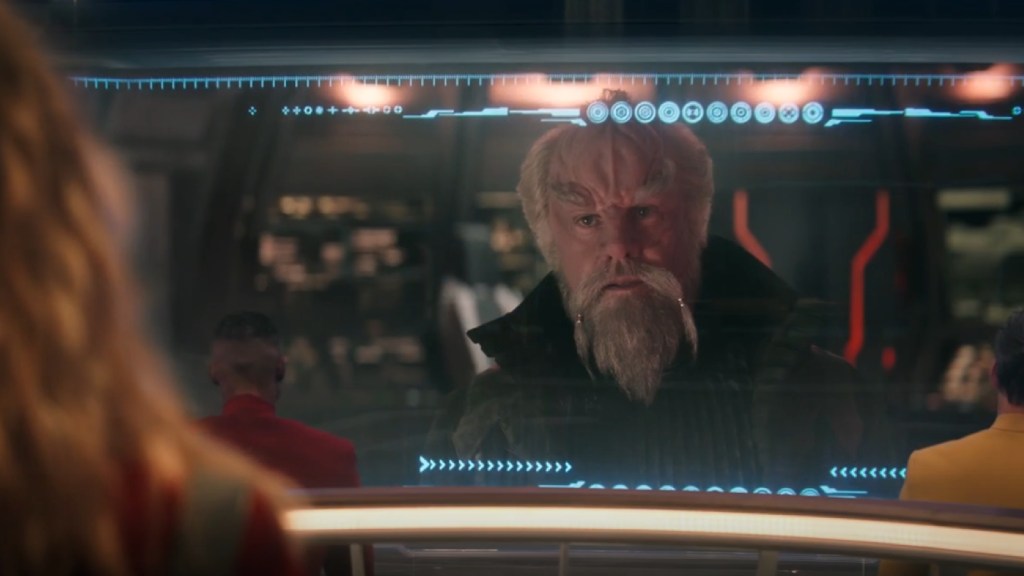
Coinciding with this, however, the Federation does have a prospective solution to the Klingon extinction. They have discovered a planet named Faan Alpha, a potential homeworld for the Klingons, perfect as a new Qo’noS. The catch, of course, is obvious; the Klingons will not accept being given a world. In fact, in this scale, the sheer scale of the act of generosity would undermine Klingon culture on a fundamental level; it would mean their very continued existence was predicated on a betrayal of everything it is to be a Klingon.
Chancellor Ake calls in a personal favor with a Klingon leader, but even that isn’t sufficient. In the end, it is Jay-Den’s own wisdom that leads the Federation to a solution; they arrange for the Klingon fleet to travel to Faan Alpha, and then claim they are intruders who have invaded Federation space and must be driven back. There’s a short skirmish, with both sides pulling their punches, before the Federation forces surrender and allow the Klingons to claim their new homeworld through conquest. It’s a smart solution, a way of cutting the Gordian knot and giving the Klingons a new future.
The conquest is a fiction, of course, but it does still allow the Klingons to remember claiming Faan Alpha with honor. It also shows the Federation of the 32nd century to be very different to that of Kirk’s time, because this is a Federation who do not care about reputation or grandstanding, whose leaders are willing to be known as those who surrendered to the Klingons. The Federation’s leadership care more about the future of the Klingon race than they do about their own pride, indicating how much this group has matured through tragedy.
What do you think of Starfleet Academy? Leave a comment below and join the conversation now in the ComicBook Forum!
Most Viewed
-

Image courtesy of Wizards of the Coast -

Courtesy of Bones Film -

Image Courtesy of Marvel Comics