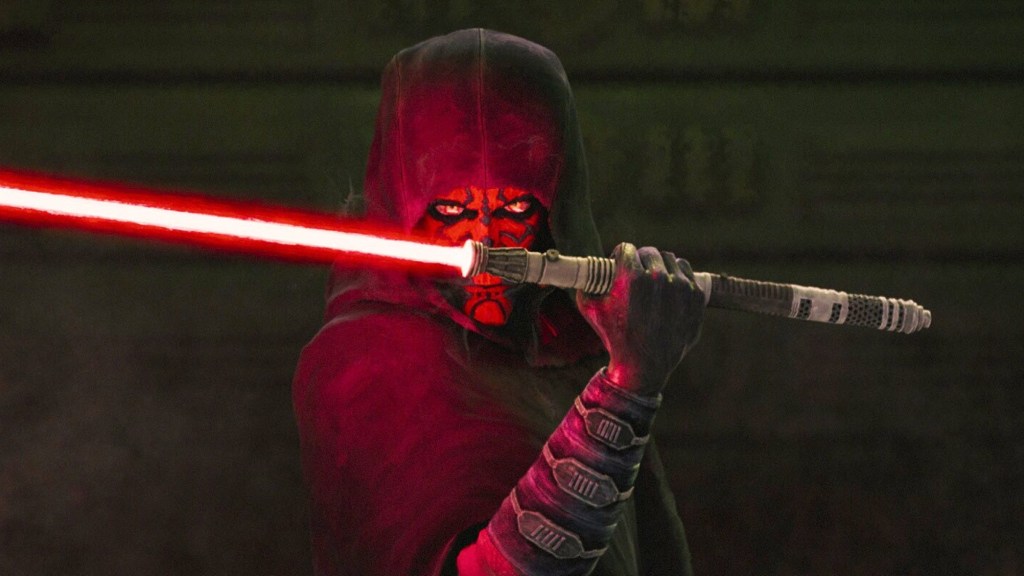
Sam Witwer, who voiced Darth Maul in Star Wars: The Clone Wars and now in the hit animated show Maul – Shadow Lord, just explained how Star Wars canon really works. Canon and continuity are baked into the shared universe model, but such ideas can be pretty tricky to handle when stories are told in so many different mediums. The old Star Wars Expanded Universe officially had a “tiered” approach (the highest being “G-level,” i.e. God-level or George-level). Disney rebooted the timeline after buying Lucasfilm in 2012, branding all non-Lucas projects “Legends.” But even that canon has fractured over the last 14 years.
Videos by ComicBook.com
Speaking exclusively to ComicBook, Sam Witwer – a veteran of both the Lucas and Disney eras – explained his interpretation of canon. “I’ve realized that Star Wars is campfire stories,” he said. “Talking about, did Ahsoka Tano have blue lightsabers in the Siege of Mandalore, or were they green? Depends on which campfire you heard that story. Did Starkiller yank a Star Destroyer out of the sky, or did he mind trick the pilot? Well, depends on which campfire; who you were around when you heard the story, and who the teller of the story is.”
According to Witwer, this was an interpretation he first began to learn under Lucas when working on Star Wars: The Force Unleashed (where he voiced Starkiller). “So George made it clear to us when were doing Force Unleashed that that was a specific version of Star Wars for the video games,” he noted. It’s why The Force Unleashed features Force powers at a greater scale than other projects. The same principle has then been applied by Dave Filoni in the current canon, with Witwer recalling how he was unnerved when reading an audiobook; it contradicted a story he’d told in The Clone Wars, and he asked Filoni for advice.
Filoni, it seems, was supremely unconcerned with the contradiction. “It’s good that it’s different,” he told Witwer. “Because you want to have these things have a reason for existing. Let the stories they tell in books lean toward the strengths of prose and literature. Let the stories you tell in video games lean into the strength of video games.”
Star Wars Doesn’t Really Have a Single Unitary Canon At All
The old Star Wars canon tried to dress this “campfire” approach up with tiers. It was a smart approach, because it meant Lucas could take anything he wanted and ignore anything he wanted to change; Expanded Universe writers could then iron out the inevitable inconsistencies. But when Disney rebooted the canon, it was with the promise things had changed. Filoni himself wrote an introduction to John Jackson Miller’s A New Dawn explaining:
“The old concept of what is canon and what isn’t is gone, and from this point forward our stories and characters will all exist in the same universe; the key creatives who work on the films, television, comic books, video games, and novels are all connected creatively for the first time in the history of the Star Wars universe.”
Readers interpreted this quite simply: the tiers were gone, and now everything was equally canon. But, in truth, this would always be impossible given the sheer volume of Star Wars content being released every month. Contradictions were inevitable, and that’s before you even factor in deliberate decisions to change the story given different mediums or the latest creative impulse. Did Clone Force 99 save Kanaan Jarrus from Order 66? How did an Imperial Star Destroyer crash on Jakku? What version of the Siege of Mandalore “really happened?”
Witwer’s explanation suggests the fandom has misunderstood continuity and canon. He views each story as a lens on a different event, explaining the inconsistencies; you simply have to decide which narrator you trust, or else shrug and enjoy the ride regardless. These are “campfire stories,” not historical records, and debates on canon and continuity treat lore more seriously than was ever meant to be the case.
What do you think? Leave a comment below and join the conversation now in the ComicBook Forum!
More TV Shows
-

Courtesy of South Park Studios / Shueisha -

Image Courtesy of Marvel