There are a lot of characters that you can remove from the history of comics and it wouldn’t change nearly as much as it seems. You could get rid of characters like Spider-Man, Wolverine, or Batman, and you’d still get the same basic comic industry that we have right now. However, if you remove Superman from the history of comics, you won’t have anything approaching the same industry. The Man of Steel took ideas from across pulp fiction of the time and blended them together, birthing the superhero as we know it. Over the decades, there have been fantastic Superman stories, tales that have shown what exactly is possible with the superhero. There’s 87 years of Superman stories to choose from of you want to get Supes, but there’s one that stands high above the rest.
Videos by ComicBook.com
All-Star Superman is superhero perfection. The 12-issue series from Grant Morrison and Frank Quitely proved to be the ultimate word on what the hero could be, melding the various eras of the Man of Steel to create a comic that is often considered flawless by critics (such as myself, obviously). By now, everyone knows the basic story of the book – Lex Luthor is able to ensure the death of Superman, leading him to do everything he can to leave the world a better place – but what really has made the book sing is its individual stories. There are some fantastic single issue stories in this comic, but the best of them, the one that really hits home everything All-Star Superman is about, is issue #10. It was one of those rare perfect comics, a book that gave the world the most memed Superman moment ever but is so much more than that.
All-Star Superman #10 Is Everything You Could Want From the Man of Steel
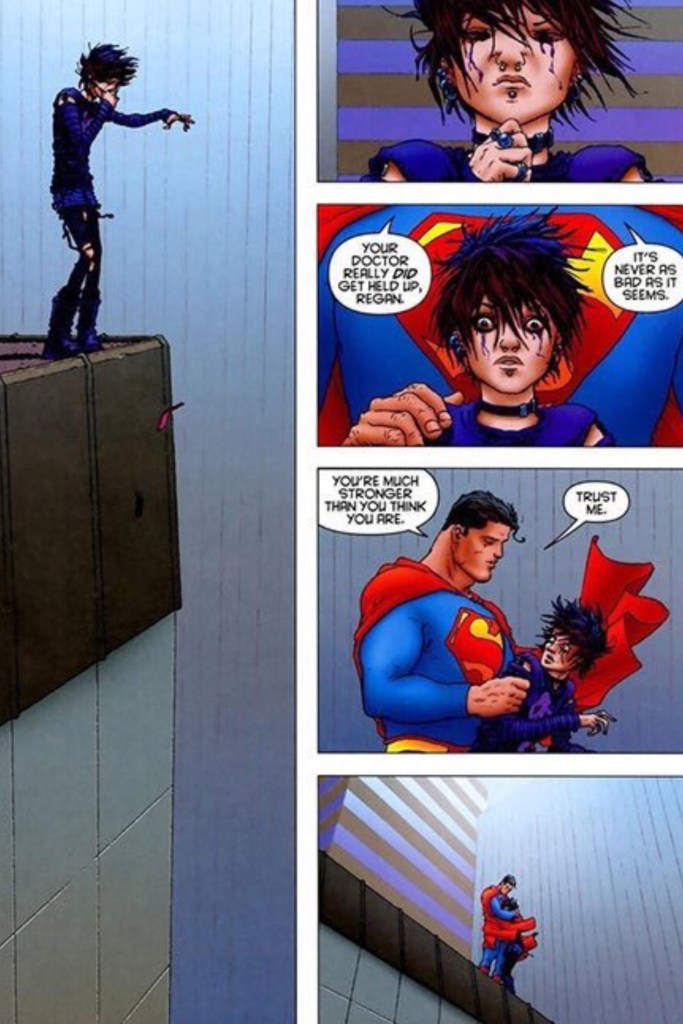
If you’ve been on any side of the Internet where superhero fans congregate, you’ve seen the above page. It’s the one everyone points to when someone asks, “Why is Superman so great?” and it has become an indelible part of the Man of Steel’s character. However, it’s just one aspect of what made All-Star Superman #10 such an amazing reading experience, one of many subplots that run through the issue that show you just who Superman really is.
Writer Grant Morrison has gone on the record talking about what Superman meant to them. Morrison’s parents were anti-war activists and their protests against nuclear weapons imbued him with an irrational fear of the bomb. However, in their young mind, Superman became an idea that countered the nuclear bomb. Instead of a force of implacable destruction, he was a force of protection, of creation, of that oh so human impulse to create a god that wanted to be like us, instead of us being like them. Morrison’s views on what Superman means are generally important to All-Star Superman, but are especially crucial to understanding what makes issue #10 so perfect.
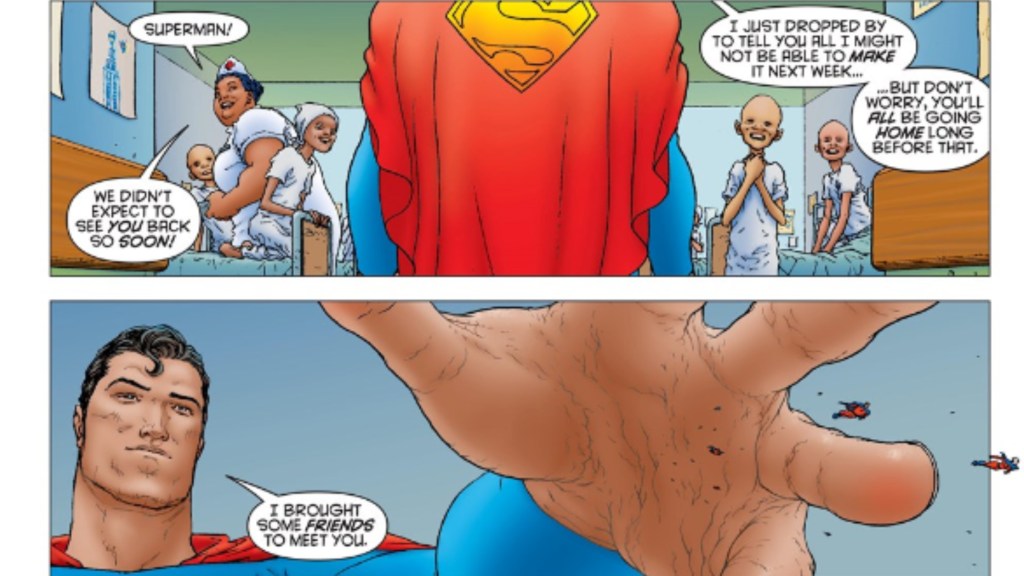
This issue is titled “Neverending” and it’s basically Superman realizing that death is much closer than ever. He goes into overdrive, writing out his will, trying to figure out how to protect and care for the Bottle City of Kandor after he’s gone, releasing his pet Sun-Eater, experimenting with his various scientific endeavors, fixing the damage to the Earth caused by two Kryptonian astronauts, going to see young cancer patients, all while protecting the people of the world (Regan is a subplot throughout the book, as we watch her psychiatrist caught up in a robot attack and miss their appointment). On the one hand, it’s Morrison showing just how much Superman has on his plate on any given day, but on the other, it’s a deep meditation on who Supes is in their eyes.
Morrison isn’t exactly subtle with the messianic imagery in this issue; Superman ends up creating an entire universe, which is heavily implied to be our own. He figures out a way to solve numerous problems, each one of them making the world a slightly better, brighter place. While Regan’s story is the one that we all jump to thinking of when we think of this issue, Superman using shrunken Kandorians to save children suffering from cancer, killing two birds with one stone, deserves to be up there. This is Morrison giving readers Superman as religious figure and it fits the character like a glove.
Of course, one can’t talk about All-Star Superman without bringing up the amazing work of artist Frank Quitely. Quitely’s style is one that definitely has its critics, yet even they would have to admit the sheer artistry on display in this issue. Quitely is able to make you feel not just like you’re looking at the events in front of you, but you’re there. That’s not because he has a realistic style, it’s because of his mastery of body language, his impeccable detail, and his thin, strong lines giving readers a world that feels fully-realized. The character acting on display in this book is sensational; the scene with Regan wouldn’t be as tear-jerking if it wasn’t for Quitely’s eye for page composition and emotional storytelling. Add in the simple, classic color palette of Jamie Grant and you get some of the best Superman art you could imagine, perfect for this issue.
All-Star Superman Wouldn’t Be the Same Without This Tremendous Issue
All-Star Superman is full of amazing moments, but if you want to really understand the entire point of the series, to get everything it’s trying to say about Superman, issue #10 is the most important. It only deals with the main plot of the book tangentially; it’s really a book about who Superman is as a character. It’s the heart of the series, where Morrison peels back the curtain and shows us how they see Superman – the all-powerful deity we deserve, a god who actually loves us and gives up his last hours on Earth to make life better for even the smallest among us. It’s Superman as religion and it’s one of the best things you’ll ever read.
For years, I’ve heard, “Why do you like Superman? He’s so lame.” He’s the all-powerful good guy in a time when that sort of thing hasn’t been cool in decades and one can even look at the superhero utopianism of All-Star Superman #10 as kind of hokey and old-fashioned. However, there’s something to this idea of Superman – the god who loves us – that this issue espouses that just resonates. One of my favorite things about All-Star Superman has always been that it combines not only different eras of Superman, but different eras of superhero comics to tell its stories. This issue takes the utopian sci-fi of the ’60s, mixes it with the emotion of the ’70s, and brings it all home with a modern sheen that shows that you don’t always have to deconstruct a superhero to prove that superhero stories can be more than simplistic morality plays, but meditations on humanity and how what we create defines us.
More Comics
-

Image Courtesy of Marvel Comics -

Image Courtesy of DC Comics -
Image Courtesy of Marvel Comics -
Image Courtesy of Marvel Comics -
Image Courtesy of Marvel Comics -
Image Courtesy of Marvel Comics -

Image Courtesy of DC Comics