Square Enix’s latest adventure, The Adventures of Elliot: The Millennium Tales, takes plenty of inspiration from gaming history while carving out an exciting future for itself. Developed by Claytechworks and with the creators of games like Octopath Traveler on staff, the fantasy adventure sees players step into the role of Elliot. Tasked with saving the land of Philabieldia alongside his fairy companion, Faie, Elliot travels a truly massive HD-2D world full of monsters, dungeons, and secrets.
Videos by ComicBook.com
While the underlying gameplay will be familiar to anyone who has played a classic adventure game like The Legend of Zelda: A Link to the Past, there’s a real focus on Claytechworks’ part to give the player as much versatility as they could want. Faie is a proactive combatant under the player’s control, with Elliot having several possible weapons, powers, and paths to utilize in his journey. During an interview with Producer Naofumi Matsushita and Head Developer Tomoya Asano, Comic Book dove into how The Adventures of Elliot brings ideas from older generations into the modern era.
CB: The Adventures of Elliot is building on the foundation laid by previous generations of great titles. How do you approach an adventure like this and strike the right balance between fresh invention and refining what came before?
Naofumi Matsushita: Across the HD-2D titles, we first explored the RPG genre with Octopath Traveler, followed by the strategy genre with Triangle Strategy. Building on that progression, we wanted to reach an even broader, newer audience with this latest entry, which led us to adopt the action RPG genre for this title. On top of this, throughout the development process, we consistently kept the Game Boy version of Final Fantasy Adventure in mind. Even the overall feel of the weapons wielded by the protagonist was inspired by the gameplay experience of that time. We worked closely with the development studio to ensure we were all on the same page regarding these aspects. Since we had a good idea of the kind of enjoyable experience we wanted to create, we decided that the next priority was the visual style, and that’s why we chose to make full use of the HD-2D style. The appeal of the HD2D visual style lies in its use of 3D backgrounds, which give the world a real sense of depth even though the characters themselves are 2D.
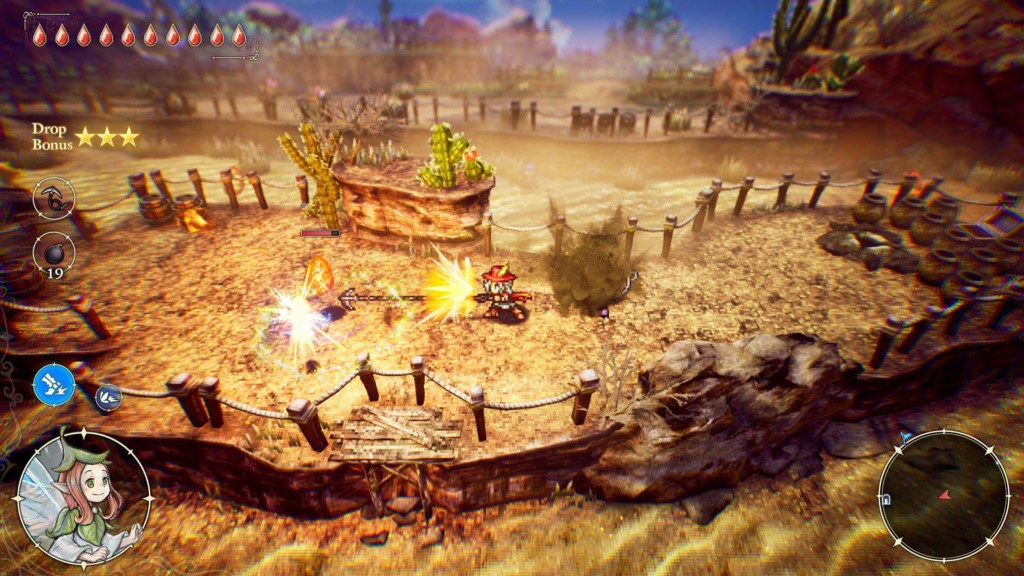
One of the main challenges was finding a way to bring that strength into a 2D action game. In pixel-based 2D action games, the screen can easily become dominated by the ground plane of the map, making it difficult for players to feel any sense of three-dimensional depth and causing the visuals to feel somewhat flat. In this title, particularly in the overworld, we adopted a “drumroll” approach, where the map curves into the background to reveal distant terrain. By incorporating original techniques to further maximize the visible range, we were able to create an experience that conveys a strong sense of depth while still being a 2D action game. Furthermore, this time we’ve introduced a unique feature that allows players to control a fairy, along with another element that adds an extra layer of player creativity to the core combat system. Our goal was to deliver classic fun within a beautiful visual style, while also offering a fresh experience through these unique additions. We achieved this balance by playing the game extensively and refining it day by day.
The rest of our interview with Naofumi Matsushita and Tomoya Asano continues below, as we discussed the team’s unique approach to the partner character, why they chose a time hopping narrative, and the importance of giving the player agency in their own adventure.
CB: What was it about Elliot and his world that got you most excited during development, as both developers and gamers?
Naofumi Matsushita: There were two major moments that got me excited. The first was during the voice-recording sessions. The actors delivered powerful performances tailored to each scene, and when we wrapped recording, I felt genuinely excited as a developer, knowing that once these voices were implemented, they would greatly enhance the story’s sense of authenticity.
The second was when the magicite system was fully implemented and became playable. Even though I had already completed the scenario multiple times, I could clearly feel that the game’s scope had expanded, with far more room for strategy and experimentation along the way. That was a moment I appreciated purely as a player.
CB: What was the development process for Faie like — how did her role within the game evolve across the course of development?
Naofumi Matsushita: From a very early stage, we knew we wanted to include a partner character, and that she would be a fairy. We also decided she would have five unique abilities, so her role in the gameplay was defined fairly quickly. As development went on, we expanded her role further by having her praise the player in various ways through her voiced lines. Since action games often involve the protagonist progressing alone in solitude, we wanted to make the journey feel more lively and engaging. That’s one aspect that really evolved over the course of development.
CB: A major mechanic of the game is exploring different eras of Philabieldia through time- travel. What excites you as game creators to get to play with a setting in so many ways?
Tomoya Asano: In my previous works, I’ve often explored the idea that the present is shaped by events in the past. The “past” is incredibly important when it comes to storytelling. This time, however, I wanted to go beyond simply conveying it through narrative and instead allow players to experience it directly through gameplay. I find the ability for players to personally engage with these key moments particularly compelling.
CB: There’s a certain open-world element to the game that really allows the player to chart their own adventure. How do you approach creating that sort of massive setting without making it feel too overwhelming for players?
Naofumi Matsushita: We began by building the game’s world, and as part of that process, we created what the development team refers to as “landmarks” (dungeons featuring key attractions) in each region, then layered the story onto them. The narrative is designed so that players don’t need to visit every landmark in every era; instead, they’ll naturally encounter them when they become relevant in a given era. This allowed us to position the remaining areas as optional detours: players can choose to explore them or skip them entirely. If they do choose to visit, they’ll receive small benefits that make their journey a bit easier. We approached the design with that clear distinction in mind.
The Adventures of Elliot: The Millennium Tales launches on June 18 for Nintendo Switch 2, PlayStation 5, Xbox Series X/S, and PC.
More Gaming
-
Courtesy of Bandai Namco