When we talk about epic movies, there are a few very specific titles that immediately come to mind, right? And one in particular — globally known, adapted from books, and turned into a trilogy that made absolute history with countless nominations and awards — stands above the rest. The Lord of the Rings saga on the big screen didn’t just tell a story; it built an entire world that still leaves audiences in awe because of its richness in detail, unforgettable characters, and that sweeping fantasy aura that feels almost impossible to top. Geography, politics, cultures, even fully developed languages — all of it helped cement that success. And yes, plenty of productions have tried to reach that same level over the years, but almost all of them either drowned in visual excess or collapsed under messy complexity. Almost all.
Videos by ComicBook.com
Dune, quietly but powerfully, arrived in 2021 and proved that true cinematic epic doesn’t have to be medieval fantasy to impress. Sci-fi plays a different game: it has to explain complex worlds without boring the audience, and most big-budget entries in the genre stumble right there. But Denis Villeneuve clearly cracked the formula and also outdid himself in 2024 with Dune: Part Two. He didn’t just adapt Frank Herbert’s novel; he totally immersed us in that universe with surprising ease.
Dune Has Surpassed the Epic Scale of The Lord of the Rings

For a long time, it felt impossible for another movie (or franchise) to reach the same level of grandeur as The Lord of the Rings. Peter Jackson’s trilogy became the blueprint for what a modern epic looks like: massive scale, enormous battles, meticulous world-building, and the sense that every single decision could shape the fate of an entire age. But what Villeneuve has done with the Dune franchise doesn’t just belong in that conversation — in some ways, it raises the bar. The key difference is that the epic scale here doesn’t rely solely on wars or heroic speeches typical of fantasy. Instead, it grows out of the atmosphere, political tension, and heavy thematic depth.
Dune and Dune: Part Two proved that large-scale cinema can be visually stunning without turning into overwhelming noise. As visually magnificent as the saga is (and Villeneuve absolutely leans into aesthetics), Arrakis isn’t just a backdrop. The desert planet is a living ecosystem and a battleground for geopolitical, religious, and economic power struggles. House Atreides, House Harkonnen, Emperor Shaddam IV, and the Bene Gesserit all operate with their own agendas, each directly influencing the central conflict. No one exists just for decoration, and if it seems that way, it’s likely because Villeneuve is setting something up for Dune: Part Three. That sense of a fully functioning world is exactly what made Middle-earth in The Lord of the Rings so immersive. The difference is that in Dune, everything feels colder, more strategic, and more calculated. And it works just as effectively.

Another area where Dune surpasses it is its commitment to visual language. True to Villeneuve’s style, there are no frantic cuts or heavy-handed exposition dumps. The saga trusts silence, wide framing, and the power of its environments. The sandworm sequences, Paul’s first ride, and the stark black-and-white scenes set on Giedi Prime, for example, don’t need dialogue to convey scale or impact. They just unfold, and you feel the weight of what they mean within the story. That’s cinema in its purest form. Maintaining that kind of aesthetic confidence, especially in a franchise this large, is something very few directors manage to pull off.

And perhaps the biggest differentiator is the thematic ambition, because while The Lord of the Rings works with clear heroic archetypes, Dune dives into messianic politics, religious manipulation, and the dangers of charismatic leadership. Paul Atreides is not your classic hero; he’s a leader molded by carefully planted mythology and circumstances spiraling beyond his control. That complexity makes the universe feel even bigger, because the conflict isn’t just physical — it’s ideological. And that’s the moment Dune stops sitting alongside The Lord of the Rings and starts challenging it as the new gold standard for cinematic epics.
Still, it would be incredibly smart for Dune: Part Three to take inspiration from one specific move in The Lord of the Rings. But how?
Dune: Part Three Should Repeat The Lord of the Rings Prologue Strategy

Dune was successful, but not on the same level as Dune: Part Two, since the first installment was essentially an introduction. Now, after the record-breaking performance of the sequel, expectations for the upcoming third film are sky-high. Simply put, the franchise has shown enormous potential, and it now has the chance to do something that The Lord of the Rings executed brilliantly: open with a historical prologue that establishes the full scope of the conflict at hand.
In The Lord of the Rings: The Fellowship of the Ring, the War of the Last Alliance sets the tone within the first few minutes, showing the scale of Sauron’s threat and the weight of that world’s history. So before the main story even begins, the audience already understands what’s at stake. It doesn’t over-explain, but it efficiently lays the groundwork. In Dune, by the end of Part Two, everything clearly points toward the Holy War led by Paul. It would be really interesting if the third installment, even without completely diving into that conflict, at least used the same strategy the fantasy epic did.
In the original source material, the jihad isn’t shown in detail: Dune Messiah jumps twelve years ahead and focuses on the aftermath rather than the war itself. But in film, showing at least the early stages of that Holy War as a prologue wouldn’t be a stylistic flourish, but a strategic narrative decision. The war Paul unleashes isn’t a minor detail; it reshapes the entire universe: millions dead, planets conquered, and religion spread by force. Opening the movie by immersing people in that chaos would create a much stronger emotional and political foundation for everything that follows. Instead of just talking about consequences, the story would make viewers feel them.
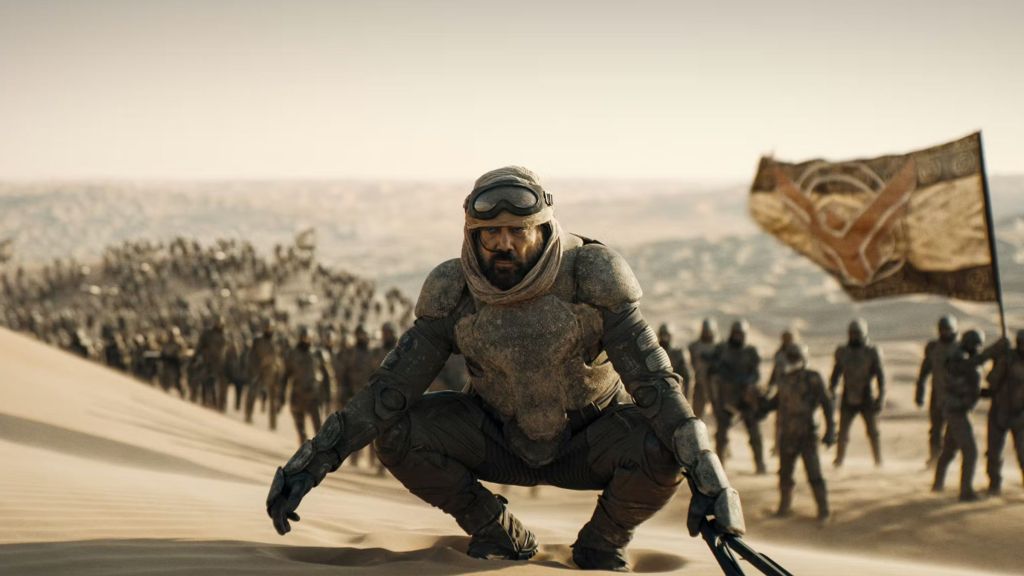
Structuring the film that way would also reinforce that the story goes beyond Paul’s internal struggle and focuses on the domino effect of his choices. The Holy War is the direct result of religious engineering by the Bene Gesserit, the planted prophecy, and Paul’s rise among the Fremen. Showing that in large-scale form right away would amplify the impact of what comes next — especially since Dune Messiah is a much more political and introspective story.
Villeneuve has already spoken about his goals with Dune: Messiah and the message he wants to emphasize — one that aligns closely with Herbert’s original intent: the danger of blindly believing in messianic leaders. Now it’s just a matter of waiting to see whether he follows through, changes direction, or maybe even exceeds expectations. It might sound minor at first, but even a few powerful glimpses of the Holy War at the beginning would make one thing crystal clear: the “hero” won, and the cost was enormous. That alone would elevate the movie’s ambition to another level. Dune is already competing with The Lord of the Rings in scale. With this choice, it could outdo it in narrative boldness and make it even harder for any future epic to top it.
What do you think? Leave a comment below and join the conversation now in the ComicBook Forum!
Most Viewed
-

Official art by Bastien Lecouffe-Deharme -

Image courtesy of Tor Books/Macmillan -

A photo of the Retrovolt Arcade taken in 2017, showing several classic arcade cabinets and stools. -

Courtesy of TOHO Animation