Year after year, satirical movies never really go out of style, especially the ones that lean into comedy to make their point. But don’t expect anything too traditional, because that approach has changed a lot lately. Instead of just telling a story and relying on jokes from start to finish, many newer films use humor as a tool for critique in very different ways. Sometimes you’ll laugh, sure, but other times, you might feel uncomfortable with a drier, darker kind of comedy. The result? A movie that feels like pure cinema, because it knows how to be smart and creative while tackling real-world issues that actually matter.
Videos by ComicBook.com
With that in mind, here’s a list of 7 great satirical comedy movies of the 21st century, ranked not by how funny they are, but by how effectively they use satire within what comedy can explore.
7) Don’t Look Up

When it was released, it felt like the entire world stopped to watch Don’t Look Up, and for good reason. It spoke (and still speaks) directly to the reality we’re living in, with a level of satire that doesn’t even try to be subtle. The story follows scientists Dr. Randall (Leonardo DiCaprio) and Kate (Jennifer Lawrence), who discover a comet on a collision course with Earth and try to warn the world, only to be ignored by politicians, the media, and a completely distracted public. It’s a plot that embraces its metaphor instead of hiding it. If anything, it’s as on-the-nose as it gets.
So why does it land at the bottom of this ranking? Not because it fails, but because it’s less refined than the others. The humor works best when the movie leans into institutional absurdity (especially in its portrayal of public reactions and media coverage), but it loses some impact when it keeps circling the same joke for too long. Still, Don’t Look Up stands as one of the strongest modern satires, and very few films capture that sense of frustration as effectively — the feeling of trying to sound the alarm in a world that just chooses not to listen.
6) Thank You for Smoking

Thank You for Smoking is a classic example of how to do satire without cranking everything up into something loud, exaggerated, or exhausting. Following Nick Naylor (Aaron Eckhart), a tobacco lobbyist who can turn any public debate into a rhetorical win, the film builds its humor around how easily arguments can be shaped, bent, and sold. There are no over-the-top scenarios or surreal setups here, just a very sharp script that makes everything feel close to reality, which is exactly what gives it its edge.
This is also one of those films that deserves to be talked about more, especially considering it’s a 2000s release that most people seem to forget. However, Thank You for Smoking sits in a more comfortable space compared to the films ranked higher. It doesn’t really push the genre forward or try to reinvent how satire can work; it simply executes its idea with consistency from start to finish. And that’s not a flaw, just a limitation in the context of this ranking. It’s not the most daring entry here, but it’s absolutely one of the smartest, proving that you don’t need chaos or exaggeration to build a great satire — you just need precision.

5) Tropic Thunder
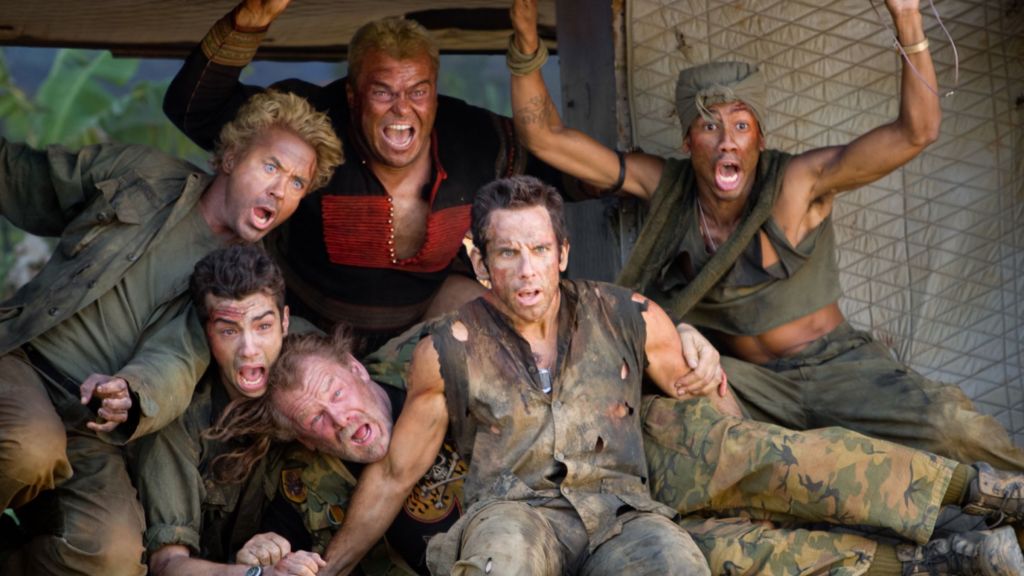
A true milestone in comedy and meta-humor, Tropic Thunder is not a polished movie, and it has no interest in being one. The story follows a group of actors shooting a big-budget war movie, who end up getting caught in a real conflict while still clinging to their roles, their egos, and the illusion of being “serious artists.” That setup becomes the perfect excuse to tear into Hollywood itself, especially the way the industry builds art on vanity, performance, and self-importance. And it works, especially thanks to a stacked cast that fully commits to the chaos.
Unlike the other films on this list, the humor here comes from excess: awkwardness, escalation, and deliberately provocative choices. It’s a loud satirical production, but still controlled enough not to turn into pure slapstick. Tropic Thunder knows exactly what it’s targeting and doesn’t waste time hiding it, but it also prioritizes entertainment just as much as critique. That balance is what gives it impact, even if it doesn’t dig as deeply or as precisely as some of the higher-ranked entries. It’s efficient, direct, and unapologetically in-your-face.
4) The Lobster

At first, The Lobster feels strange because it completely breaks away from basic expectations of what a comedy is supposed to be. That already shows in its premise: in a world where single people are forced to find a partner within a set timeframe, or they’ll be turned into animals, we follow David (Colin Farrell) as he tries to adapt to totally arbitrary rules. It sounds absurd (and it is), but the point is that what the film is really criticizing, which is the social pressure to fit into “relationship models,” is extremely familiar and grounded in reality.
What makes The Lobster work is the balance between originality and clarity of purpose. The humor is dry, almost uncomfortable, and it never really guides the audience toward an easy laugh. That can definitely push away viewers expecting a more traditional comedy, but it’s also what makes the satire more effective. It’s the kind of movie that feels almost alien at first, until you realize how well-crafted it actually is. And because it’s built more as an observation than a commentary that spells everything out, it ends up exposing how ridiculous social expectations around relationships can be when you really look at them.
3) The Menu

Whoever has watched The Menu might not even remember it as a comedy at first, and that’s because it’s so controlled that it often feels like a straight-up thriller (which, honestly, isn’t wrong either). The humor is extremely biting and dark as it follows a group of wealthy guests invited to an exclusive dinner, where each course is shown to be something far more disturbing than the last. The film uses that setting to really dig into elitism, consumer culture, and the way art gets turned into a status symbol.
But what actually puts The Menu in the top 3 is its execution. The script knows exactly when to lean into humor and when to let tension take over; it understands when a dark joke lands and when silence is more effective than a punchline. The comedy isn’t there just to break tension — it’s there to amplify the satire itself. Even while operating within a thriller framework, it uses humor in a very measured, almost surgical way. Everything about it feels deliberate, and that control is what makes it so sharp.
2) The Death of Stalin

If the goal is pure satirical comedy, then The Death of Stalin is easily the most reliable entry on this list. The story follows the power struggle after Stalin’s death, with Soviet leaders trying to position themselves politically as chaos starts to unfold. The humor here comes from how the movie turns a historically heavy moment into a chain of crazy decisions driven by ego, opportunism, fear, and incompetence. Everything becomes a survival game where no one is actually in control of the situation, but everyone is pretending they are. The critique basically is: everything falls apart, even within an authoritarian regime.
But despite being almost flawless in its execution, The Death of Stalin doesn’t really try to expand the genre. It is still an extremely well-built script, with good dialogue and a rhythm that never wastes time. You watch it smoothly, always wanting more to see what it will deliver next. Every scene serves both comedy and critique at the same time. However, it doesn’t take big risks, and that’s not necessarily a bad thing, but when thinking about the best satirical films of the 21st century, it only loses out to one that is much more ambitious and transformative.
1) Get Out

Everyone already knows Get Out is one of the best movies of the century, basically locked in as a future classic. And as a satire specifically, it’s brilliant because it doesn’t feel the need to follow a single comedic formula to work. With a very uncomfortable kind of humor, combined with psychological horror, the story follows Chris (Daniel Kaluuya), who visits his girlfriend’s family and starts realizing something is deeply wrong in what initially seems like a welcoming environment. But even as it builds toward its climax, it takes its time without ever feeling boring.
And Get Out gradually builds this sense of unease in a way that lets the audience catch up emotionally with the protagonist, almost in real time. So it doesn’t spell out what it’s criticizing; it makes you feel it first, and that realization hits harder because of how naturally it develops. But what really sets it apart as the number one pick is how it uses comedy: it’s not about how often it appears, but about purpose. The dark humor doesn’t announce itself; it seeps into the story. That’s what makes it so smart and easily the movie that expands the reach of satirical comedy the most.
Which of these satirical films is your favorite? Leave a comment below and join the conversation now in the ComicBook Forum!
Most Viewed
-

Image courtesy of Wizards of the Coast -

Image courtesy of Daybreak Game Company -

Courtesy of Bones Film