Nothing in entertainment is guaranteed. A movie might be announced to be in development that never actually makes it to production or a television series might get picked up only to be cancelled before it ever makes it to air. It makes things frustrating for fans, but there is perhaps one thing when it comes to television specifically that is especially frustrating. It’s when an intriguing series debuts, hooks you with a wild premise, and then not only ends up cancelled but leaves viewers with a huge cliffhanger that will never see resolution. 17 years ago, one such series debuted on ABC and it’s something that we still haven’t quite gotten over.
Videos by ComicBook.com
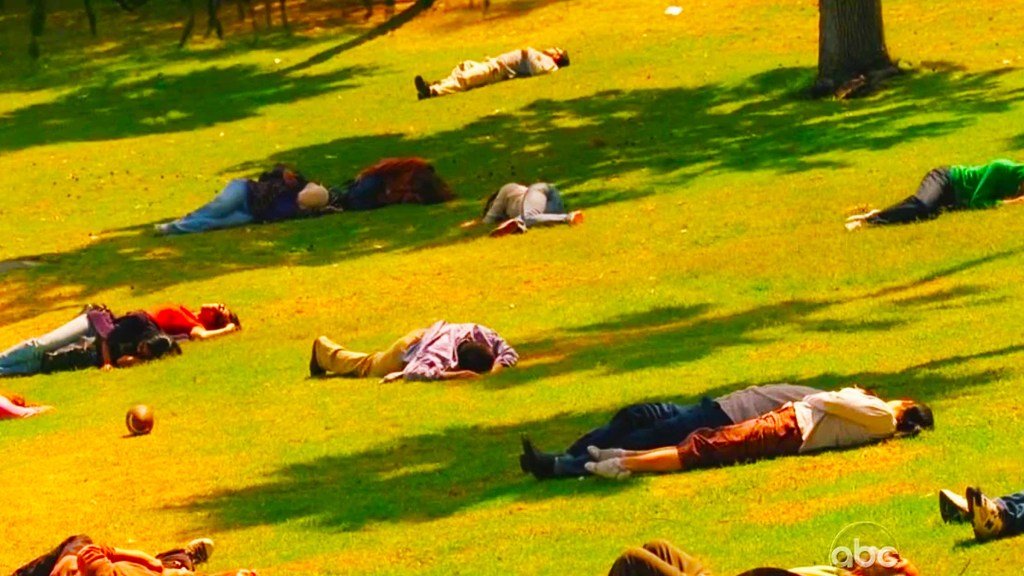
On September 24, 2009, ABC aired the series premiere of FlashForward. Created by Brannon Braga and David S. Goyer (who also wrote the screenplay for the Blade trilogy, Christopher Nolan’s Dark Knight Trilogy, and Man of Steel, just to name a few of his projects) FlashForward was based on Robert J. Sawyer’s novel of the same name and centered around a mysterious event: something causes nearly every person on the planet to simultaneously lose consciousness for exactly two minutes and seventeen seconds on a specific date and, during that blackout, people see visions of their lives six months into the future — a “flashforward”. The series featured a strong cast including Joseph Fiennes, John Cho, and Courtney B. Vance, but was cancelled in May 2010 before the finale. Said finale did something truly wild — and left a mystery that remains unsolved for television fans to this day.
FlashForward Was High Concept Sci-Fi With High Stakes (But That Cliffhanger Is a Doozy)

For many sci-fi fans, FlashForward is one of the most frustrating cancelled too soon series in the genre. In terms of its general concept, there really wasn’t anything quite like it. The entire story hinged on that strange event where the whole planet experienced a 137 second “flashfoward” experience upon losing consciousness that let them a vision of their own lives six months in the future. While one would think that getting a sneak peek of your own life would be exciting, it’s not that simple. Not everything people saw in their flashforwards was positive — some of the main characters see themselves having substance issues relapses, someone’s wife sees herself cheating on her husband, one person even sees nothing and that nothingness is a suggestion that they won’t be alive in six months. Add to those issues the fact that no one knows what caused it, and you get a mystery investigation on multiple levels. A team of Los Angeles FBI agents come together to try to figure out what happened and, perhaps more importantly, if it will happen again.
The series ends up working on multiple levels. You have the main mystery of what the heck happened, and each episode also entangles the personal mysteries of the characters as well. There is also the fallout of what happened during the 137 when everyone was unconscious as that time was not without consequences. There is also the added element that the story is building to a very specific date — April 29, 2010 — so there’s an urgency to solving the mystery which may have massive global involvement. The first seasons races its way towards the future date of the flashforwards and when it arrives, it is poised to throw the series into high gear for a second season. Some of the flashforwards come true, some are true but slightly altered, and then there are some shocking turns: an abduction, an explosion that leaves the fate of a main character up in the air, and perhaps most stunning at all, another blackout, this time with people experiencing flashforwards that go to many different dates. That’s it. We don’t know who lives, we don’t know who dies, and we really don’t know what happens next or if there are more blackouts to come.
FlashForward’s Broadcast Schedule Contributes to the Cliffhanger Frustration (But There Is a Way to Find Out What Happens Next)
The lack of resolution to FlashForward has long frustrated fans of the series and sci-fi fans generally, but it wasn’t the only frustrating element of the series. FlashForward had a bit of an unusual broadcast schedule. The 22-episode first (and only) season was divided roughly in half with the first 10 episodes airing between the September premiere and December 3, 2009, with the second half airing March 18, 2010, until the finale in May. While breaks aren’t necessarily unusual for television — hiatus around the holidays are a thing, even now — FlashForward had a particularly long one. More than three months is a long time to go between the active parts of a series (or at least was a long time in 2009.) When the series returned, there was a notable drop in ratings with the decline largely continuing to the end. There’s no guarantee that not having had such a significant break would have changed the show’s fate, but it is certainly possible, especially since the break happened right when things were getting really interesting.
After the series’ cancellation, we did get a bit of information about where the series would have gone in its second season. Sawyer shared his own memo of suggestions for the story, which included the series dealing with a global extinction-level event and the idea of a catastrophic and permanent shutdown of human consciousness that would have required the “good guys” to work with the “bad guys” to stop it. However, while those elements of the story never came to pass and the television show does have significant differences from Sawyer’s novel, there is a way to get some sort of conclusion to the general idea of FlashForward. Sawyer’s book places the source of the flashforwards on CERN experimentation and a future flashforward takes the main character billions of years in the future and, ultimately, a rejection of the immortality that would allow him to actually see it for real. It’s not exactly the same story, but it’s still a very cool one (and it makes the show’s cliffhanger a little easier to accept.)
More TV Shows
-
Image Courtesy of Marvel