After three seasons, Silo has finally revealed the real reason for the end of the world. Set in a dystopian future where the Earth has become uninhabitable, Silo has guarded its secrets for three seasons. The Silo’s architects have gone to great effort to hide the truth, using memory-altering drugs to wipe all memory of the “Before Times.” But now, in Season 3, Silo is beginning to pull back the curtain courtesy of a series of tremendous flashbacks. We’ve already learned the origin of the memory wipes, first developed as a trauma response.
Videos by ComicBook.com
But why did the world end? In Silo, the United States has been drawn into war with Iran after a dirty bomb was detonated on U.S. soil. That particular plot has raised quite a few eyebrows in 2026, when war between the U.S. and Iran has become unexpectedly topical, but I admit I found the idea of a nuclear apocalypse in Silo pretty underwhelming. Yes, nuclear weapons are terrifying and a nuclear war is an Armageddon-level event, but this is a threat we’ve faced for decades. Silo is so much more creative than that – and, thankfully, nuclear war is misdirection.
Silo Season 3 Reveals the Real Reason the World Ended
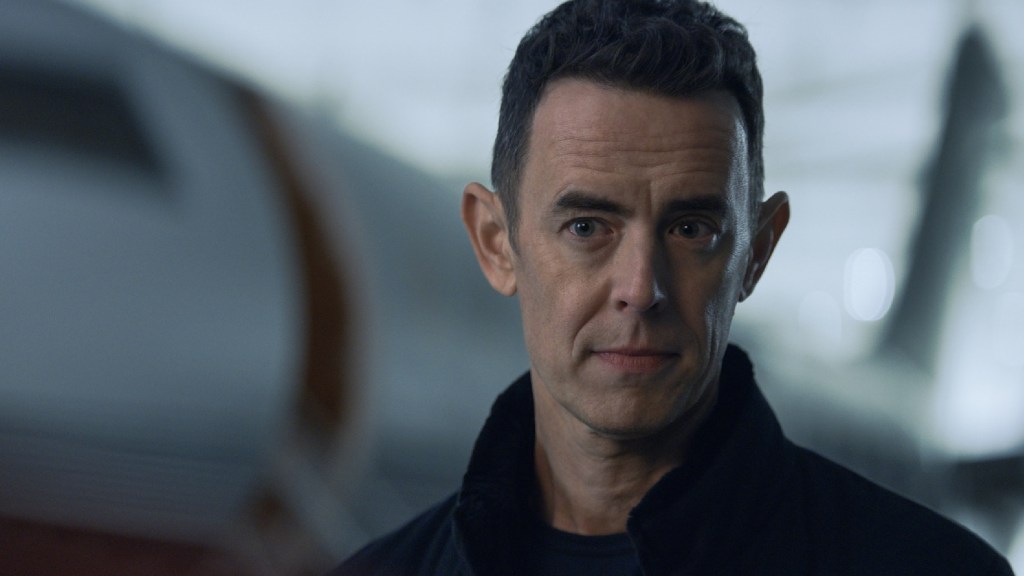
Silo episode 7 ended with a glimpse of the silos under construction. In episode 8, we finally learn the reason the trillionaire Per Stenson has had them built; he believes the world is doomed to destruction. In the “Before Times” story, Stenson presents a summary of existential threats facing humanity. But, in his view, the greatest danger lies in nanotechnology. He believes cheap nanotechnology could easily outstrip conventional military forces, with sophisticated nanobots taking control of standard technology. Most horrific, he imagines a scenario where self-replicating nanobots consume all organic life, turning humans into “gray goo.”
Stenson reveals military forces are already developing nanotech weapons. The dirty bomb attack on U.S. soil was an Iranian nanoweapon, and the previous episodes’ bombing runs were an attempt to ascertain how advanced Iranian nanoweapons are and destroy the lab. Charlotte’s fighter squadron was deliberately sacrificed to nanotech, and a nuclear weapon was then used to destroy the Iranian facility. It’s a shocking revelation; in the Before Times, life goes on as normal even though nuclear weapons are already being used to stave off an even greater threat.
This finally explains why the silos are envisioned as self-contained facilities; the slightest contact with the outside world would have risked nanobot contamination. Because these nanobots are self-replicating, a single nanobot slipping through would ultimately doom an entire silo. Given the world outside the silos is literally just “gray,” it’s safe to assume Stenson’s “gray goo” scenario has indeed come to pass. By Juliette’s time, the entire world has been consumed by nanobots.
Have the Nanobots Really Been Wiped Out?

But this brings us to the one truly ominous question: Have the nanobots really been wiped out? Stenson envisioned the silos as “seeds,” but previous seasons of Silo have revealed the facilities are being managed by an artificial intelligence that appears to have a very different agenda: control. This AI has established a perfect system, with memory wipes, breeding programs, and even horrific safeguards – meaning it can literally wipe out a silo’s entire population should it lose control. The AI has already hinted it has other safeguards, meaning it could easily also control the nanobots.
Whether the AI controls the nanobots or not, though, the risk of nanobot infiltration has increased during Silo Season 3. Juliette has blazed the trail, traveling between one silo and another, and her friends forced doors open before the normal sterilization process had been completed. It’s easy to imagine a scenario where just a couple of nanobots had slipped through, and that’s all it would need. A single nanobot would be able to begin the process of replicating itself, consuming organic tissue as a resource. That would (almost inevitably) lead to a silo’s fall.
This season of Silo has deviated from the books quite a bit, but in this case we’re following the same plot thread. Frankly, I couldn’t be happier; as terrifying as nuclear war may be, the idea is pretty old hat for science-fiction. Instead, Apple’s tremendous sci-fi show is taking a much more original approach. Nuclear bombs are a prelude to something far more dangerous, and the threats posed by nanotech weapons look set to take the show in a whole new direction.
More TV Shows
-

Image courtesy of Paramount Television -

Image courtesy of Cartoon Network -

Image Courtesy of ABC Networks