Hazbin Hotel has captivated audiences with its unique blend of adult comedy, showstopping musical numbers, intriguing characters, and a surprisingly intricate lore. From the moment audiences were introduced to Charlie Morningstar, the Princess of Hell with a dream of redeeming sinners, fans have been dissecting every frame and line of dialogue for clues about the show’s deeper mysteries. While many theories revolve around the ultimate fate of Hell, the Vees’ motivations, or the human backstories for both angels and sinners alike, a particularly interesting detail challenges one of the most basic assumptions presented as truth since the pilot: the identity of Charlie’s mother, Lilith.
Videos by ComicBook.com
What if the glamorous figure seen on the heavenly beach and garden, seemingly enjoying an eternal vacation, isn’t Lilith at all? A closer look at seemingly insignificant artistic details, combined with biblical and Hazbin lore, suggests a shocking twist that could redefine everything we thought we knew about the Morningstar family and the very foundations of Hell itself.
The Person Relaxing In Eden Is Not The One We Know From Hell

One of the most striking pieces of evidence supporting this theory lies in the consistent physical depiction of Lilith throughout the series. In flashbacks, statues, and even Charlie’s fond memories, Lilith is always portrayed with prominent, large horns. These aren’t subtle nubs; they are a defining characteristic, an undeniable part of her demonic form. Now, consider the Lilith seen lounging on a tropical beach or amidst a lush garden. This woman, while undeniably as elegant as the Queen of Hell should be, lacks these distinctive horns. Her floppy, wide-brimmed hat, while stylish, could not possibly conceal horns of the size consistently shown to be a physical part of the real Lilith. This visual discrepancy alone is the first red flag.

In Season 2, Episode 2—”Storyteller”— the woman is sitting at a table in a garden with a plate of sliced apples and a snake-like piece of jewelry around her leg. Apples, of course, are synonymous with the Forbidden Fruit and the Tree of Knowledge, and the Serpent is the iconic form Lucifer takes to lead Eve to the fruit in the Garden of Eden story. These symbols—apples, trees, and snakes—are all intrinsically linked to Eve, the first woman created by God, not Lilith. In many traditions, Lilith predates Eve and was cast out of Eden for refusing to be subservient to Adam (considering the depiction of Adam in Hazbin Hotel, who could blame her?).
Why would the show’s creators and animators consistently link Lilith with imagery solely linked to Eve if she were truly Lilith? Interestingly, the apple iconography extends far beyond the beach scene. Charlie’s cell phone case has an apple on it, while the person we’re led to believe is Lilith has the Tree of Knowledge on her phone case. There is also apple iconography all over the newly rebuilt Hazbin Hotel in the second season, as well as on Lucifer’s staff. The snake and an apple are even prominently featured on Lucifer’s top hat. Neither the apple nor the snake is traditionally associated with Lilith. The implication is clear: the person we are being led to believe is Lilith is, in fact, Eve.
The Story Of Charlie’s Family Is Far More Complicated Than Anyone Thought
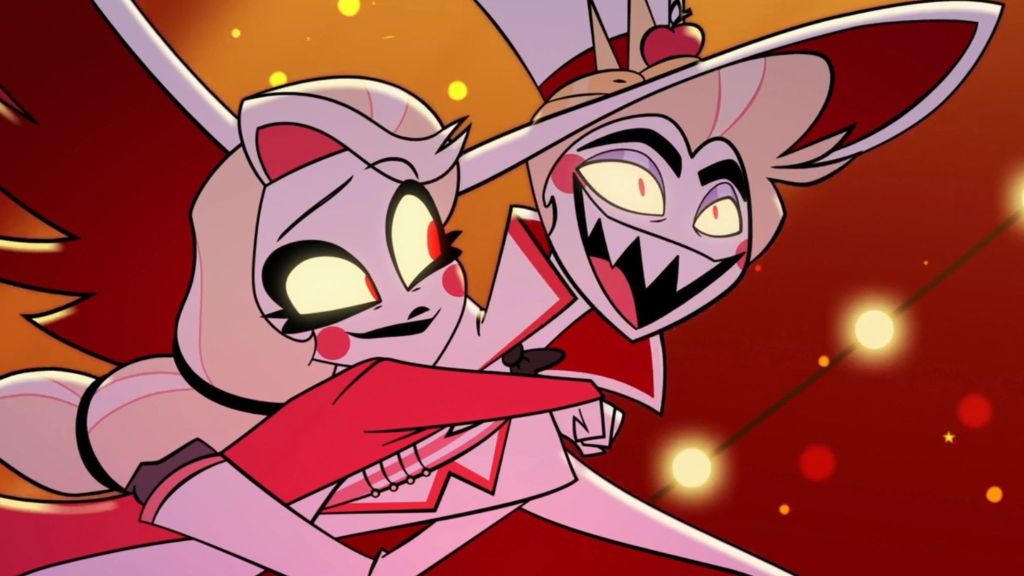
Further supporting this theory is a blink-and-you-miss-it detail from the first episode of Season 1. When Charlie is reading “The Story of Hell,” a quick shot shows a silhouette of Eve with an apple, and her hair and general shape perfectly match the “Lilith” seen on the beach. While Lilith, in flashbacks and photos, has lush and (for lack of a better term) puffy hair, Eve’s hair is straight, long, and always shown to be flowing in the wind. This isn’t a mere coincidence; it feels like a deliberate breadcrumb left by the creators for eagle-eyed viewers.
If this “Lilith” in the garden is indeed Eve, it gives a more plausible explanation for her sudden and extended absence and apparent disinterest in Charlie and Lucifer. Why would Eve, a human sinner, care about the affairs of Hell or Lucifer and Charlie? It would also explain the mysterious halos adorning the trees in the garden during “Storyteller,” suggesting a heavenly prison rather than a leisurely retreat. Eve, as the origin of sin, would be the one person fit for such a divine confinement. This revelation opens up a Pandora’s Box of possibilities for the show’s overarching story. If Eve is masquerading as Lilith, what is her motivation? Is she seeking to exploit the Morningstar family’s power, perhaps to gain access to Heaven or more forbidden knowledge?
Another fascinating theory is that Eve and Lucifer are, in fact, Charlie’s biological parents. Lucifer himself confirmed an intimate relationship with both of Adam’s ex-wives in the Season 1 finale. If Eve was actually Charlie’s mother, having her identity hidden and her daughter given to Lilith (who, unlike Eve, was not a sinner) would make for a truly Shakespearean twist. If Eve was separated from her child by divine (and possibly even Hellish) powers and essentially “replaced” by Lilith, her own act of possibly posing as Lilith would be ironic.
Alternatively, if Eve were stripped of her Hellborn daughter (where in biblical lore, she produced only sons while alive on earth with Adam) and forcibly imprisoned, it could explain a bitterness and a potential descent into darkness. Could Eve, fueled by jealousy and resentment, even have become the mysterious yet-to-be-introduced Roo—the Root of all Evil, who is poised to be the looming “big bad” of the series? Significantly, in Vivienne Medrano’s concept art of Roo, the villain is also depicted wearing a large floppy hat and has tree/branch-like tendrils reaching upward (perhaps towards heaven).
This single detail—the true identity of the woman on the beach—has the power to rewrite the entire foundation of Hazbin Hotel, making it even harder to wait for future seasons.
What do you think? Leave a comment below and join the conversation now in the ComicBook Forum!
Most Viewed
-

Image Courtesy of A-1 Pictures -
Image Courtesy of Prime Video