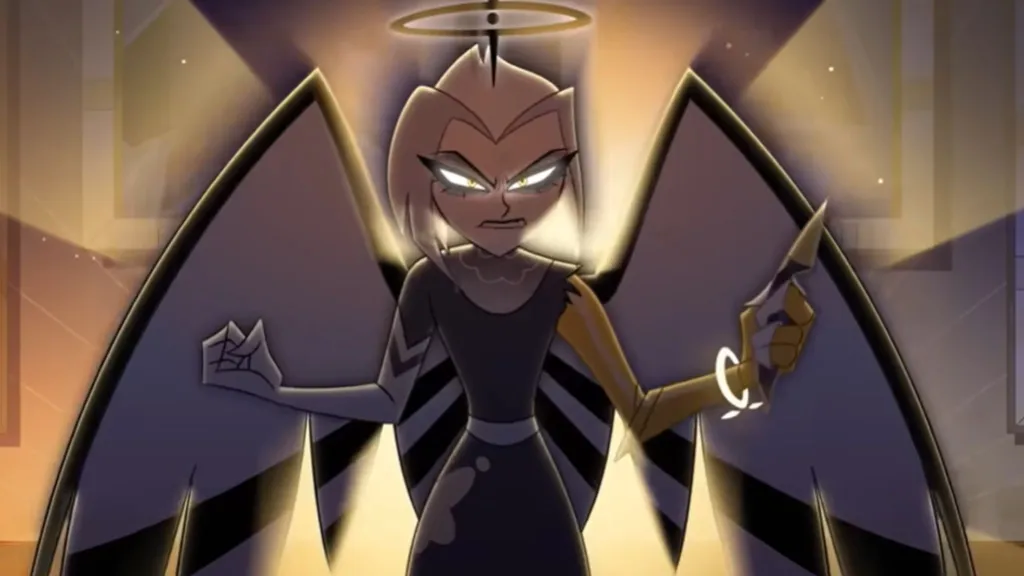
The world of Hazbin Hotel is built on creator Vivenne Medrano’s unique take on traditional Christian theology, where the sinners in Hell seek redemption while the angels in Heaven carry out systematic genocide without any qualms. No character embodies the hypocrisy and terrifying zealotry of Heaven’s elite more completely than Lute (Jessica Vosk), the second-in-command of the Exorcist army. Following the death of her partner, Adam (Alex Brightman), Lute’s upcoming long-awaited solo “Gravity”—released ahead of the Season 2 premiere—serves not just as a declaration of war but as a deeply symbolic psychological spiral.
Videos by ComicBook.com
Analyzing the lyrics, auditory elements, and visual iconography of the scene reveals a carefully constructed and twisted journey ahead: Lute is losing her spiritual footing, twisting divine scripture to fuel a personal vendetta. This vengeful anthem suggests her rage, which is strikingly similar to the deadly sin of Wrath, is so consuming that she is set on a collision course with the very sanctity of Heaven, potentially transforming the once-devoted angel into a force of the demonic fury she sought to destroy for ages.
Lute’s Vengeance Distorts the Holy Purpose of Heaven’s Extermination
The most striking lyrics of “Gravity” revolve around Lute’s relentless call for retribution, which she justifies with the idea of divine judgment. Phrases like “an eye for an eye,” “the flood’s coming,” and “hard rain is gonna come down” are striking references to the Old Testament, specifically invoking the covenantal law and the concept of a fearful, uncompromising God who was swift to enact divine vengeance upon humanity. The law of lex talionis—”eye for an eye”—found in Exodus, is a legal principle from over a thousand years BCE designed to limit crime with harsh punishments for potential thieves/criminals. However, Lute uses the idea as a justification for the boundless, extreme violence she plans to bring down upon Charlie Morningstar and the Hazbin Hotel.

Similarly, the lyrics of “Gravity” have multiple constant references to the biblical parable of Noah and the Great Flood. Besides vowing that a “storm’s coming” and “hard rain is gonna fall down,” Lute blatantly states “the flood’s coming,” signaling her belief that Hell, and by extension Charlie, is so spiritually corrupt that it requires complete annihilation—a cleansing of quite literal biblical proportions on a scale that only an Old Testament God would inflict. Her repeated vow that “blood demands blood” reinforces this Old Testament theme of harsh and unrelenting retribution, suggesting that Adam’s death requires a price that the standard Extermination protocol simply cannot achieve; it requires a personal, catastrophic act of heavenly violence. This is no longer righteous justice; it is the raw, untempered sin of Wrath.
Crucially, Lute’s thematic descent (a force of gravity in and of itself) is only highlighted by the song’s unsettling musical backdrop. The Latin monk-like chanting in the background throughout the track, echoing words of religious authority, is both sacred and corrupted at the same time. The phrases “Sanctus Dominus” (Holy Lord/Holy God) are intertwined with “Vindictus” (Vengeance) and “Ignis” (Fire).
By layering the pure declaration of God’s holiness over the words for vengeance and fire, Lute’s psyche is actively corrupting the foundation of her faith. She is using the language of the God she serves to sanctify her own, deeply personal rage. The “fire” she speaks of is not just the Hellfire she wishes to unleash, but the consuming fire of her own anger, which is ironically stripping her of her angelic status as she falls deeper and deeper into her self-perpetuated cycle of Wrath. The sophisticated use of these Latin terms—sacred language twisted to justify a sinful emotion and planned actions—highlights the moral decay within Heaven itself and foreshadows Lute’s spiritual downfall. She is not carrying out a decree; she is weaponizing piety.
The Iconography Suggests a Final, Tragic Transformation for Lute

The climax of Lute’s spiral during “Gravity” is visually emphasized by her own angelic wings. She dives headfirst and rapidly downward, which is an unmistakable parallel to the traditional depiction of the ultimate fallen angel, Lucifer. In Season 1, Lucifer describes his expulsion from Heaven as a swift, downward, tragic fall of a perfectly innocent angel cast out from the celestial realm simply because of curiosity and big dreams. Lute’s headfirst dive—a frantic, uncontrolled plunge fueled by obsession—serves as a powerful symbolic omen for her upcoming story. Her rage, her inability to forgive or seek any form of balanced justice, has become her tragic flaw. Just as Pride was the reason for Adam’s death, Wrath is the sin most actively consuming Lute.
This is the most critical element of the show’s entire theme. Hazbin Hotel is centered around Charlie’s belief that sinners can, potentially, be redeemed. This means that a being can transition from a state of sin to a state of grace, as proved by Sir Pentious’ brave and selfless actions in Hell that ultimately sent him straight to the Pearly Gates. Since Charlie’s theory holds true in one direction, the opposite must also be possible: an angel, by committing one of the Seven Deadly Sins on such a devastating level (untempered Wrath calling for mass destruction and self-proclaimed vengeance), can find themselves falling from grace into Hell.
Lute’s commitment to an “eye for an eye” system, far exceeding the measured—if brutal—mandate of the Extermination, sets her up as the spiritual opposite of Charlie Morningstar. While Charlie strives to lift souls up, Lute is driven to drag her own spiritual status down through her quest for vengeance. Adam’s death was a catalyst, but Lute’s reaction is the choice that seals her fate. Her violent, headlong plunge suggests she will become the physical manifestation of the Wrath she feels, possibly leading to a spectacular, heartbreaking transformation into a fallen angel. This would not only add another layer to an already compelling antagonist but would fundamentally test Charlie’s philosophy, creating the ultimate counter-example to redemption. The coming “hard rain” may not be for Hell, but for Lute’s own soul.
Hazbin Hotel Season 2 premieres on Prime Video on October 29.
What are you most excited to see in the upcoming season? Let us know in the comments!
Most Viewed
-

Image Courtesy of Netflix -
Image Courtesy of Netflix -

Image Courtesy of Ufotable -

Warner Bros. Pictures