
Today, collectors take for granted how comprehensive DC and Marvel Comics action figure lines like Marvel Legends have become, even including left-field deep-cut choices like figures from the 1967 Spider-Man cartoon. But turning back the clock to when that series was on the air, Marvel Comics fans would count themselves lucky to have Ideal’s Marvel Captain Action outfits or Louis Marx’s unarticulated super-hero statue figures. Today, many fans point to Toy Biz’s legendary 1990s Marvel action figures as the first time the breadth of the Marvel Universe was made available in toy form. But decades before that, Ideal would give kids a unique way to recreate the world of Marvel’s most popular hero with almost two-dozen characters from the pages of The Amazing Spider-Man. The 1973 Ideal Spider-Man playset would be the first – and in some cases only – time that Spidey’s iconic friends and foes left the four-color world of comics. The only catch was that these toys weren’t exactly action figures.
Videos by ComicBook.com
The 1973 Ideal Spider-Man playset was made of cardboard and vinyl. Its nineteen characters were all brought to life as 2-D cardboard punch-outs, held up with plastic stands like board game pieces. Also included was a free-standing vinyl backdrop for the figures, comprised of three environments (a villain lab, the Daily Bugle, and Peter Parker’s apartment) for them to interact with. Ideal produced similar playsets for DC’s two most popular heroes, Batman and Superman, as well as for Dick Tracy. Disappointingly, this is their only foray into Marvel – though a fan has an easy time imagining what they could have done with an Avengers set in this format! Although an obscurity, these playsets are very popular with collectors because they represent a snap-shot of their favorite hero in the early seventies. The costumes, characters, and even settings are pulled right from the pages of 1973’s Amazing Spider-Man or Action Comics. And that means that collectors don’t want even a single piece missing from these rare, flimsy, fifty-year-old cardboard playsets. Incomplete, a set can still sell for more than a hundred dollars. Complete, a seller can all but name their price.
How One Decision Gave the Ideal Spider-Man Playset Its Most Notable Feature
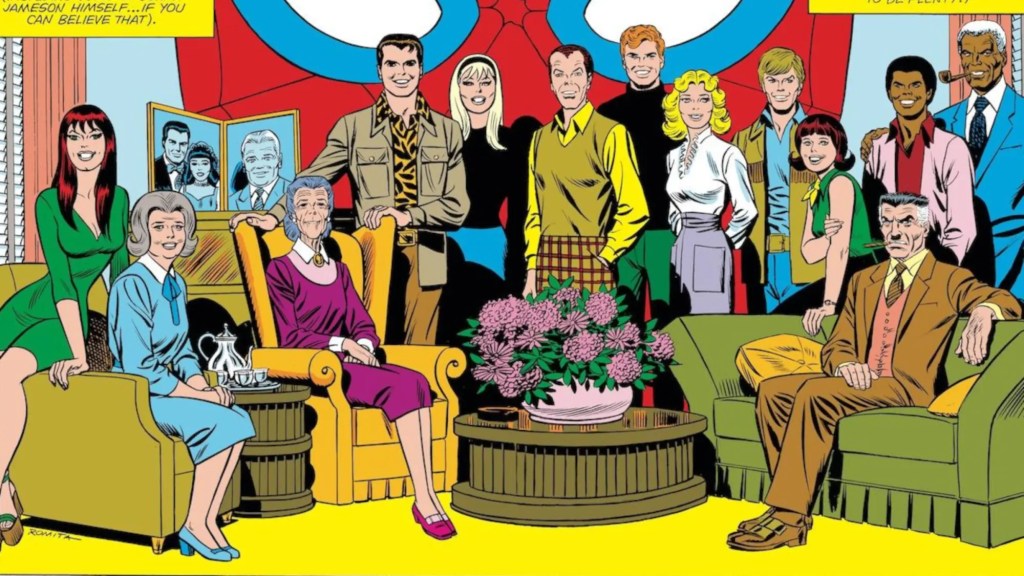
For the Spider-Man playset, Ideal made a surprising character selection decision: they chose to focus on Spidey’s civilian life as Peter Parker over his Spider-Man rogues’ gallery, including nine of his friends and allies versus only eight of his villains – depending on how you want to count J. Jonah Jameson. In the case of a few, this is literally the only comics-based figure of them ever produced. Randy Robertson, who debuted in 1968’s Amazing Spider-Man #67, has been a regular character in the comics ever since (even becoming Peter Parker’s roommate at one point), but has never been merchandised outside of this set. Even more surprising is that this is the only civilian Flash Thompson ever made, although a animated series-inspired Flash Thompson alternate head was included with a 2024 Marvel Legends set. Numerous figures have also been produced of Flash’s Agent Venom identity.
By the same token, you could argue that any classic Hobgoblin figure is really a figure of Ned Leeds, but this playset is the civilian Ned Leeds ever made. It’s a reminder of Ned’s surprisingly minor role in Spider-Man before Jacob Batalon made him a fan favorite in the MCU, introduced as a romantic rival to Peter in the early silver age. The “best friend” characterization seen in the MCU is much closer to Miles Morales’ relationship with Ganke Lee. In the comics, Ned is most notable for marrying Peter’s first girlfriend, Betty Brant, also included in the set. To complete the Daily Bugle bullpen, the paper’s benevolent editor (and fan favorite) Robbie Robertson is included. Robbie and Betty were graced with their second-ever toys as Lego Minifigures in the 2021 Daily Bugle set.
How One Character Dates This Set Almost Down to the Month
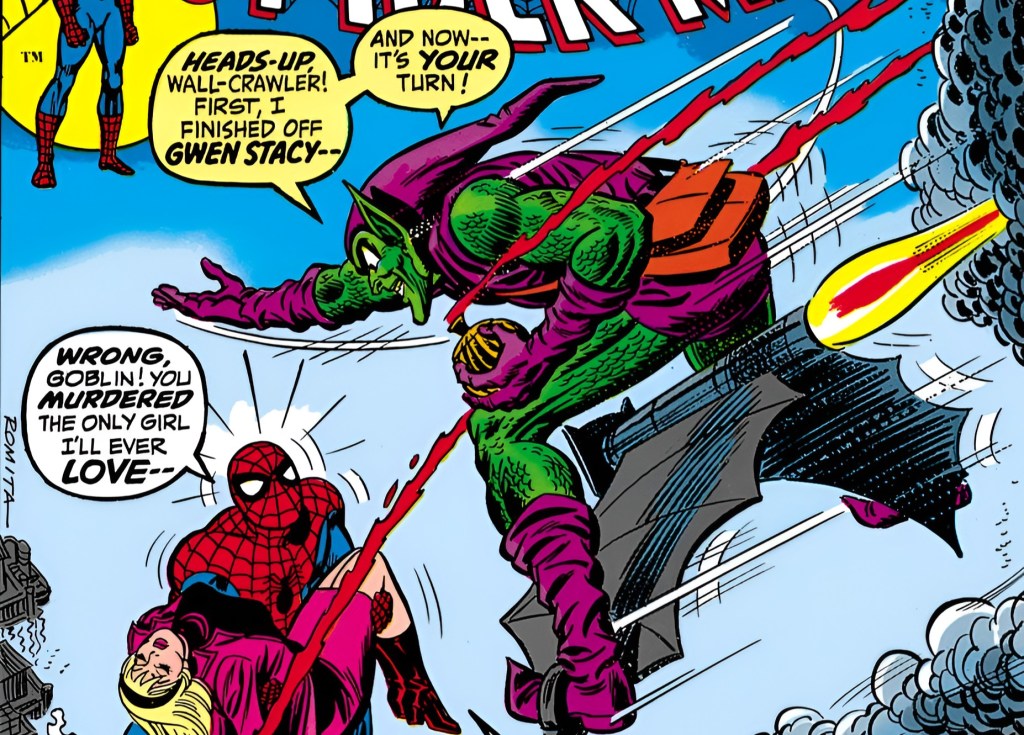
Like Ned, Harry Osborn has received some merchandise in his live-action form, but his cardboard cut-out here – complete with the much-mocked comic Osborn hair – is the only figural depiction of a character who has been a constant in the Spider-Man comics since 1965. Not included is a character who debuted alongside Harry, Peter’s first love Gwen Stacy. This is actually a testament to how closely Ideal was following the source material: the set was released in 1973, Gwen Stacy had been killed in March of that year in the landmark Amazing Spider-Man #121. Oddly, the original Green Goblin, who was killed in the following issue, is one of the villains included in the set. Harry Osborn would eventually take over the Green Goblin mantle, but not until the following year.
Rounding the civilians are a few characters who have received their share of merchandise: Aunt May, J. Jonah Jameson, Mary Jane Watson, and Peter Parker. Aunt May was given an infamous 12” doll in Toy Biz’s “Famous Covers” line, as well as a Marvel Legends figure based on Spider-Man: The Animated Series. J. Jonah Jameson and Mary Jane Watson are perennial action figure favorites, finding their way into virtually every Spider-Man line produced over the decades. Model and fashion victim Mary Jane becomes the most “time capsule” feature of the playset, sporting an incredibly of its era fringe suede dress.
However, to Spider-Man fans, there’s a more interesting, more poignant moment in time the set captures: the beginning of Peter Parker and Mary Jane Watson’s comics-defining love story. 1973 marks the year Mary Jane transitioned into a fixture in Peter’s life, caring for him after Gwen’s death. Across two years of comics, writer Gerry Conway slowly turned this friendship to love, culminating in Peter and Mary Jane’s first kiss in 1975’s Amazing Spider-Man #143. This playset captures the world of Spider-Man in a moment of transition, and even its 2-D cardboard form, anticipates some of the greatest Spider-Man storylines that were to come.
The Villains & Legacy of the Ideal Spider-Man Playset
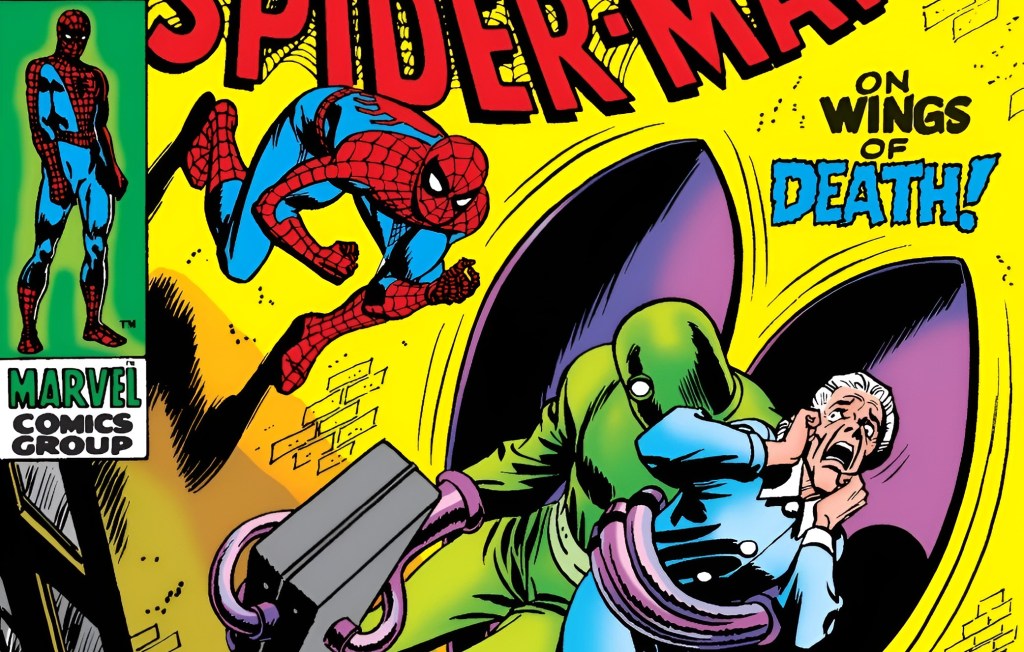
Eight foes for Spider-Man were included with the set: Green Goblin, Doctor Octopus, Lizard, Kraven the Hunter, Mysterio, Rhino, Beetle, and the Prowler. Prowler sticks out in the set for a couple reasons, as even by this point in the comics, he was not a villain, but instead a reformed vigilante. He had last appeared in 1971’s Amazing Spider-Man #93, drawn into conflict with Spider-Man after the wall-crawler is falsely accused of murder. For an astute Spider-Man fan, Prowler’s inclusion actually gives Spidey a costumed ally to team-up with against the other seven villains. Among these, there are also some interesting choices, and looking at them closely provides a fascinating snapshot of this moment in Spider-Man’s history. While Rhino seems like a no-brainer inclusion today, circa 1973, he had only fought Spider-Man once, in his 1966 debut. Rhino had instead become a regular opponent of the Hulk, battling the green goliath every couple of years. The character wouldn’t face off against Spider-Man again until a 1981 issue of Marvel Team-Up.
Similarly, Mysterio had not menaced Spider-Man since 1968, though he’s undoubtedly one of Spider-Man’s most visually striking foes, which was likely why he was chosen. Beetle is just as unusual of a pick, having only appearing in two issues of Spider-Man, the most recent of which was 1971’s Amazing Spider-Man #94. His inclusion does make for the most unique villain in the set, as this figure is the only one ever produced of Beetle’s creepy, sucker-fingered original look. The remaining four villains (Doc Ock, Green Goblin, Lizard, Kraven) constitute the most obvious choices, appearing just as regularly in the comics then as now – although as mentioned, the Green Goblin was recently deceased. Green Goblin and Lizard would also be chosen by Mego in 1974 as the only two Marvel villains to appear in their World’s Greatest Super-Heroes line, although shockingly, this is the only time Doc Ock makes an appearance in merchandise until Mattel’s 1984 Secret Wars figures.
While later lines would give fans dozens of Spider-Man’s most iconic foes, none have captured his early adventures better than this set. This set manages to capture the look and feel of Peter Parker’s college years, helped significantly by the inclusion of so many of the faces that make up his civilian life. Every super-hero has super-villains, but none have the always crowded, always complicated personal life of Peter Parker. Marvel itself would launch a comic emphasizing this duality in 1976 with Peter Parker, the Spectacular Spider-Man. With this set, Ideal demonstrates that it’s always been this tenuous work-life balance that makes Spider-Man who he is. The set’s value today is a testament to how much this side of the character continues to resonate with fans, its influence still seen in adaptations to this today.
Who’s your favorite Spider-Man supporting character? Leave a comment below and join the conversation now in the ComicBook Forum!
More Collectibles
-
Courtesy of Warner Bros. Pictures -
Courtesy of 20th Century Studios


Forum Conversation: Hot Take: Sinister Six is the best villain team up idea!
Go to ForumI think I agree with you that a group like the Sinister Six works immensely well regardless of lineup due to their shared history with Spider-Man. I feel the same way about Batman’s rogues gallery, though while they do work together at times, they don’t go as far as forming a team, so the Sinister Six gets the upper hand in that regard.
Here’s my line of thinking:
So there’s one hero, in this case Spider-Man, who has an established rogues gallery or mostly solo acting villains that hate the hero so much they decided to team up against him to stop him.
I actually think it’s a stronger concept than teams like the Legion of Doom. The Legion is iconic, but it often feels like a collection of villains because every hero has to have an evil counterpart. The Sinister Six feels more natural because every member has a shared history with one person.
The personalities are also half the fun. They’re all convinced they’re the one who deserves the credit, which means the team is constantly one bad argument away from falling apart. Watching them cooperate while barely tolerating each other is often just as entertaining as watching them fight Spider-Man.
A good Sinister Six story doesn’t even need the strongest lineup. As long as the villains have history with Spider-Man and believable chemistry, the concept almost writes itself.
That’s why I think the Sinister Six is the best villain team-up idea in comics.
What do you all think?