
In its twenty-eight year run, DC’s The Brave and the Bold distinguished itself as one of the publisher’s most dynamic comics, reinventing itself several times to suit changing comic book audiences. In this inaugural 1955 issue, the comic was a swashbuckling fantasy adventure, featuring Robert Kanigher and Joe Kubert’s Viking Prince, Kanigher and Irv Norvick’s Silent Knight, and Ed Herron and Russ Heath’s Golden Gladiator. The Brave and the Bold emerged from the literal final days of the Golden Age, its seventh issue arriving on newsstands at the same time as Showcase #4’s “Mystery of the Human Thunderbolt” ushered in the Silver Age. Beginning with its twenty-fifth issue, Brave and the Bold would become an instrumental component in defining that Silver Age, first as a try-out title akin to Showcase, then as a first of its kind rotating team-up title. By the time of its 1983 cancellation, Brave and the Bold had introduced readers to dozens of DC’s most iconic teams and characters.
Videos by ComicBook.com
Before we discuss just how rare Brave and the Bold #1 is, a quick terminology note: “high-grade” and “low-grade” are terms used by comic collectors to refer to the condition of a comic on visual inspection; “graded” and “ungraded” refer to professional, objective grading by a body like the CGC (Certified Guarantee Company). The Overstreet Price Guide lists the value of The Brave and the Bold #1 at a floor of two or three hundred dollars in low-grade (2.0) condition. That price increases astronomically for a higher-grade sample: the most recent sale of a 4.0 copy of The Brave and the Bold #1 was for seven hundred dollars. Higher-grade samples are vanishingly rare, and seldom sell for below four figures. The CGC lists less than two hundred graded copies in existence in any condition, which is comparable to the number of copies All-Star Comics #8 (Wonder Woman’s first appearance; two hundred and thirty-six graded copies) on record. Next week, Heritage is set to auction a low-grade, ungraded copy – one of only a handful available online today. They estimate a $200-400 close for the auction, but with a comic this scarce, there is always the potential for a break-out sale.
Why The Brave and the Bold #1 Is More Significant Than Its Handful of First Appearances
The nineteen-fifties were an era marked by growing pains for comic book publishers. For most of the decade, especially the years immediately following the 1954 adoption of the Comics Code, publishers weren’t sure what audiences wanted out of the medium. They knew what they didn’t want, however: super-heroes. In the years immediately following World War II, super-hero comics fell out of favor, and by the early fifties, all but a handful had been discontinued. Horror and crime comics briefly flourished before being functionally banned by the Comics Code; war and western titles grew in popularity. The Brave and the Bold existed in an odd niche, a historical adventure comic taking place in time periods not explored in comic books (seriously – name me one other comic series set in ancient Rome). It sold well enough to justify its continued publication, but as the decade came to a close, that was changing.
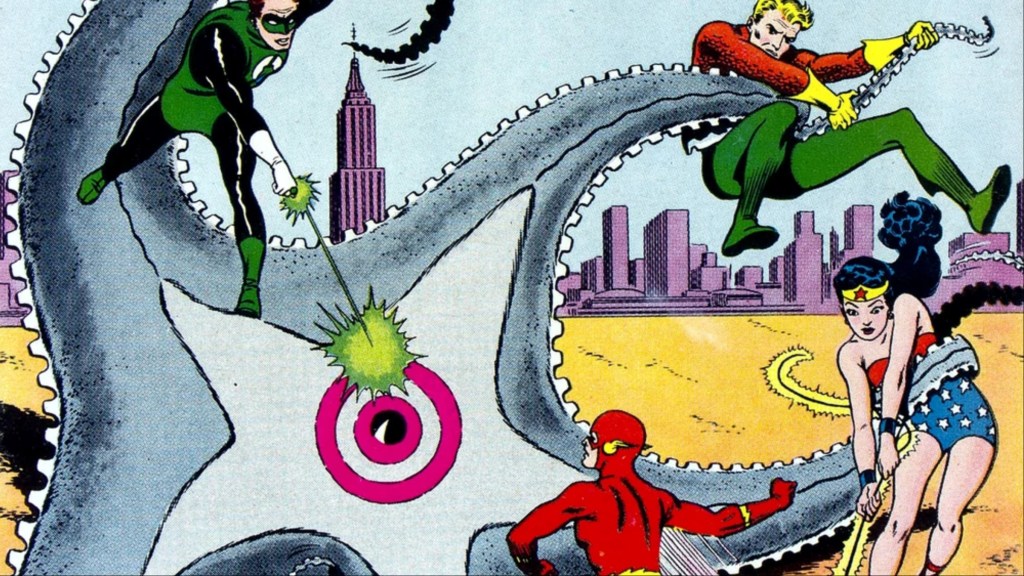
Showcase had found remarkable success with its revival of the Flash, as well as with new characters like the Challengers of the Unknown and Adam Strange. It seemed that science fiction was the key to reinventing the super-hero genre for fifties audiences, and suddenly, Brave and the Bold’s sword and chivalry were looking very old-fashioned. In 1959, the decision was made to transition the title into a “try-out” book akin to Showcase, used as a testing ground for new concepts to see if their sales could sustain being spun off into their own comic. The first test of the “try-out” Brave and the Bold was a team called “the Suicide Squad,” scientific adventurers in the mold of the Challengers of the Unknown. Lukewarm sales saw the Squad’s adventures peter out after three issues, to be replaced by the latest in Gardner Fox’s updates to DC’s Golden Age stable: an all-new “Justice Society of America” style-team. Brave and the Bold #28 introduced readers to the “Justice League of America,” consisting of heavy-hitters Superman, Batman, and Wonder Woman, new-comers the Flash and Green Lantern, the recently-revived Aquaman, and perennial second-stringer Martian Manhunter.
The Justice League were a sensation, with sales for their Brave and the Bold adventures not only enough for DC to spin them off into their own title, but for a rival publisher to try their hand at a superhero team of their own. DC’s follow-up, Cave Carson and his “Inner Earth” adventures, proved less popular; but Gardner Fox and Joe Kubert’s revamp of Hawkman in Brave and the Bold #34 was another success, spinning off into its own comic in 1964. Beginning with issue fifty, Brave and the Bold transitioned into a team-up comic, with each issue pairing two reader-requested heroes. Issue #54 featured a team-up of DC’s teen sidekicks, Robin, Aqualad, and Kid Flash, christened the “Teen Titans” for their second appearance in issue #60 (where they would be joined by Wonder Girl, triggering a decades-spanning continuity headache). Ten issues later, Batman starred in a Brave and the Bold team-up story for the first time, and the title gradually shifted into a Batman-centric book. Beginning with issue #74, Batman headlined Brave and the Bold, remaining its marquee character until its 1983 cancellation.
The Decades-Lasting Legacy of The Brave and the Bold
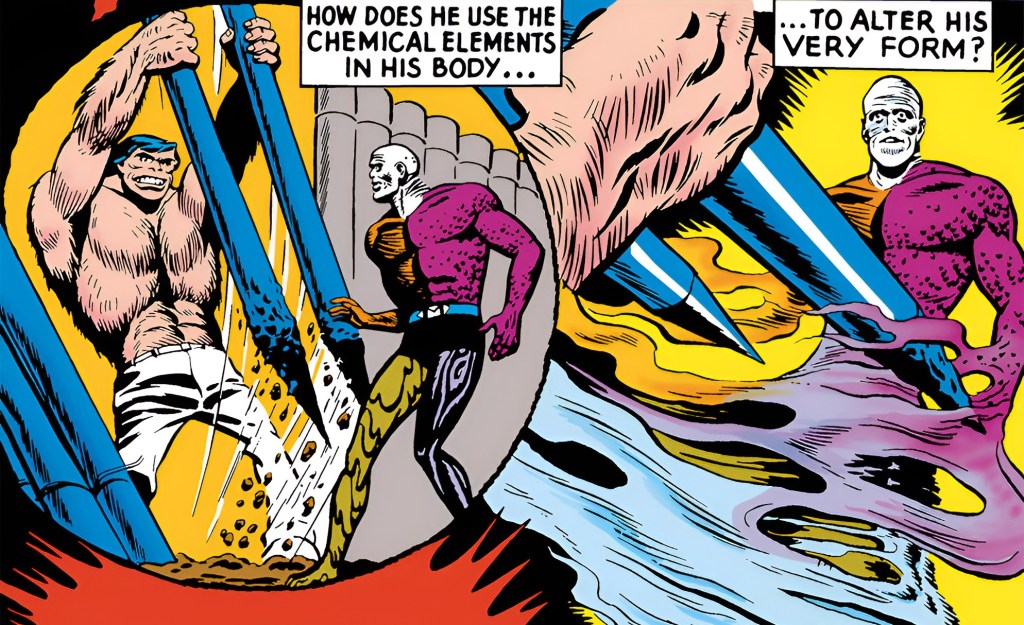
The Brave and the Bold was cancelled in 1983 to make way for a new Batman title, Batman and the Outsiders, which used the Caped Crusader in a supporting capacity, serving as den-mother to a misfit team of super-heroes. Fittingly, this included Metamorpho the Element Man, introduced in Brave and the Bold #57 by Bob Haney and Ramona Fradon. Metamorpho’s intentionally off-beat tone was designed as a light parody of Silver Age super-heroes, designed to compliment the Doom Patrol and the Metal Men. Metamorpho would team with the latter team in issue #66, one of the last before Batman took over the title. The Outsiders were introduced in Brave and the Bold #200, marking the first appearance of members Katana and Halo, and allowing Brave and the Bold to go out with an issue that preserved its legacy as a proving ground for new characters. The name “the Brave and the Bold” is likely most familiar to contemporary comic book fans for its use as the title of a Batman animated series, Batman: The Brave and the Bold, airing from 2008 to 2011.
An extended love letter to the Silver and Bronze Age, Batman: The Brave and the Bold was an instrumental gateway drug for a generation of DC fans, introducing them to the breadth of the publisher’s characters and worlds. Across its three seasons, Batman: The Brave and the Bold featured everything from Kamandi, the Last Boy on Earth to a global invasion by Starro the Conqueror – though surprisingly, it never got around to any of the title’s original stars. Viking Prince, however, made a guest appearance (complete with Joe Kubert art) in a 2006 episode of Justice League Unlimited, entitled “To Another Shore.” Even there, Viking Prince is presented as a relic of a bygone era, though one to be treated with reverence by the modern heroes of the DC Universe. Comic fans have a similar relationship with those earliest Brave and the Bold issues: they represent the end of an era, as well as its literal transition into the next.
Who’s your favorite character introduced in The Brave and the Bold? Leave a comment below and join the conversation now in the ComicBook Forum!
More Collectibles
-
Courtesy of Warner Bros. Pictures

Forum Conversation: Which Marvel Hero Has the Best Supporting Cast?
Go to ForumI have to give it to the one character that carried marvel on his back for many years and many movies way before any of the spider man or x-men movies ever came out. If you dive into some history it’s safe to say that although not the most popular nor the biggest money maker for marvel, hands down the Punisher has to be marvels mvp. Don’t forget it was the Punisher played by Dolph lundgren back in the 80’s that brought marvel back into mainstream pop culture. Not spider man or avengers or x-men. Frank Castle has stood the test of time battling just about everyone in the marvel universe at some point. His supporting cast can potentially be any characters you want to incorporate and it still flows seamlessly because of his interactions with just about everyone over the years.
I’ll go the other way and say Daredevil.
Foggy, Karen, Ben Urich, Jessica Jones, Iron Fist, Luke Cage, Black Widow, Elektra, Captain America, Punisher, Maya Lopez, and that’s not even counting the villains.
I hadn’t thought of Captain Marvel. Honestly, I haven’t read much Captain Marvel in a long time.