
Although some of its heroes have endured, the super-hero landscape of the forties was a very different place than today. The Marvel Universe wouldn’t exist for another couple decades, and in its embryonic form, was represented by Captain America, the Sub-Mariner, and a different Human Torch than the one you’re thinking. And while DC had introduced the likes of Batman and Superman already, Superman was being outsold by his own knock-off, Fawcett Comics’ Captain Marvel. The “Golden Age” of the forties was so-named not for quality, but for exposure: more children were reading comics in this era than in any other before or sense, and the playing field was wide open for publisher like Fawcett, Fox, Quality, and dozens more now-defunct publishers. Many were even incorporated into DC through mergers and acquisitions, their heroes like Blue Beetle and Plastic Man becoming fan favorite parts of the DC Universe. Many more have been relegated to the proverbial dustbin of comics’ history. Another doesn’t really fit easily into either category: Blackhawk.
Videos by ComicBook.com
Quality Comics’ Blackhawk is an iconic figure in comics history, star of his own comic series through the early eighties, as well as one of just four super-heroes to be published continuously through the fifties (alongside Batman, Superman, and Wonder Woman). Blackhawk is patently old-fashioned, an ace pilot whose globe-trotting adventures and multi-national team recall even older heroes like Doc Savage. He’s a misfit within the DC Universe, the peculiarities of his history keeping him out of the classic ranks of the Justice Society; the world of his stories making him difficult to pair with many of DC’s other heroes. Despite that, Blackhawk’s throwback nature earns him a loyal cult following, not the least of which are the legions of kids who grew up reading his adventures in the 1940s-1960s. While not regarded with the same awe as Action Comics #1, Detective Comics #27, or even the first appearance of a JSA member like the Spectre, Blackhawk’s first appearance in 1941’s Military Comics #1 is still among the rarest and most notable key issues of the Golden Age. This week, Heritage is set to auction one of just three 9.0 or higher graded copies in the world, at a price already higher than the last time one was auctioned in 2009.
Blackhawk’s Five Decade Journey From Top Seller to Forgotten Hero
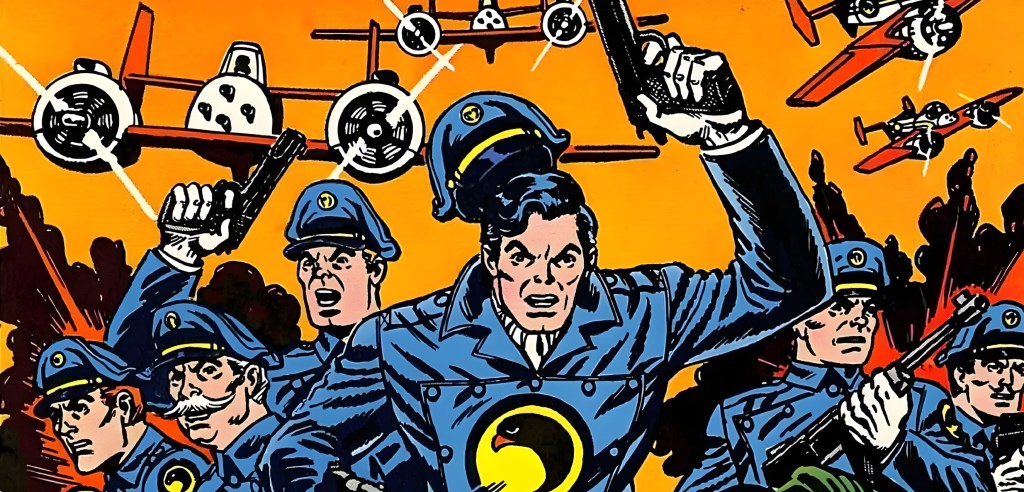
For a long time, Blackhawk’s greatest advantage was that he wasn’t a super-hero. The character was an ace pilot, his true name and history unknown, outside of his being Polish-American. Over the decades, writers would gradually fill in his backstory, giving Blackhawk the true name of Janos Prohaska, a Polish Air Force pilot turned mercenary, turned freedom fighter by the outset of World War II. Blackhawk assembled the “Blackhawk Squadron” to this end, a group of the world’s greatest pilots and warriors, dedicated to ridding the world of evil. In the Golden Age, the other Blackhawks were characterized as broad ethnic caricatures, in subsequent eras, this would be softened, and the pilots given more distinct personalities. There are seven classic members of the Blackhawk team: Stanislaus, Blackhawk’s second-in-command; Dutch weaponsmaster Hendrickson; Andre, their mechanic; Olaf, a skilled acrobat and hand-to-hand combatant; American scientist Chuck; and Blackhawk’s ward (sidekick in earlier depictions), young Wu-Cheng.
In the 1940s and 1950s, the Blackhawks’ two-fisted military tales of adventure helped set them apart from other super-hero titles. They seldom fought super-villains, and the comic existed in a more grounded world than those of competitors like DC or Marvel. A young reader could envision themselves fighting alongside Blackhawk more easily than the super-powered Superman or Flash (which also helps explain the enduring appeal of Batman). Despite this, Quality Comics’ sales suffered in the early 1950s, a time of major upheaval for the comic medium. Super-heroes faced a decline in popularity after World War II, replaced by violent crime and horror comics. Following the publication of psychologist Frederic Wertham’s infamous condemnation of these and other comics, Seduction of the Innocent, parents came to regard comics with suspicion, and pains were taken to give them a more wholesome public image. Sales suffered, and many publishers, already ailing from the loss of super-hero titles, folded. Quality leased its character and title trademarks to DC, including those for Blackhawk, which began to be published under DC in 1957.
The change in publishers meant major changes to Blackhawk. Under DC, the title turned in the direction of science fiction, with the Blackhawks battling otherworldly threats and science-gone-wrong in the vein of DC contemporaries like Challengers of the Unknown. In 1959, a “Lady Blackhawk” was introduced in #133, becoming the title’s breakout character — after a few decades. Lady Blackhawk, Zinda Blake, was transported to the present-day DC Universe as part of the Zero Hour event, enabling Gail Simone to use the character in her Birds of Prey run. Throughout the Silver and Bronze Age, Lady Blackhawk remains a chronically underused “unofficial” or “honorary” member of the Blackhawks team. Sales waned throughout the sixties as the popularity of the super-hero genre revived, leading to the reimagining or cancellation of nearly all of DC’s “scientific adventurer” teams like the Blackhawks and Challengers. In a surprisingly meta move, Blackhawk #228‘s cover featured no less than Superman declaring the Blackhawks “washed up.”
What followed was a short-lived, radical reinvention of the title, turning the Blackhawks into a team of costumed super-spies working for a shadowy extragovernmental organization, its tone and art owing a visible debt to Jim Steranko’s boundary-pushing Nick Fury, Agent of S.H.I.E.L.D. Each member of the team, save for Blackhawk himself, gained their own super-hero identity in an effort to renew reader interest. It failed, the book was cancelled with issue #243 less than two years later. Gerry Conway led an effort to revive the title in 1976, this lasted for seven issues before Blackhawk was cancelled again. This time, the cancellation looked like it would be permanent — then Raiders of the Lost Ark hit theaters.
How Steven Spielberg Has Kept the Conversation About Blackhawk Going Since the 80s
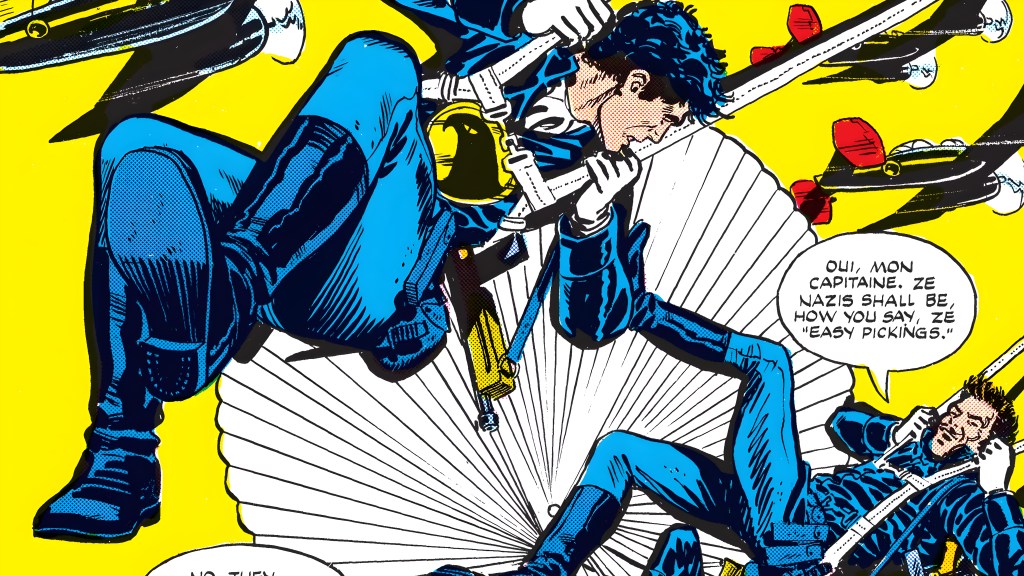
Since the eighties, rumors have swirled that Steven Spielberg is interested in bringing Blackhawk to the big screen. In the eighties, these were just rumors, but they renewed public interest in the character enough that, as writer Mark Evanier tells it, “suddenly DC thought it was advantageous to have a Blackhawk comic back on the schedule.” Evanier explained that what he thinks happened was that “somebody just inquired ‘Are the rights available if we want them?’ and DC let that leak or it leaked somehow.” Either way, Blackhawk was back, and Evanier’s take returned the character to his grounded, World War II roots (and did much to address the ethnic caricatures that plagued the Gold and Silver Age versions of the team). The revived Blackhawk lasted for a further two years and twenty-three issues, ending in 1984 with #273. After its cancellation, Blackhawk and the Blackhawks were given a last brief revival by Howard Chaykin (in a three-part mini-series and subsequently as an Action Comics back-up feature), and would otherwise settle into making sporadic guest appearances in other DC titles. A short-lived eight-issue New 52 title, Blackhawks, tried and failed to reinvent the team for a modern audience.
Spielberg’s name would become attached to Blackhawk again in 2018, when Warner Bros. would officially announce plans for Spielberg to direct Blackhawk from a script by David Koepp. There’s been little movement on the film since, with David Koepp and James Gunn both casting doubt on whether Spielberg is still interested in moving forward with the project. It’s a shame, as Blackhawk’s adventures are tailor-made for the sweeping adventure, romance, and grandeur of classic Spielberg. His fifteen-part 1952 serial, Blackhawk: Fearless Champion of Freedom, is the archetypal example of the classic adventure serials Lucas and Spielberg alike have cited as an inspiration for the Indiana Jones franchise. Even without an upcoming movie to help galvanize collectors, the copy of Military Comics #1 on auction through Heritage is still an incredible find, representing only the third time on record that a copy in this condition has ever come up for auction. Up to a price of $5.6k at the time of writing, the auction looks like a record-breaker for a comic that, to borrow a phrase, “belongs in a museum.”

Forum Conversation: Which Superman Costume Is Your Favorite?
Go to ForumAs of now the Kingdom Come suit
My main answer to this is that when Dan Mora draws Superman, it’s instantly my favorite. I think I prefer the modern suit best, which is just an updated take on the classic costume.
Now, two honorable mentions here if we are going a little more out there with the designs. First, Michael Turner’s Godfall suit is wild but actually rules. Second, I will always have a soft spot for the Electric Blue Superman suit. It just looks so flipping cool.
I actually like the New 52 costume a lot but Kingdom Come might be my absolute favorite. Alex Ross is just amazing.