
Only a handful of Golden Age comics can come close to matching the historical significance of 1940’s Flash Comics #1. The issue introduced readers not only the Scarlet Speedster, but the original Golden Age incarnation of Hawkman, and beloved Justice Society of America mainstay Johnny Thunder and his Thunderbolt. Plus, the issue introduces Shiera Sanders, the original Hawkgirl — though she doesn’t take on her heroic alter-ego until the following year’s All-Star Comics #5. This is where DC began to build a universe, debuting heroes who would soon become charter members of the Justice Society of America. Before Flash Comics #1, the heroes of the DC Universe consisted of Superman, Batman, Zatara, and the Crimson Avenger. By the end of 1940, that roll call would expand to include Robin, the Spectre, Hourman, Doctor Fate, and the Green Lantern. The epicenter of that super-hero explosion, which would earn the “Golden Age” its name, began here. It’s no wonder, then, that the Overstreet Price Guide lists this as the twelfth most valuable comic of the era — unrestored, of course.
Videos by ComicBook.com
Comic book restoration is a long-standing and controversial collecting practice. For decades, it was acceptable to pay a professional or to attempt at home to improve the condition of a vintage comic book. As comic book grading became common practice, restoration came to be seen as “cheating” the grade, artificially inflating the book’s value. As a result, restored books are often worth a mere fraction of the price of an unrestored copy, even when the issue in question is a Golden Age mega-key like Flash Comics #1. The CGC (Certified Guarantee Company) lists less than one hundred copies of Flash Comics #1 on their population report. In an unrestored 8.0 grade, Heritage Auctions quotes a value of $234k. But the copy on auction through Heritage later this week was the recipient of extensive restoration, making it an “apparent” rather than a true 8.0. At the time of writing, this looks to be a $200k difference, as the current price sits just shy of $27k.
Flash Comics #1 Gave Fans Three Super-Hero Origins for the Price of One
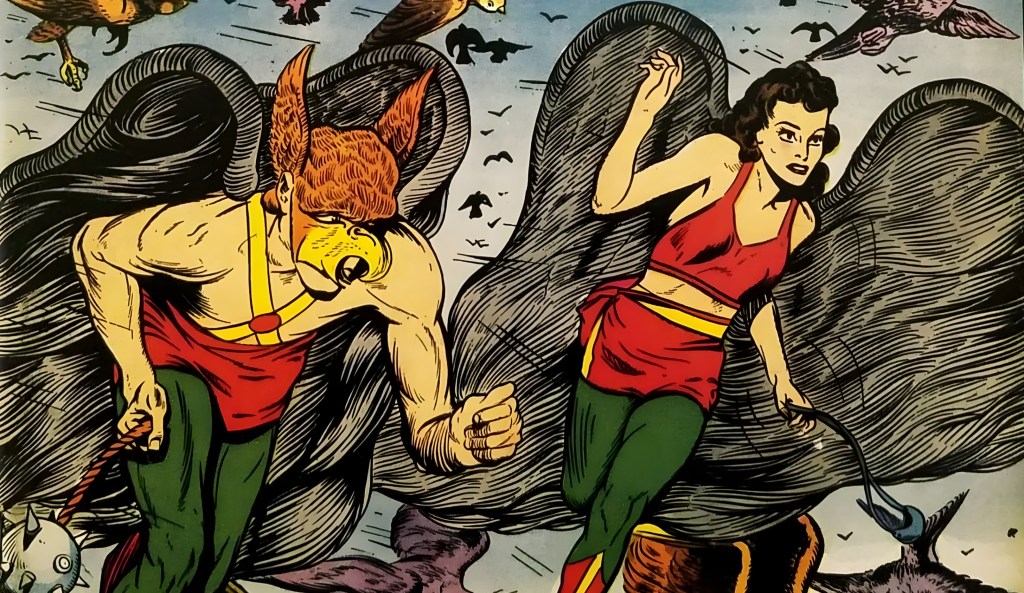
While DC’s “big three” (Superman, Batman, and Wonder Woman) are products of the Golden Age, they transcended the era, evading cancellation at its tail end and evolving to suit a changing medium. If you say “Golden Age” to a DC Comics fan, they’ll instead think of the heroes of the Justice Society, rooted in and defined by the era that spawned them. These characters emerged from the culture and the conventions of the 1940s, embodying the courage and determination of an America in the midst of World War II. After their initial retirement at the decade’s close, a conscious decision was made by subsequent creators to keep these characters frozen in time. Gardner Fox created “Earth-Two” for them to inhabit, and though time passed there and its heroes aged (Earth-Two’s Superman is distinguished by his graying temples, after all), it always felt like the Golden Age never ended. Even Crisis on Infinite Earths did little to change this, collapsing the multiverse but retaining the World War II-era for the heroes of the Justice Society.
Much of this owes to the storytelling, with the origins of Jay Garrick’s Flash, Carter Hall’s Hawkman, and Johnny Thunder feeling distinctly old-fashioned. As written in Flash Comics #1, college student Jay Garrick is experimenting with “hard water” (water with a high mineral concentration, for those of us who didn’t pay attention in science class) when he accidentally gains super-powers from minerals in the water’s vapor combining with the chemicals in the cigarette he is smoking. Ret-cons would change this from “hard water” to “heavy water,” a key component in atomic bomb research. Taking on the identity of “the Flash,” Garrick first dismantles a protection racket operating in his home of New York City, then foils a spy ring that have kidnapped his girlfriend’s army major father. Garrick would headline the Flash until its 1949 cancellation, as well as All-Flash Quarterly from 1941 to 1947. He also appeared in Justice Society stories in All-Star Comics beginning in 1941 and lasting until 1951. After All-Star Comics‘ cancellation, Garrick would not appear again until Gardner Fox’s landmark The Flash #123, when he would team up with his Earth-One successor Barry Allen for the first time.
The Carter Hall iteration of Hawkman drew influence from Universal’s The Mummy with its themes of ancient Egyptian reincarnation. Hall was an archaeologist and the reincarnation of Egyptian Prince Khufu, murdered along with his lover Chay-Ara by jealous priest Hath-Set. When Hall touches the ancient Nth metal dagger Khufu used to kill Khufu, he regains his memories of his past life. Creating the costume and Nth metal anti-gravity belt of “Hawkman,” Hall rescues Chay-Ara’s reincarnation, Shiera Sanders, from Hath-Set’s reincarnation, Anton Hastor. This became the basis for a notorious continuity headache after Crisis on Infinite Earths, which had to square the “reincarnated Egyptian prince” Hawkman with the Silver Age “alien policeman” Hawkman introduced by Gardner Fox in 1961’s Brave and the Bold #34. As well as joining the Flash in founding the Justice Society, Hawkman served with distinction in Roy Thomas’s fan favorite All-Star Squadron, a World War II-set love letter to the Golden Age heroes and villains of DC Comics.
Johnny Thunder is a comparative footnote, but a fondly remembered one among JSA fans. The character is kind of ridiculous, and his origin is laden with poorly-aged Orientalist stereotypes. Johnny is the seventh son of a seventh son, kidnapped by mystics of “Badhnesia” for an occult ritual on his seventh birthday. Instead of bringing power to the Badhnesians, the ritual causes Johnny to gains control of a genie known as the Thunderbolt — though he can’t seem to remember the magic incantation to summon the genie. After years (and twenty issues of Flash Comics) of summoning the Thunderbolt by accident, he discovers that the magic words are “cei-u,” pronounced phonetically exactly the same as the English language phrase “say you.” Like Snapper Carr and the Justice League or Rick Jones and the Avengers, Johnny Thunder was in the right place at the right time, chosen to be the first new member to join the Justice Society in All-Star Comics #6. As a result, the character was revived alongside the rest of the team in Gardner Fox’s Silver Age Justice League-Justice Society team-ups, cementing him as one of DC’s major Golden Age heroes in the eyes of long-time comic fans.
The Nine Decade & Counting Legacy of Flash Comics
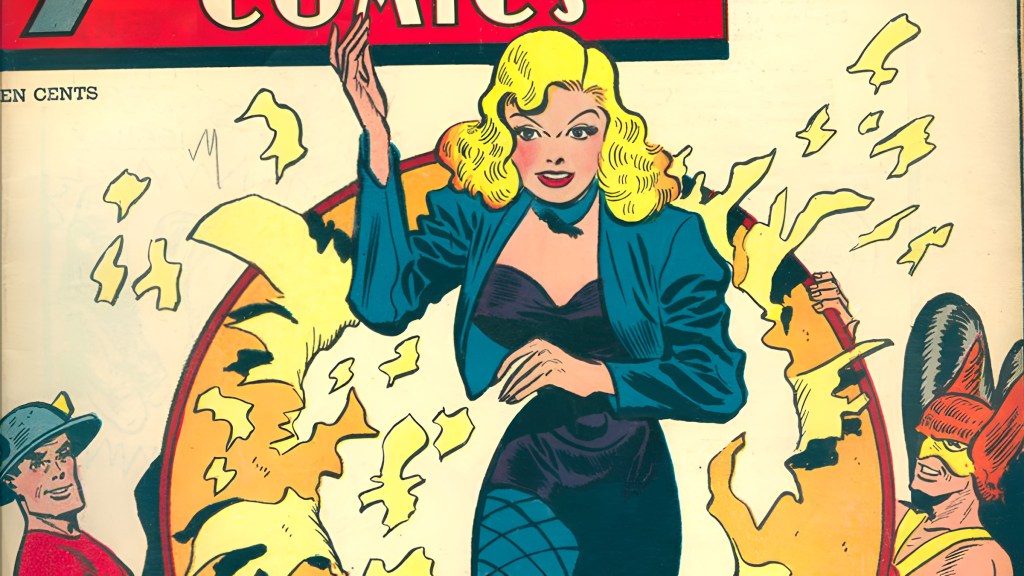
Before the end of its Golden Age hundred-and-four issue run, Flash Comics would spawn one of the era’s other most iconic characters, Black Canary, as well as fan-favorite villains like Gentleman Ghost and the Shade. Retitled “The Flash,” Flash Comics was revived in 1959 as the adventures of the Barry Allen Flash, retaining its original numbering and beginning with issue #105 (also the first appearance of Mirror Master). Jay Garrick would return in his former comic two years later, in the aforementioned Flash #123. Reader response (and sales) were so overwhelmingly positive that, over the next several years, all of the classic Justice Society heroes were revived, many fighting alongside their Silver Age counterparts. Such was the case for Carter Hall’s Hawkman, who switched cowls to avoid visual confusion with the Thanagarian Katar Hol. Annual Justice League-Justice Society team-ups became a tradition, lasting up to the early eighties.
Crisis on Infinite Earths changed this status quo and the Golden Agers’ history, but did nothing to reduce their role in the DC Universe — if not strictly because comic readers wouldn’t have it any other way. These heroes have become firm cult favorite for true DC fans, their old-fashioned heroism a reminder of the genre’s earliest days. If any book were to serve as the emblem of those beginnings, it would be Flash Comics #1. And while the $27k bid on the Flash Comics #1 up for auction through Heritage is a far cry from the eye-watering $234k that the book could sell for, it is still a staggering sum. While the restorations on the book are a negative for many comic collectors, for the fan who does add this copy to their collection, the apparent 8.0 condition brings the book closer to looking as it did in 1940, when a child bought it off the newsstand and for the first time saw the names of characters every kid still knows eighty-six years later. Shy of Action Comics #1 or All-Star Comics #8, it’s difficult to imagine a better book for the centerpiece of one’s collection.
Who’s your favorite Golden Age DC hero? Leave a comment below and join the conversation now in the ComicBook Forum!





Forum Conversation: Favorite piece of Frank Frazetta Artwork
Go to ForumOh there are so many great pieces from Frank Frazetta! I’ve always loved Death Dealer and the Destroyer is another contender.
The Silver Warrior!
Also the Buck Rodger’s covers he did for Famous Funnies.