Spider-Man is one of the most popular superheroes in the entire world, and he especially showed that with the first trailer for Spider-Man: Brand New Day. The first trailer for Spider-Man’s fourth Marvel Cinematic Universe movie finally dropped, and there was something in it for every fan of the Wall-Crawler to love. Peter Parker’s life is in shambles, but Spidey is swinging higher than ever, fighting legends like the Hand and the Punisher. Of course, one of the biggest changes Peter will deal with is the new set of mutations. He’s becoming something much more spider than man, and the first step towards that was developing organic webbing.
Videos by ComicBook.com
Usually, Spider-Man’s webs aren’t a part of his powers. He makes web fluid, which he can launch from special wrist-mounted shooters. However, there have been a few occasions where he created them himself. Most people know this power from Tobey Maguire’s Spider-Man trilogy, but the truth is that these organic webs actually have an origin in the comic books. Today, we’ll briefly look over how he developed those powers, and what this might mean for the MCU’s own mutating Spider-Man.
From Spider-Man to Man-Spider
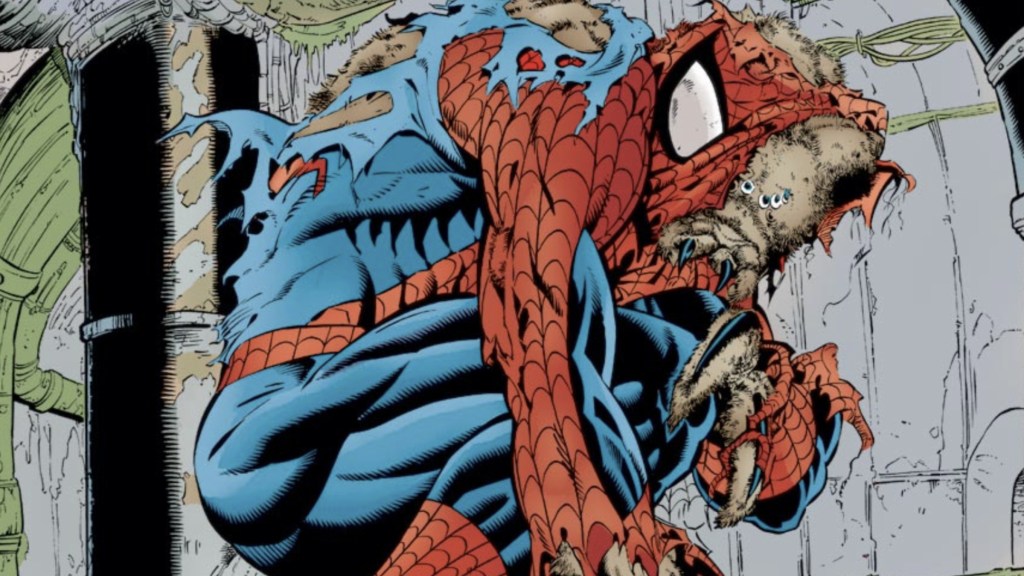
Peter’s journey to gaining organic webbing began when he first encountered the villainous Queen in Spectacular Spider-Man (2003) #15. She was a mutant of the subspecies Homo Insectus and could control any insect or person with that genome. Unfortunately for Spider-Man, he had enough spider in him to count, meaning he fell under Queen’s control. She decided to make him her “perfect” mate and infected him with a mutating enzyme. Over the next several days, Peter changed, gaining more spider-like features like massive hairs and extra eyes. By the end, he had completely transformed into a giant spider.
What Queen hadn’t foreseen, however, was Peter’s body adapting to her changes. Spider-Man died soon after he mutated, but a once-again human Peter burst from his own corpse. He wasn’t completely back to normal, as he developed several new abilities from the ordeal. His Spider-Sense increased to allow empathetic communication with insects and spiders, his strength was buffed, and, of course, he could fire webs straight from his wrists. Given that this was caused by an outside force in the comics, it stands to reason that some event, perhaps a run-in with the Hand, could expose him to something that would kick-start this mutation.
It doesn’t seem like the MCU is taking the Queen approach, but instead using something more sci-fi-based, where Peter’s body rapidly undergoes more mutations until he comes out stronger. The movie will likely also draw inspiration from Spider-Man’s transformation into the monstrous Man-Spider, which has appeared several times in the comics and, famously, in the ‘90s classic Spider-Man: The Animated Series. However Marvel decides to go about this, Spider-Man’s organic webbing will be awesome to see on the big screen again, especially if they take inspiration from how it was done in the comics.
Do you prefer organic webbing or web-shooters? Leave a comment below and join the conversation now in the ComicBook Forum!
Most Viewed
-

Image Courtesy of Crunchyroll -
Image Courtesy of Netflix