After Star Wars became a massive success in 1977, the race was on for the next big sci-fi hit. Universal jumped into the new space race quickly with some assistance from one of the creative forces behind A New Hope. When George Lucas needed someone to create the visual effects for the space battles in his movie, he was pointed in the direction of John Dykstra. Dykstra had a background in industrial design, but had been working in commercials with a solid reputation and developed a remote-controlled camera system at UC Berkeley. He would build the team of artisans and modelers that would create the world of Star Wars for Lucas at Industrial Light & Magic. He would also develop the Dykstraflex camera to film the movie’s pitched space battles on a small scale. The visual effects supervisor would win an Academy Award for the work he and his team did on Episode IV. Less than a year later, another project would call on Dykstra and concept artist Ralph McQuarrie to create visuals for a war between space fighter pilots and robotic enemies. George Lucas wasn’t amused.
Videos by ComicBook.com
Battlestar Galactica premiered on ABC on September 17th, 1978. Created by Glen A. Larson, the series followed a fleet of human survivors searching for Earth after robots called Cylons destroy their homeworlds. The fleet was protected by the starship Battlestar Galactica and its wing of Viper pilots including Apollo, Starbuck, and Boomer. Its three-hour premiere was estimated to have cost between seven and eight million dollars. The broadcast was interrupted by the signing of the Camp David Accords, but ABC resumed airing the episode once the ceremony was over. Over 65 million people watched the premiere. But before a single person had seen a frame, the show was already in legal trouble.
“The Battle of the Galaxies”
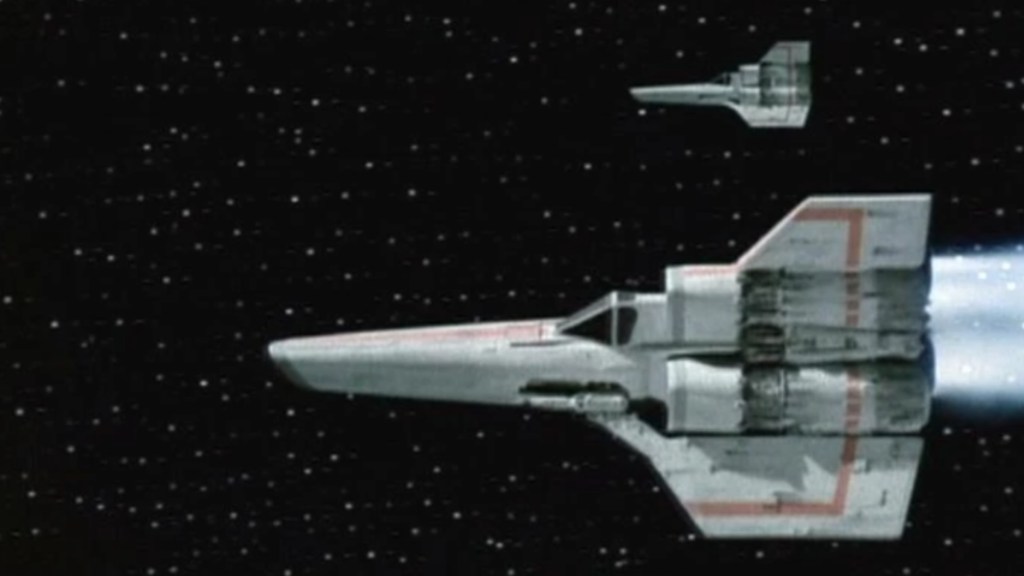
In June of 1978, 20th Century Fox and Lucasfilm filed a lawsuit against Universal. Declared “The Battle of the Galaxies” by Hollywood trades, the suit alleged that Battlestar Galactica infringed the copyright of Star Wars by replicating its narrative structure, character archetypes, and visual aesthetics. Fox and Lucasfilm detailed 34 similarities including the show’s original working title, Star Worlds. The suit also claimed that the show copied Lucas’s servant droids and the storyline that a rebel fleet fought a battle against a totalitarian regime.
Universal didn’t flinch when it countersued, arguing that Star Wars borrowed heavily from earlier science-fiction projects. The company cited its own 1972 film Silent Running as an inspiration for Star Wars‘ droids, a film that John Dykstra had also worked on. Universal also owned the rights to the Buck Rogers serials, a known inspiration for Lucas when he wrote the script. A judge initially dismissed the copyright claims, but an appeals court revived it in 1983, after the show had already ended. Universal and Fox eventually settled the matter out of court, though we would have loved to see a judge weigh in on the merits of pastiche.
Separate from the copyright suit, George Lucas had beef with John Dykstra. After Star Wars wrapped, Dykstra and several members of the ILM team remained in Van Nuys and formed a new effects company called Apogee. When the team began working on Battlestar Galactica using the same equipment that Dykstra had helped create for Star Wars, Lucas objected. In his mind, the equipment was ILM property. The equipment was returned and Lucas set about building a new team at ILM to begin work on The Empire Strikes Back, leaving Dykstra in the cold.
Battlestar Galactica was More Than a Knock-Off

The studio may have been sued because Galactica had similarities to Star Wars, but it also had an identity of its own. The show was released on the heels of the Vietnam War and featured a story of displaced people searching for a new home after losing their way of life. The series had deep layers of lore involving the robotic Cylons and the twelve colonies rooted in creator Glen A. Larson’s own religious experience. The series didn’t get too dark though, as its often campy tone kept the proceedings family friendly. The show even had a pet sidekick, Muffit the robot dog. Muffit was actually played by a chimpanzee in a suit. Like we said, the show had layers.
Galactica would return in a darker and more serious reimagining from Ronald D. Moore in 2003. The reboot peeled back many of the show’s goofier layers to present a complicated fable about humanity, its legacy, and the fallout when those two things are at odds. The show would bring George Lucas’s dream of dogfights in space full circle with its stylized space battles between Viper pilots and Cylon Raiders. At its core, the show was about an aircraft carrier and its fighter pilots, and Moore’s production made sure it had the fire fights to match.
While Lucas and Dykstra do not appear to have publicly reconciled, Dykstra’s part in creating Star Wars has gotten greater recognition over time. The Disney+ documentary Light & Magic includes both men addressing the difficult production and their disagreements. It also places Dykstra and the ILM team at the center of the effects breakthroughs that made the movie possible. Lucas publicly credited Dykstra’s contributions, while Lucasfilm has preserved the name of the Dykstraflex camera system in its archives. The dispute over Battlestar Galactica tried to determine who could make a space opera. If only they had known there was no space fat lady, and the era of Starwarsploitation had only just begun.
More TV Shows
-
Image Courtesy of Marvel Comics -

Image Courtesy of Prime Video -

Courtesy of Cartoon Network -
Image courtesy of Paramount Television