On November 10th, 1969, Sesame Street introduced an idea that transformed television’s biggest problem into an opportunity. Kids learned advertising jingles before they could read, and television kept them glued to the screen. So producers Joan Ganz Cooney and Lloyd Morrisett asked why not use those same techniques to teach kids something useful. Rather than fighting television’s addictive allure, they chose to exploit it. It’s been 57 years, and Sesame Street is still one of television’s greatest experiments.
Videos by ComicBook.com
The idea started in 1966 with Cooney and Morrisett talking about the educational possibilities of television. Morrisett had noticed how easily his young daughter remembered advertising jingles. If commercials could teach children to remember a product, why couldn’t a television show teach them letters and numbers? With help from the Carnegie Corporation, the Ford Foundation, and the federal government, in 1968 they created the Children’s Television Workshop. Their series, which mixed education with entertainment, was particularly aimed at preparing disadvantaged children for school. The birth of the experiment is explored in the 2021 documentary Street Gang: How We Got to Sesame Street.
The original Sesame Street looked like a real city neighborhood, complete with apartment buildings, a corner store, and a familiar stoop. The cast of humans included Matt Robinson as Gordon, Loretta Long as Susan, Bob McGrath as Bob, and Will Lee as Mr. Hooper. Audiences responded positively to seeing a multicultural cast represented positively on TV. Children learned their ABCs, but also about friendship, cooperation, and people with different lives than theirs.
Jim Henson Helped Bring Sesame Street to Life
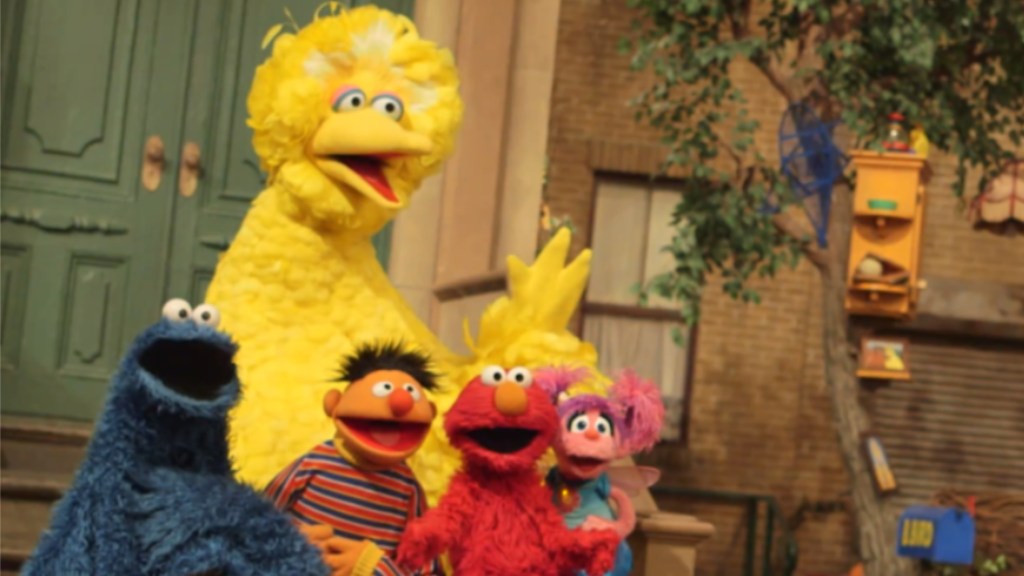
The Muppets of Jim Henson were critical to the show’s success because they were already television veterans. In 1955, Henson was showing off his creations on Sam and Friends including an early Kermit the Frog. Rowlf the Dog was a regular fixture on The Jimmy Dean Show. But Sesame Street gave us Bert and Ernie, Cookie Monster, Oscar the Grouch, and Big Bird. Henson voiced Ernie and Kermit, while Frank Oz voiced Bert and Cookie Monster. Kermit frequently appeared as a television reporter, interviewing fairy-tale characters and the more unpredictable residents of the neighborhood. Big Bird was one of the show’s most loved characters, voiced by puppeteer Caroll Spinney, who also did Oscar. Big Bird was originally thought to be a silly, dumb bumpkin, but he became a curious six-year-old who learns with the viewer. I Am Big Bird: The Caroll Spinney Story gives a fantastic look at Spinney’s career and contributions to Sesame Street.
Sesame Street has featured celebrity guests since the beginning. Carol Burnett showed up in the premiere, and James Earl Jones gave an alphabet lesson in an early episode. Hollywood stars have been regular visitors over the decades. Hugh Jackman taught focus, Ryan Reynolds dressed as the letter A for an A-Team parody, and Mark Ruffalo explained empathy. Henry Cavill joined Elmo for a lesson in respect, and Ryan Gosling appeared with Elmo in 2026. David Corenswet and Rachel Brosnahan taught Elmo that you don’t need superpowers to be a hero.
Sesame Street Became the Very Thing It Was Created to Challenge

By the 1990s, Sesame Street was a merchandising juggernaut. Elmo, who became a massive commercial phenomenon after Kevin Clash took over the character in the 1980s, became the Tickle Me Elmo doll. The toy created a shopping frenzy across the country in 1996 as parents scrambled to find the laughing doll before Christmas. One of the most wanted toys in America was the product of a show created to fight the influence of advertising on children. Of course, the Children’s Television Workshop employees need to eat, and licensing provided revenue to support its educational mission. The economics of television also changed. Sesame Street reached a deal with HBO in 2015 to air first-run episodes on the premium network before PBS. Later the series moved to HBO Max before Netflix became its streaming partner in 2025. New episodes are available for free on PBS KIDS.
Fifty-seven years later, Sesame Street has survived changing audiences, technology, and the business of television. Its characters became celebrities, its merchandise made huge revenues, and its home evolved from just public broadcasting to the world’s biggest streamer. But the original idea remains a simple one. If television could teach kids to memorize commercials, surely it could teach them their ABCs.
Who’s your favorite celebrity guest star on Sesame Street? Let us know in the comments below.
More TV Shows
-

Image Courtesy of Disney -
Image Courtesy of UGT / Fuzzy Door / MRC -
Image Courtesy of UGT / Fuzzy Door / MRC