The passing of Sir Patrick Stewart in October has left a void in our hearts bigger than the Delta Quadrant, giving Trekkies and Trekkers alike a mourning period that will feel worse than Voyager’s “Year of Hell.” Stewart left behind a powerful legacy of work that ranged across multiple decades, a catalog of films that audiences will surely enjoy for generations to come. But to those who grew up during the era of Star Trek: The Next Generation, he will always be Jean Luc Picard.
Videos by ComicBook.com
Picard was known for his diplomatic skills and sagacious handling of conflicts through words instead of photon torpedoes (although he wasn’t opposed to getting his hands dirty when necessary). He was a character that inspired many people in real life, showing them how a leader should sound and act — a person that leads by example and not by force. In honor of this Starfleet Admiral and the person behind the pips, we have a suggested viewing list of selected TNG episodes that are not only Picard’s finest moments, but also Stewart’s greatest performances aboard the USS Enterprise.
7) The Drumhead
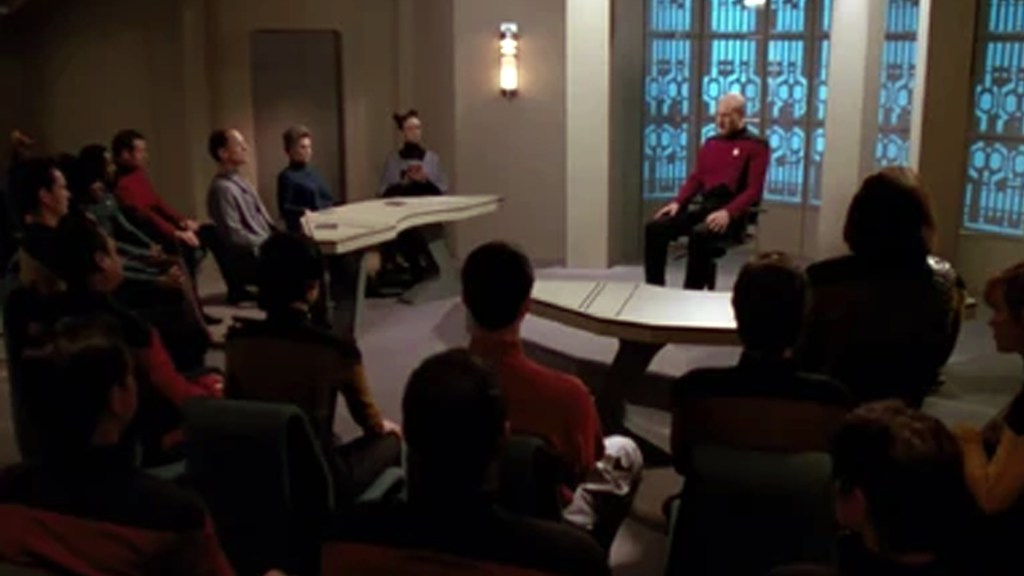
Star Trek has always been political, and “The Drumhead” is an outstanding example of how it addressed a topic that remains relevant even today. Taking a page out of Arthur Miller’s The Crucible, “The Drumhead” pits Captain Picard against Starfleet’s legal brass to defend his crew in the midst of a figurative witch hunt. Stewart is matched onscreen by Jean Simmons, an Academy Award nominee and Golden Globe winner who plays Picard’s adversarial counsel Admiral Satie. Consumed by paranoia and desire to dispense with swift justice, her ice-cold presence and calculating words push Picard on his backfoot throughout the episode, offering him a scene partner who uses a cross-examination as effectively as a phaser.
Stewart delivers some great lines in this one, and his monologue when he is put on the stand is just as impactful today as it was over 30 years ago. These lines should be taught in law school, especially Picard’s quote when he says, “With the first link, the chain is forged. The first speech censured, the first thought forbidden, the first freedom denied, chains us all irrevocably.” Equally important is how this episode concludes, with Picard reminding Worf to beware of the enemy within, “villains who twirl their moustaches are easy to spot. Those who clothe themselves in good deeds are well camouflaged.” If you enjoyed this episode, we also recommend “Measure of A Man,” where Picard fights to prove Data is a sentient being with rights and not merely the property of Starfleet.
6) Starship Mine
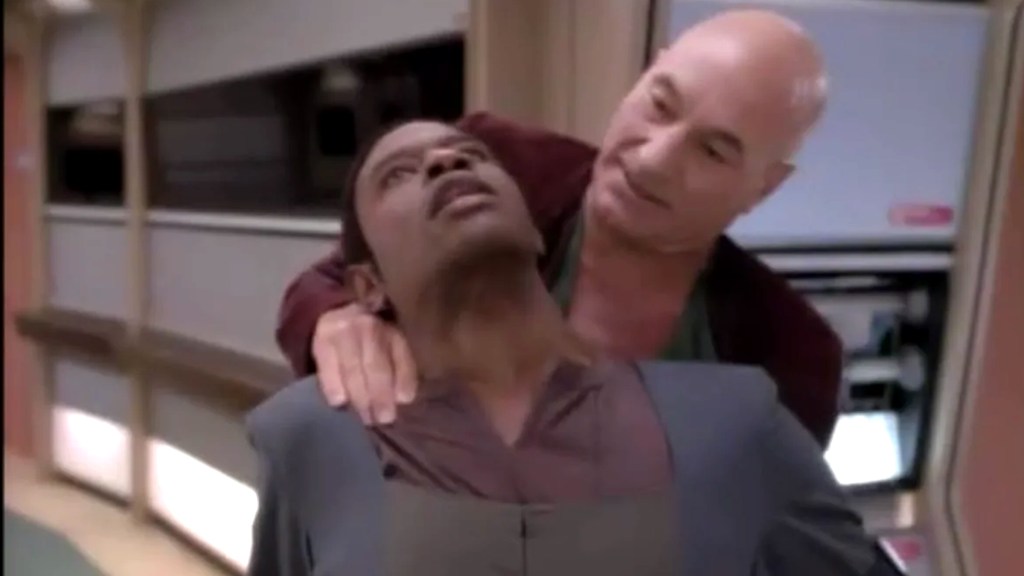
“Starship Mine” answers the question of what Die Hard would look like if it was onboard a spaceship, with Picard taking on the role of action hero. The Enterprise is scheduled for a routine decontamination, which requires the entire crew to evacuate for their safety. Picard returns to the ship to retrieve his riding saddle only to be confronted by a mercenary who is part of a team attempting to steal trilithium resin from the starship. Unarmed and alone, Picard must outwit, outmaneuver and outmatch these soldiers of fortune to protect his home in the stars.
This episode shows what a badass Picard can be, something the character wasn’t often allowed to be. Through his defense of the ship, we learn that Picard is a clever tactician in close quarters combat, a master of the Vulcan nerve pinch (doing it to Tim Russ who would later become one on Voyager), an accurate archer, and knowledgeable in every Jeffries tube that ship holds. However, one of the most memorable parts of this episode isn’t the action, but a quiet moment between Picard and his ship. After the crew has disembarked ahead of the cleaning, Picard leaves his ready room and takes a solitary stroll around his bridge one last time. It’s a touching scene because the Enterprise means so much to Picard, but it’s difficult not to watch it through the perspective of seeing Stewart say goodbye to his ship while we say goodbye to him.
5) Darmok
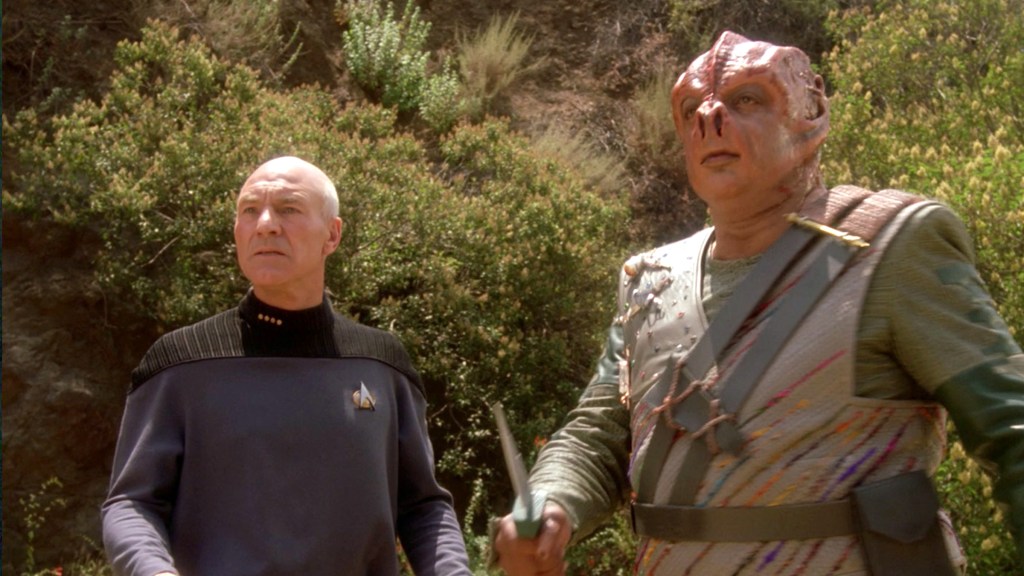
If you understand “Darmok and Jalad at Tanagra” and know how to respond, you are a true Star Trek fan. Aside from its lasting effect as a meme-worthy statement, “Darmok” is a showcase of Picard’s diplomacy and sense of command. Absconded from his ship to an unfamiliar world alongside the leader of an alien species who speaks in a very unconventional way, Picard is forced to learn how to communicate and gain his trust while also defend themselves from the beasts that stalk the planet’s surface.
Picard spends the majority of the episode on this strange new world with Dathon, leader of the Tamarians played by veteran actor Paul Winfield. What makes it so fascinating to watch is how much drama is played out despite neither character understanding each other until the third act. This isn’t an easy task, but Stewart and Winfield make it look effortless. Their onscreen rapport is unmistakeable, and the storytelling is top notch, delivering a combination of action and emotion that makes this stand out not just because it is quotable, but also because it’s an excellent episode that show Trek — and Stewart —at its best.
4) Tapestry
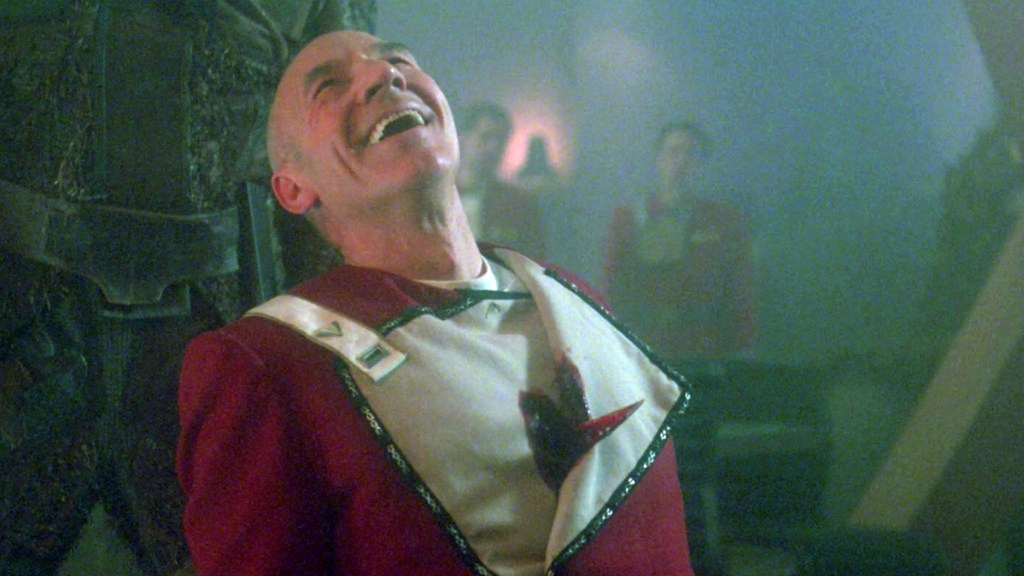
There was no way we could write a list like this and not have a Q episode as part of it. “Tapestry” is a Star Trek What-If episode that asks what would happen if Picard changed one moment from his life that could affect the remainder of it. In this case, it’s a fight over a game of Dom-Jot against a Nausicaan who stabs Picard in the heart, and ultimately sets him on a course for the center seat on board the Enterprise. After dying in an altercation, Q offers Picard a second chance to have no regrets in his life, showing him what a world would look like if he avoided the tussle. The Butterfly Effect reveals that dodging this brawl led Picard to be timid and safe, never taking the same risks that would one day make him a bold captain.
Of course, the timeline is corrected and Picard learns a valuable lesson, but the big story here is seeing a side of Jean-Luc before he’s the stuffy diplomat. During the first season of the show, Stewart was known for taking his role extremely seriously, even scolding his fellow cast members for cracking jokes on set. By the end of the series, Stewart was notorious for breaking the most during scenes and actually encouraging pranks and laughter while filming. “Tapestry” shows what happens when we pull on loose threads of our past, and Picard helps us to live without regret over things we can’t change that shaped the people we became years later.
3) The Inner Light
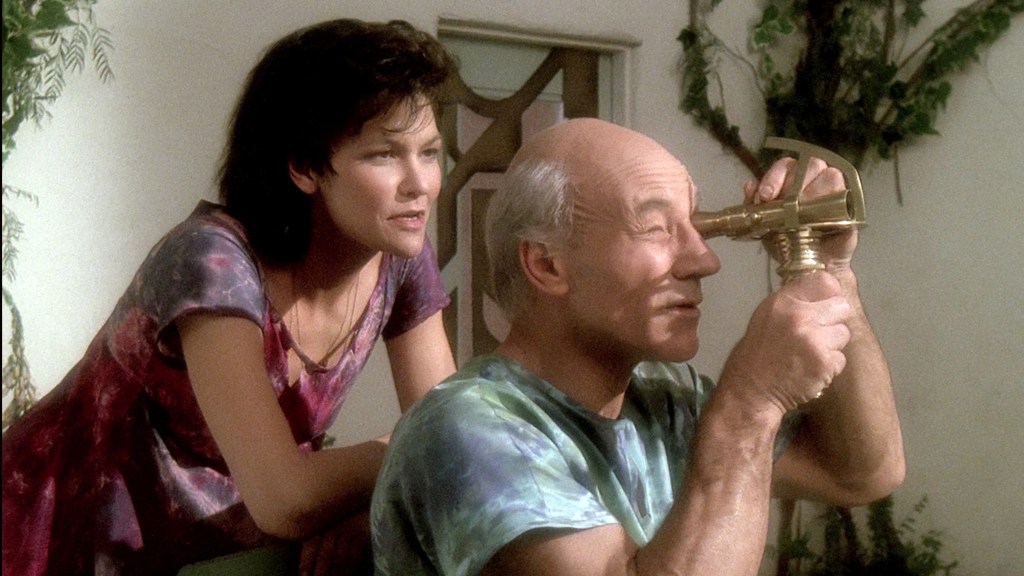
Many fans call “The Inner Light” one of the best episodes of Star Trek TNG, and rank it equally high across the 60 years of the show’s overall history. After being zapped by an alien probe, Picard’s consciousness is transported to the planet Kataan, where he becomes a villager named Kamin. While the Enterprise tries to revive their incapacitated Captain, Picard lives a second life as this quaint person, shouldering the burden of a world that has been gone for a thousand years but now has a new person to tell their cautionary tale.
This out-of-body experience gives Picard a new perspective, living an entire lifetime in 20 minutes. He has friends, a family, and a community to rally behind — not too dissimilar to what he has with Starfleet, but in a more grounded way seen through the eyes of a person who has something very different than Picard has ever experienced. It’s a beautiful episode that will always be considered one of the preeminent episodes of Trek, and allows Stewart to play a character fundamentally distinct from who he had been for the past four seasons. It also taught Picard how to play the flute, an instrument he somehow kept from his dream… but we don’t talk about that.
2) Family
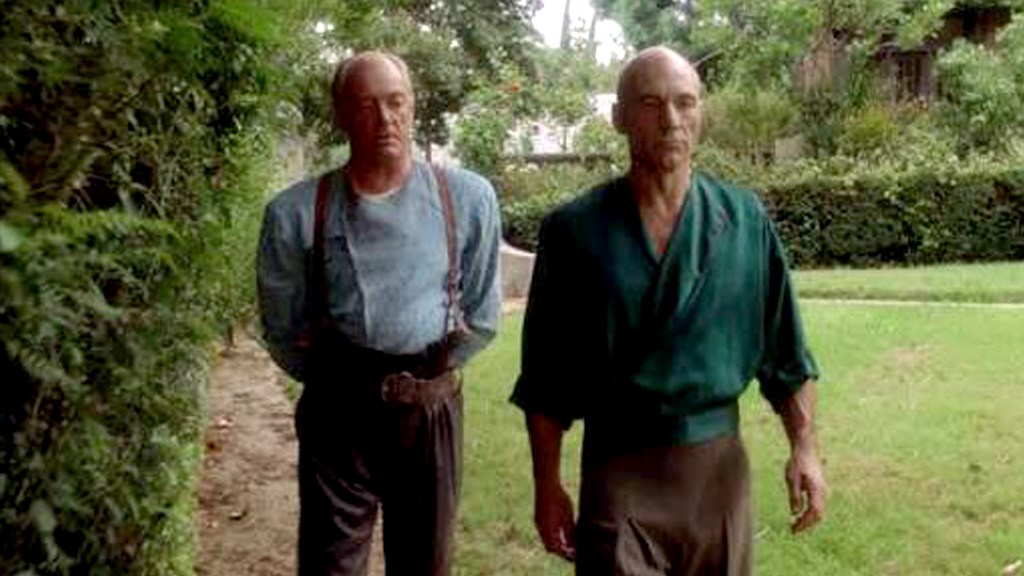
This might not be at the top of many lists for Best TNG episodes, but it is when we’re discussing the acting prowess of Patrick Stewart. Two episodes earlier, Picard was assimilated by the Borg and became their spokesperson, wreaking havoc on Starfleet during their battle at Wolf 359. Although Picard was successfully dissimilated after he was rescued by the Enterprise, the pain and suffering he caused while in his altered state remained. “Family” is Picard’s brief time away from his ship and crew, reluctantly returning to his family’s home and vineyard in France to heal.
Instead, he is met by his antagonistic older brother Robert (played by Jeremy Kemp), who pokes and prods him with sharp comments at every opportunity. The verbal jabs escalate into a muddy fist-fight that finally breaks Picard, opening up the floodgates to let loose the emotional trauma he has kept within after his time with the Borg. This was the most vulnerable we had ever seen Picard in TNG’s history, shedding the indestructible facade of a Starfleet captain to remind us of the human under the uniform. At first glance it seems like a throwaway episode, but “Family” is a powerful story that is vital to the development of Picard (as well as the others highlighted in the B-plots), and a chance for Stewart to shine in a way he never did before as this character.
1) Chain of Command
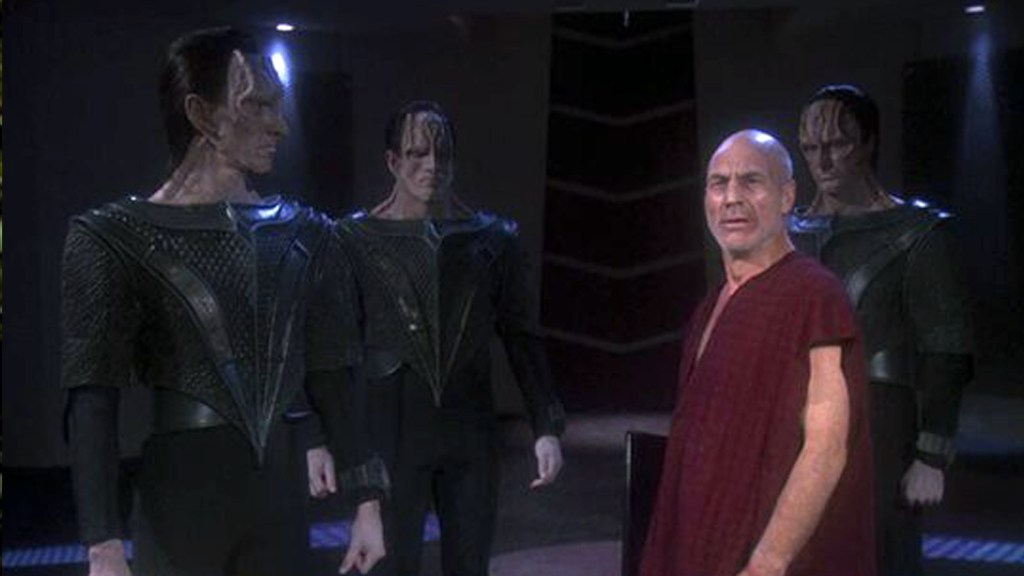
“Chain of Command” is among the most unsettling pair of TNG episodes to watch. The first episode of this two-parter concerns the unexpected change in command between Picard and Captain Jellico (Ronny Cox) so Picard can prepare for his secret commando raid with Worf and Dr. Crusher in Cardassian territory. The mission goes FUBAR and Picard is captured by Gul Madred (David Warner), who spends the following episode torturing him. The second part is watching these masters at work, with Stewart and Warner pouring every ounce of their classical training into their two-man show. Sure, there is stuff happening on the Enterprise but none of it compares to Gul Madred’s ruthless inquisition of Picard.
If “Family” was Picard at his most emotionally vulnerable, “Chain of Command” is Picard completely and utterly defenseless. He is exposed – literally and figuratively – as Gul Madred hammers him with questions, attempting to gaslight Picard into total submission in a scene that mirrors parts of George Orwell’s Nineteen Eighty-Four. Off-screen, much time was spent learning about the psychology of torture to make it as authentic as possible. Stewart pushed for this, demanding it be as intense as possible so he could give the best possible performance.
“Chain of Command” is a testament to the craftsmanship that Stewart had as an actor, giving us a taste of Shakespeare in space by taking away all of the power Picard had and stripping him to his most raw elements. By the end, Picard is changed forever in a fashion that may have been just as damaging to him if not moreso than his time as Locutus, yet he persists through resilience and finds a way to move forward. It’s one of the reasons we love Picard so much, and we have Patrick Stewart to thank for giving us that lesson and so many others.
What’s your favorite Captain Picard moment? Let us know in the comments.
More TV Shows
-

Image Courtesy of Disney -

Image Courtesy of UGT / Fuzzy Door / MRC