I’m going to admit something publicly that I’m not sure I’ve ever told another living soul: I’ve never played Assassin’s Creed IV: Black Flag. Shameful, I know. As a professional games journalist, one would imagine that I would have played the game that practically everyone considers the greatest in the series. Yet here I am, completely unaware of who Edward Kenway is, why he is so beloved, and what’s up with all the pirate shenanigans. Of course, I have a basic understanding of why the critically acclaimed action-adventure title is so beloved, but I have yet to dip my toe in its shimmering blue waters.
Videos by ComicBook.com
There is good reason for that, naturally. I have played my fair share of Ubisoft’s historical romps, and, perhaps a tad blasphemously, believe that Unity is the greatest Assassin’s Creed title, although that is perhaps better left for another article. However, something about the older titles, Black Flag specifically, prevented me from truly getting stuck into the series as a whole. Indeed, one of the biggest issues with the original Black Flag was its penchant for tailing missions, a series of inane quests that even Ubisoft seems to have recognized were terrible. Fortunately, Black Flag Resynced appears to have addressed this issue alongside my other big issue with the supposed best Assassin’s Creed game.
Assassin’s Creed Black Flag’s Terrible Tailing Missions Have Been Fixed
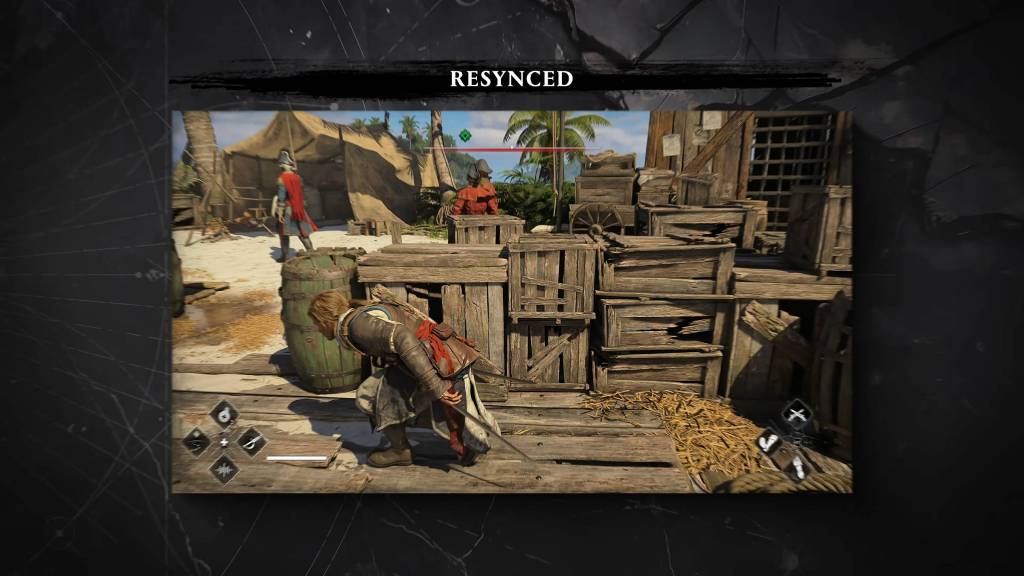
Infamously, Assassin’s Creed IV: Black Flag was peppered with asinine tailing missions that had you slowly follow a target while attempting to eavesdrop on conversations. This is a staple of the AC franchise, or at least it certainly was commonplace in the earlier games, and was largely presented as it appeared in Black Flag in every other entry. However, where Black Flag flailed was in both its instance on putting them absolutely everywhere, and its implementation of them. Should you be caught in your tailing efforts, you desynced and had to start all over again. Naturally, this proved somewhat frustrating, especially considering the enemy AI could be, at times, unpredictable, as too could Edward’s movements when traversing the busy streets.
These tailing missions are, thankfully, one of the many features Black Flag Resynced fixes. Indeed, Ubisoft itself even pokes fun at the mechanic’s rather inconsistent implementation in the gameplay overview trailer for Black Flag’s remake. Crucially, these tailing missions were one of the biggest detractors preventing me from getting invested in Assassin’s Creed Black Flag. After having learned of their existence and their prevalence as a gameplay mechanic, I was rather put off. I’m not a fan of instant fail missions, quests you have to restart because of a mere fumble, especially when, in context, it would make no sense for your character to have simply failed. Resynced’s solution of allowing you to continue fighting should you be caught is logical and a huge reassurance that this style of old-school game design has been well and truly ironed out.
Additionally, Assassin’s Creed Black Flag Resynced has addressed the game’s rather awful melee combat, an issue that plagued even my favorite AC game, Unity. The series’ original approach to combat was stiff and painfully arduous, resulting in combat affairs that took too long and ultimately felt unnatural. Resynced’s approach not only appears to make combat far more fluid and energetic, but infinitely more complex, with Edward’s skill set feeling significantly more fleshed out. While I appreciate Black Flag’s naval battles are the core highlight of the action gameplay loop, it is reassuring to learn that when on the ground, I won’t have to endure more of Assassin’s Creed’s outdated and frankly abysmal combat.
Resynced May Finally Be My Opportunity To Play Assassin’s Creed Black Flag
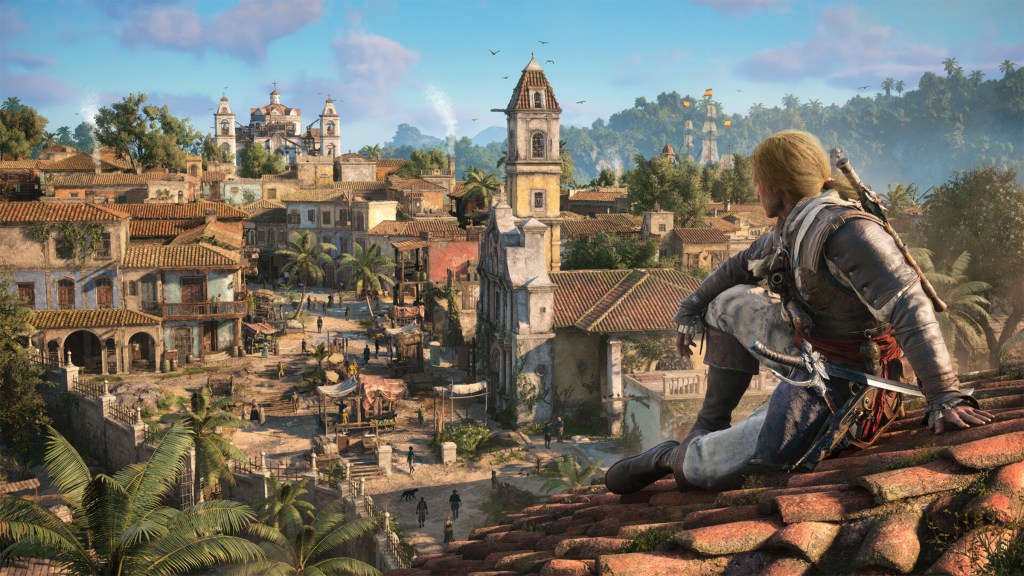
I mention all of this because a lot of what Assassin’s Creed IV: Black Flag did beyond these frustrating design flaws is apparently phenomenal. Many praise its narrative as being one of the strongest, Edward for being its most compelling protagonist, and its naval battles as being some of the most thrilling in all of gaming. I wanted to experience all of that for myself, but this barely 13-year-old game with its outdated design was getting in the way of itself. Yet, admittedly, had you asked me a day prior to the official unveiling of Resynced whether or not I’d be bothered in a remake of Black Flag, I’d have likely shrugged with apathy.
That’s because I’m not particularly fond of the industry’s penchant for remakes, not least because it mirrors the inane, financially motivated remakes of recent animated films from companies like Disney. It has always been my firm belief that remakes take resources from the production of new IP, and, inherently, feel like cash grabs disguised as nostalgia-bait. Crucially, I also believe that the industry is not nearly old enough for remakes to be as popular or frequent as they are. However, what I have always failed to take into account is that, unlike those aforementioned movies, games have aged rather poorly. The speed at which the technology powering our games has evolved is remarkable and a double-edged sword, one that we can’t help but marvel at and appreciate, but that also depreciates games less than a decade old.

13 years in video game development is a rather long time, and a lot has changed, even within the Assassin’s Creed series and formula. Ubisoft has evolved tremendously as a developer, and many of its more infamous mechanics have been removed in favor of clever game design. Yet, its older games still held plenty of value, specifically in areas that aren’t technologically driven, but rather ideologically or creatively. These aspects still deserve to shine, but, unlike with film, are hampered by fundamental features that become unbearable to sit through or feel simply inaccessible to a modern audience. So, remakes clearly have value in the gaming industry when implemented correctly and, like in the case of Black Flag Resynced, actually implement fan-requested features.
It will be nice to have access to a version of Black Flag that retains a lot of what it got right the first time around, but caters to our modern sensibilities. I hope fans of the original are as pleased with Ubisoft’s efforts as I am and see this remake as a positive thing, as, while certainly a fraction of its target audience, one would hope those who suffered through those aforementioned tailing missions will be best served. Of course, I’m intrigued to see how long it takes before we feel as if Assassin’s Creed Black Flag Resynced requires a remake, but that is an article for another time. For now, Edward Kenway’s adventures are finally ready to be enjoyed without all the complications of outdated design.
What do you think of Assassin’s Creed Black Flag Resynced’s changes? Leave a comment below and join the conversation now in the ComicBook Forum!
More Gaming
-

Courtesy of Saber Interactive -
Image Courtesy of Electronic Arts/Secret Mode