Joe Dante’s Piranha came in 1978 at the height of the Jaws fever, when every studio tried to satiate the audience’s sudden interest in tidal terrors. Produced by Roger Corman with a script by John Sayles, the movie follows a batch of genetically engineered killer fish that a botched military project accidentally releases into a resort lake, leading to mayhem. While the premise allowed director Joe Dante to craft some gruesome creature-feature kills, Piranha also offered a pointed satire of Cold War-era military recklessness, which explains its longevity. Nearly two decades later, a 1995 television remake, also produced by Corman, failed to charm both critics and the audience. It would take another 15 years for director Alexandre Aja to take his shot at Piranha 3D, a second remake that understood the appeal of the original and updated the spectacle for a new generation.
Videos by ComicBook.com
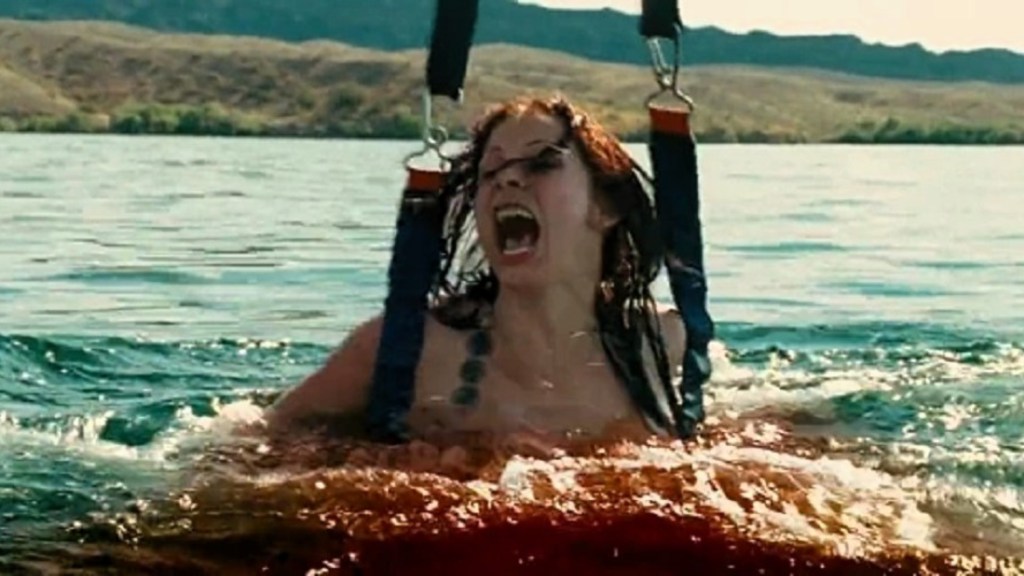
Released on August 20, 2010, exactly 16 years ago today, Piranha 3D arrived at the peak of the post-Avatar 3D boom, fully embracing the gimmick. The story relocates the carnage to Lake Victoria, Arizona, where an underwater tremor unleashes prehistoric piranhas on a massive spring break party. Elisabeth Shue leads the cast as the town sheriff, alongside Adam Scott, Jerry O’Connell, Ving Rhames, Jessica Szohr, Steven R. McQueen, Christopher Lloyd, and a memorable Richard Dreyfuss cameo that nods directly to Jaws. Made for a reported $24 million, Piranha 3D grossed over $83 million worldwide — a solid hit, even if not a blockbuster. On top of that, critics were surprisingly receptive, with the film holding a 76% fresh rating on Rotten Tomatoes and earning praise for its self-aware blend of gore and dark comedy. Those numbers were enough for Piranha 3D to briefly revive the franchise, leading to 2012’s much-maligned Piranha 3DD.
Piranha 3D Understood What Made the Original a Cult Classic
Piranha received a lukewarm reception when it opened in the summer of 1978, treated as one more cheap Jaws knockoff in a year full of them. The film’s reputation improved considerably over the following decades, as Dante’s later films, especially The Howling and Gremlins, made his subversive instincts harder to ignore. Viewers who returned to Piranha found that Dante and Sayles had smuggled a lot of social commentary into a movie with lewd jokes and gore, with the film’s actual villains being military scientists, government officials, and business owners who value secrecy and profit over public safety. That satirical undercurrent gave the movie a personality that most Jaws knockoffs lacked and helped it build a cult following through VHS and cable.
The 1995 television remake, directed by Scott P. Levy for Showtime, showed exactly how interesting the original version was, by comparison. Levy’s Piranha reuses the same script and structure of Dante’s movie, but plays the story as a straight survival thriller. That means the military satire disappears and the humor is almost nonexistent. 1995’s Piranha is not aggressively bad, and one could even call it competent. However, without the satire, it is just a forgettable monster movie with no larger point behind it.

Aja understood that a great remake respects the spirit of the original, even if it has to make changes to the story structure. That’s why his 2010 version restores the comedy and updates the satire for a different cultural moment. The setting is a spring break party at Lake Havasu, and the film aims at exploitative reality television and Hollywood’s sleazy video producers, while also satirizing how US party culture treats excess as entertainment. For instance, O’Connell’s character, a Girls Gone Wild-style filmmaker, is the modern equivalent of the greedy resort owner from the original. The movie mocks him, then dispatches him in one of the most memorable kills in 2010s horror.
Don’t get me wrong, Piranha 3D is absolutely gory and brutal, but the fact that it’s willing to laugh about itself and the stupid stereotyped people it throws in the water makes the experience better. Aja had already proven his horror credentials with the French production High Tension and his mind-blowing remake of The Hills Have Eyes, and he would later direct Crawl, a fan-favorite creature feature. He already was a confident filmmaker, and used that to turn Piranha 3D into a fun thrill ride that has aged surprisingly well, with one glaring exception.
It’s Almost Impossible to Watch Piranha 3D As Intended
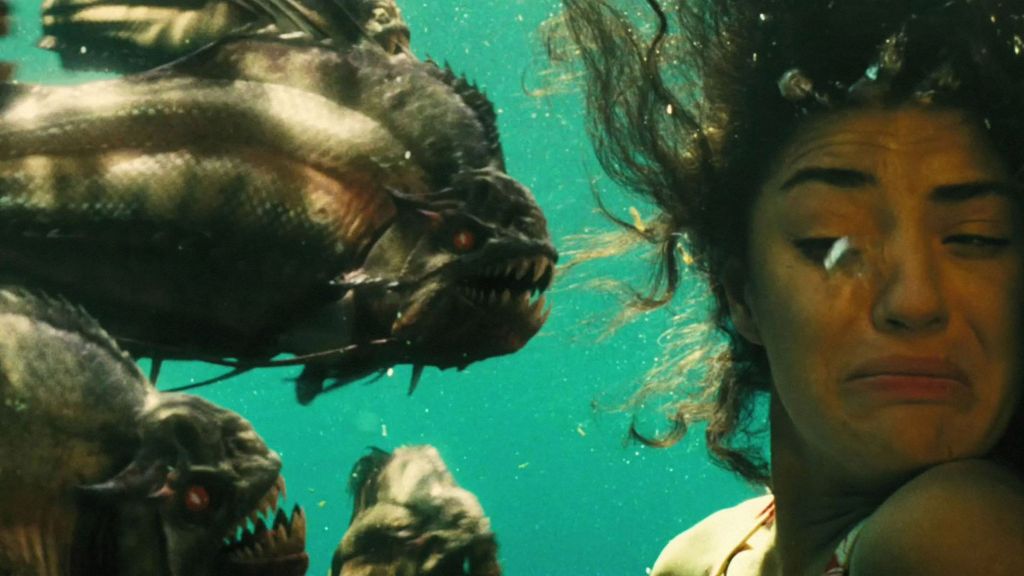
Aja shot Piranha 3D in conventional 2D and converted it to stereoscopic 3D during post-production, a technique still uncommon among major studio releases in 2010 but which let the crew plan gags around the added depth with specific elements and frames. Watching Piranha 3D in cinema was a memorable experience, but the movie would suddenly throw a fish in your face or push a severed limb into the theater. There were also gruesome moments where bodies were devoured in the foreground, right before your eyes. In the 2D format, the movie still works, but the added gore and humor are lost. Sadly, few people can still watch Piranha 3D as intended.
Samsung, LG, Sony, and Panasonic all stopped producing 3D-capable televisions by around 2017, after the 3D fad had faded. Theatrical 3D bookings have also declined, now limited mostly to major franchise releases willing to cover the added production cost, with very few reruns of older movies. A 3D Blu-ray edition of the film exists, but watching it requires both a compatible player and a compatible television, equipment most households replaced years ago in favor of 4K sets. Of course, the 3D Blu-ray of Piranha 3D went out of print, and used copies now sell at inflated prices for a format most people cannot play. Finally, every streaming platform currently offering Piranha 3D, including Tubi, provides only the regular 2D version. For the time being, you either have deep pockets or you resign yourself to watching the lesser version of Piranha 3D. Lucky us who managed to be there when it hit theaters.
More Movies
-

Courtesy of Columbia Pictures