Spoilers for Clayface follow.
Videos by ComicBook.com
Batman’s presence, or lack thereof, in Clayface has been one of the biggest talking points about the DC Universe horror movie throughout its production. Now that the film is out, viewers know that although much of the movie takes place in Gotham City and the titular character, also known as Matt Hagen (Tom Rhys Harries,) becomes one of the Dark Knight’s famous supervillains, no version of Batman actually appears in the movie, nor is one directly referenced. That being said, the influence of a famous Clayface storyline from Batman’s most beloved TV show is still apparent throughout the film.
The early version of Clayface’s script that got the film greenlit was written by modern horror guru Mike Flanagan, who had been exploring making a film focused on the character since before the independent DC Studios and its shared cinematic universe were announced. Flanagan has frequently noted how he was inspired by “Feat of Clay” the two-part episode of Batman: The Animated Series that introduced Hagen (voiced by Ron Perlman,) to the DC Animated Universe. Flanagan’s busy schedule prevented him from directing the film as he originally hoped to, and after James Watkins was selected to helm the film his past collaborator Hossein Amini was hired to make revisions to the script. Despite this, the film ultimately still echoes “Feat of Clay” throughout, with the ending following the episodes’ conclusion especially closely, though one could argue the earlier version of the story is executed better.
Clayface’s Batman: The Animated Series Arc Helped Shape the Film
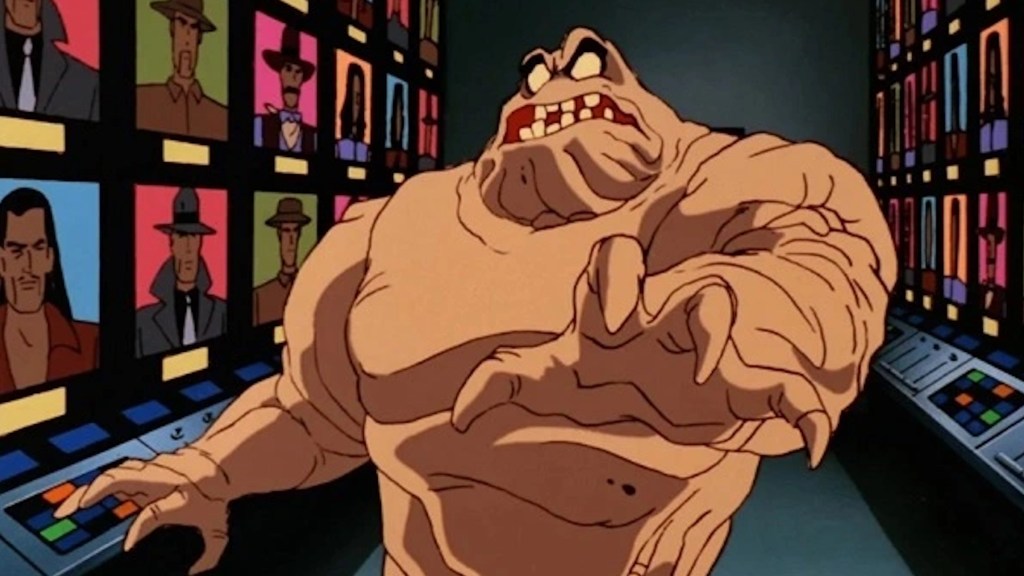
Many different DC Comics characters have used the alias Clayface. The earliest iteration was ill-fated actor Basil Karlo, who did not originally possess superpowers. The first comic book version of Matt Hagen was a treasure hunter who gained his shapeshifting abilities after making an exotic discovery. “Feat of Clay” blended the two, solidifying both the acting backstory and powers as quintessential aspects of the character. Like Harries’, Perlman’s version of Hagen is a successful actor whose career collapses when his face is disfigured. The animated Hagen gains his powers after becoming addicted to an experimental beauty cream called “Renuyu,” rather than volunteering for off-the-books medical experiments directly as Harries’ does.
“Feat of Clay” begins with Matt working for gangster Roland Daggett in exchange for steady supplies of Renuyu. The substance has already granted Matt the ability to change his appearance, and he attracts Batman’s (Kevin Conroy) attention while disguised as Bruce Wayne during an attempted assassination. As in the film, Matt initially uses the dangerous treatment as part of a desperate attempt to sustain his acting career, but after Daggett orders his men to kill him, which they attempt to do by force-feeding Matt an overdose of Renuyu, his resting form is transformed into that of a clay-based monster, after which Matt seeks revenge.
When he attempts to kill Daggett at a television studio Matt is confronted by Batman, who, having deduced his identity, plays excerpts of Matt’s films on the studio’s monitors. Matt is driven mad, reflexively using his powers to transform into his various past “roles,” including the people like Bruce he framed for crimes. Stumbling into some monitors, he is electrocuted, briefly reverting to his true, disfigured face and remarking to Batman that he’s always wanted to perform in a great death scene and lamenting that “I won’t be able to read the notices,” before appearing to die in his full clay form. However, coroners later discover that the clay body is hollow and Batman begins to theorize that Hagen’s death was in fact just a performance and that he’s still alive. This is subsequently confirmed, with Matt shown adopting the appearance of a woman and laughing maniacally, his voice and yellow eyes recognizable.
The Clayface Movie Has an Ambiguous Ending

Although the film’s ending is instead centered on Matt’s relationship with Caitlyn Corr (Naomie Ackie,) the scientist who created the treatment that gives him his powers, the outcomes for Matt are very similar. After realizing that Matt murdered his enemies and the former friends that betrayed him, Caitlyn goes to inform her fiancé, Detective John Borelli (Max Minghella) of this. But Matt has already killed John and assumed his appearance and begins professing his love for Caitlyn. She uses a taser on him, knocking him out a window. The shock from the taser causes him to completely lose control of his powers, shifting to a form resembling the monstrous one from comics and animation. Caitlyn prepares to hit the “kill switch,” that will shut down the nanites that give him his powers, but hesitates as she believes this may kill Matt as well. Ultimately, the decent part of him briefly shines through and convinces her to do so, with Matt’s destabilized body appearing to ooze into a sewer. However, the film’s final scene shows Caitlyn giving money to a homeless person that turns out to be a disguised Matt. He’s now living underground and speaks to what he initially believes is Caitlyn but is really just a detached and transformed part of his clay body, before reabsorbing it.
While the film’s ending has its merits, the one in “Feat of Clay,” is arguably more effective for a few reasons. Matt’s growing fixation on Caitlyn is an effectively disturbing addition to the movie and Harries and Ackie play the final scenes particularly well, but by focusing the last scene in particular on the relationship Matt imagines between them the film diverts its focus somewhat from the main idea of Matt’s concern with his appearance leading him to become a villain. One of the main reasons the disfigured actor storyline has been embraced as the quintessential Clayface origin is that it’s unfortunately a very relatable story. Anyone who feels pressure to live up to society’s unrealistic expectations of physical beauty can see themselves in Clayface, especially those whose work or passions put them in the public eye like actors’ do. Lonely people becoming obsessed with those who show them kindness is also unfortunately common, but isn’t always as sympathetic, and Matt’s fixation on Caitlyn is consequently the less compelling of his two main storylines so the focus on it makes the last scene less tragic than it could be.
The ending of “Feat of Clay” is also clearer about what it signifies for the character’s future. The maniacal laughter from Perlman’s Matt is appropriately cartoonish but it also cements that his personality has shifted to that of a villain, to match his superficially frightening appearance. Batman and the viewer are fairly sure that Clayface will continue to pose a threat in the future, and he certainly does in later episodes, though his motives are still largely sympathetic, with the character continually trying to cure himself and regain his original appearance. The future of Harries’ version is much less clear, and not just because the film doesn’t end by setting up or featuring a showdown with Batman as many fans hoped it would. All Matt’s enemies are gone so he has no significant reason to continue committing crimes (it’s not even clear if he really needs food, water, or shelter anymore,) and living underground suggests that he’s given up trying to maintain any kind of normal or public life despite being able to disguise himself. The roar he lets out after absorbing the clay Caitlyn shows that his delusions don’t satisfy him but other than that it’s really just a reiteration of his pain that’s arguably unnecessary. The scene doesn’t indicate what the character’s most likely to do next so the viewer is unsure whether to primarily feel sad for him or be frightened of the further harm he could cause, no matter how sympathetic his motives.
Clayface is in theaters now.
More Movies
-
Image courtesy of Marvel