It’s hard to talk about the greatest actors in Hollywood history without bringing up Heath Ledger, whether it’s for his performance in a memorable feature like Brokeback Mountain, a comfort movie classic like 10 Things I Hate About You, or the iconic The Dark Knight. The actor had one of the most impactful, yet tragically short, careers in the industry, going from romantic comedies to much more complex roles, eventually taking on one that completely changed the way people looked at his career. It may not be talked about or remembered as much as some of his other work, but once you watch it and learn the story behind it, it’s impossible not to admire Ledger even more.
Videos by ComicBook.com
What happened was the actor actually passed away while this movie was still being filmed, and what followed is so unusual that it would be unbelievable if it hadn’t actually happened. How was the feature able to be released without him when there was still an important part of his role left to film? Normally, a situation like this would mean rewriting the script ot finding a replacement, but in this case, there was a far more creative solution — and it only existed because the movie pretty much allowed anything to happen.
Why The Imaginarium of Doctor Parnassus Is a Standout Movie in Heath Ledger’s Career

Released in 2009, The Imaginarium of Doctor Parnassus stars Ledger as Tony, a mysterious man who gets involved with the group led by Doctor Parnassus (Christopher Plummer). Parnassus is an immortal man who travels the world with a theater troupe, carrying a mirror that can transport anyone who walks through it into fantasy worlds. This is where the story starts getting a little more surreal, with the characters entering realities shaped by pure imagination. And Tony is an important part of that. However, it was while filming the movie in early 2008 that the actor died. So, naturally, director Terry Gilliam came to believe there was no way to finish the project, especially since Ledger had already filmed a considerable amount of material, but there were still scenes left that were necessary to complete the story.
At that point, the whole thing could have ended there — and, honestly, it probably would have with any other production. But Gilliam had one advantage that very few other directors would have had in that situation: his film was already completely insane. So instead of trying to find a realistic way to explain an actor change, he realized he could do the exact opposite. The world of Parnassus already allowed people to change their look, for example, so Tony could just have a different face eventually. That’s how Johnny Depp came into the cast, readily agreeing to help finish the production. But of course, it wasn’t that simple, given the actor also had a packed schedule and couldn’t film all of the remaining material. So what could they do? Jude Law and Colin Farrell, who were also friends of Ledger, stepped in.
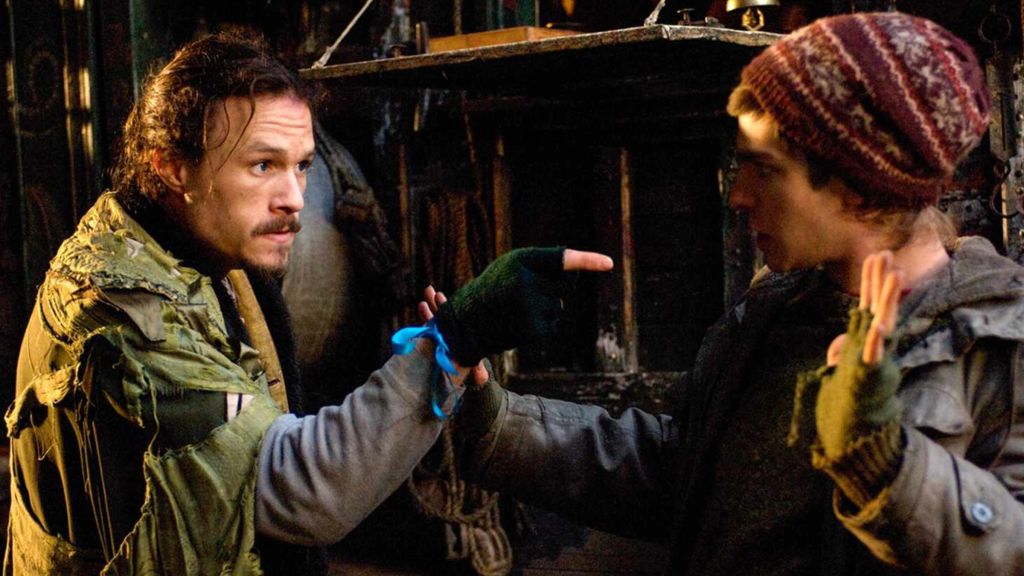
Basically, all three actors played the same character at different points, with each one representing a new version of Tony after he went through the mirror. And this was probably the best decision the movie could have made for the story, not because it was perfect, but because they didn’t try to pretend nothing had happened. In another feature, doing this just to finish a protagonist’s scenes would have been totally distracting, right? Here, the change was built directly into the plot — it made sense. Sure, the script had to be changed, but not as much as you might expect, since the character’s nature made some flexibility possible: Tony was a difficult person to figure out, and each time he went through the mirror, he could reveal a distinct side of himself. So, Depp ended up playing a more charming and seductive version of the character, Law took the middle ground, and Farrell brought out his darker side.
But the best part of the whole strategy is the tribute, since Ledger’s involvement could easily have been replaced by another actor simply reshooting all of his scenes. Thankfully, in The Imaginarium of Doctor Parnassus, his footage was preserved, and it’s actually one of the things that makes the movie more enjoyable to watch.
The Final Result Is One of Hollywood’s Most Extraordinary Stories

The entire story happening behind the scenes would have been enough to become a Hollywood legend. Gilliam had to restructure the script, work around the schedules of three different actors, and figure out how to film the new scenes without ruining what Ledger had already done — and that’s no small task. Depp, Law, and Farrell also had to find a balance between continuing what their friend had started and bringing their own interpretations to the character. In the end, everything worked out, with the movie making approximately $61 million worldwide. It wasn’t exactly a huge success, but it received a reasonably positive response and a modest box office considering the extremely complicated circumstances surrounding its production. Critics and audiences also praised the way the feature handled Ledger’s absence.
But some details make this whole story even better: Matilda, the actor’s daughter, was not included in his will, which had been written before she was born. That’s when Depp, Law, and Farrell decided to help in a pretty significant way: all three gave up their fees for the movie, with the money going to Matilda. Plus, Gilliam was also so affected by everyone’s effort that he even decided to change the film’s final credit. Instead of the traditional “A Film by Terry Gilliam,” the movie ends with “A Film from Heath Ledger & Friends.” He later explained that, after everything that had happened, he didn’t feel right treating the movie as another one of his works. To him, the feature only made it to the finish line because so many people decided to keep going when it would have been understandable to give up.
Now, knowing all of this, watching The Imaginarium of Doctor Parnassus completely changes the experience of seeing Tony walk through the mirror and come back with a different face. What was supposed to just solve a problem became kind of an inseparable part of the movie’s identity. It’s not a matter of saying the tragedy made the film better than it actually is, but it certainly made its existence and the way it eventually reached audiences much more remarkable.
More Movies
-

Courtesy of 20th Century Studios -

Image Courtesy of Marvel -

Image Courtesy of Lucasfilm -

Image Courtesy of Sony