Hugh Jackman became one of the biggest names in Hollywood because of his role in Fox’s X-Men films as Wolverine. He stepped into a role that had the potential to completely destroy his career, but was able to excel, making comic fans forget that he was tall and handsome and not short, hairy, and unloved. The Australian actor was able to ride the role into the spotlight and stayed there because he was really that great of an actor. He could do superhero action, he could do romantic comedies, he could sing and dance, he was charming and funny, just one of those talents who could do everything well. Wolverine allowed him to kick in the door, but he kept his place because he was able to star in roles that fans loved.
Videos by ComicBook.com
In the early ’00s, Jackman was everywhere in Hollywood. His movies made money and soon, Universal Pictures thought that he was big enough to anchor an entire franchise. Universal was once the biggest name in big screen horror, with Dracula, Frankenstein, Mummy, Werewolf, Creature From the Black Lagoon, and various other hits establishing what horror movies were for decades. However, they had rarely been able to parlay that success into the modern day. Jackman was looked at as the missing ingredient and this led to the legendary mid ’00s bomb Van Helsing. The film was meant to bring the Universal monsters back to the big screen, creating an all-new franchise… if it hadn’t bombed.
Van Helsing Brought Action Schlock to the Universal Monsters and Scared Off the Audience
The early to mid ’00s were an exciting time to be a moviegoer and Van Helsing is an example of everything right and wrong with cinema at the time. Blockbuster movies had become the engine that drove movie threaters – I worked at a theater back then, becoming projectionist/manager in an 18-plex and we would sometimes have as few as six movies playing – with superhero movies, Pirates of the Caribbean, Shrek (we played Shrek 2 every twenty minutes for weeks), Harry Potter, and the like becoming the dominant movie theater paradigm.
Jackman’s early successes as an actor were influenced by the role of Wolverine, but he was able to prove he was a box office draw on his own thanks to starring in numerous movies. Hugh didn’t just do action or franchise films, so the fact that his movies did well for the most part was enough to make him something of a hot commodity. He was the center of one franchise, so Universal Pictures reasoned that it would be possible for him to be the center of another one. In fact, they had the perfect one – the classic monsters of the Golden Age of Cinema: Dracula, the Werewolf, and Frankenstein’s Monster. However, they decided to put the focus elsewhere, on the marketable star.
While these creatures all became legends, Universal was never able to find the same kind of success of them over the decades. Part of the problem was obvious – since the source material was public domain, anyone could make their own version of the monsters and there was nothing Universal could do about it. It wasn’t smart to create a franchise with them at the center, because other people could play off the success of your version. The success of characters like Wolverine and Jack Sparrow showed that action heroes with a more nerdy bent could work well, and Van Helsing was the perfect example of a character that was focus-grouped into existence.
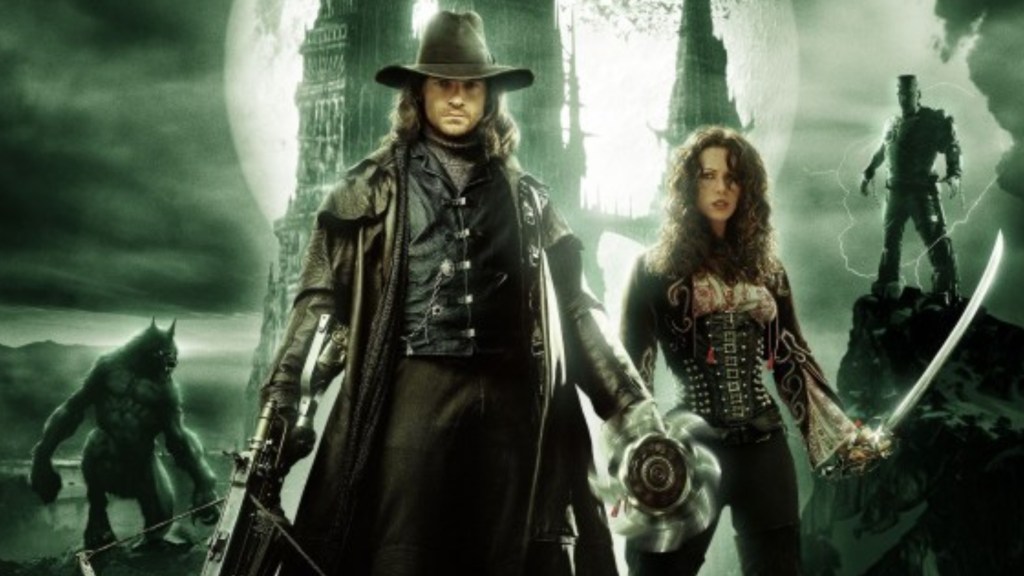
Van Helsing was created to appeal to the teen boys who had always been the bread and butter of the movie business. The character in the books was an old school vampire hunter, one who was just as much scholar as he was hunter. Universal decided to take the vampire hunting scholar and put an emphasis on the hunting; now, instead of just being a person who studied the occult, he was part of a secret organization called the Knights of the Holy Order, a group run by the Catholic Church that protects humanity from monsters using a variety of “secret” technology, with its own order of monks working with the hunters.
Jackman as Van Helsing is all macho competence and action movie schlock, the kind of action hero that’s full of cliche lines and superhuman abilities. Friar Carl, played by Faramir actor Davis Wenham, was the bumbling smart guy sidekick, often the butt of jokes. Kate Beckinsale plays Anna, the “not like the other girls” monster-fighting love interest, all tight pants and corsets because teenage boys, with Dracula played by Richard Roxburgh with the perfect amount of ham, as an evil dark lord-type, the center of a web of evil that wrecked the lives of everyone in the movie. Jekyll and Hyde show up, we get Frankenstein’s Monster, and there’s a twist with the werewolf that’s not exactly predictable, but not really surprising either.
While Pirates of the Caribbean showed that summer blockbusters could be more than just action movie thrills, Van Helsing was blockbuster schlock of the highest order. It was filled with massive set pieces, CGI everything, dad jokes galore, the hammiest villains you can imagine, and kind of weapon’s grade corniness that you could only get from a movie that was product first, story second. Watching it, even back then, you could see how they hoped that it would become one of those massively popular blockbuster franchises that sold toys by the ton, but didn’t really care so much about the story. Some executive probably thought his automatic crossbow would become a big-selling toy or something. Every decision in the movie looked like it was made to appeal to the biggest audience.
However, the movie didn’t come close to hitting the level it needed to be considered any kind of success. The film’s budget was $160-170 million and it made about $300 million. This isn’t exactly terrible, but it also wasn’t really enough to greenlight a sequel. Universal spent a lot of money marketing the movie, hoping that it would appeal to the teen and younger boys the movie was marketed towards. However, 2004 was the year of Spider-Man 2, Shrek 2, Harry Potter and the Prisoner of Azkaban, and The Incredibles. Audiences were spoiled for quality blockbusters and Van Helsing was ignored as the weeks went by and better movies opened.
The Franchise That Wasn’t

Van Helsing is the perfect example of everything not to do with a film franchise. Looking at it, you can tell that from the beginning, this wasn’t a film made because everyone had a real passion for the character of Van Helsing and wanted to bring him to life in a new way. This was a movie that was made with the idea of becoming a massive blockbuster. There was an entire marketing blitz, starring the kind of marketable star that did walk-up business – Jackman movies were often something that men and women could agree on, so they probably figured it would have a rich secondary life after a big premiere.
However, while the movie opened at number one with $51 million, it was blown away by what came after it. It opened in early May, before the kids got out of school and I think Unversal figured that it would kick off the summer well. However, negative word of mouth and one of the biggest blockbuster summers of all-time (don’t just take my word for it; go and look up what came out that year) meant that it would die a quiet death. Don’t let anyone tell you that Van Helsing is a hidden jewel; it’s as mediocre as it looks. It’s funny when you think about how many times that Universal tried to bring their monsters back in various ways in the modern day and all the different ways they failed. Van Helsing failed for much the same reason that the Dark Universe would a decade later – they put the cart before the horse, planning on a blockbuster before they ever put anything to film.
Do you remember Van Helsing? Do you think it would have made for a good franchise long term? Sound off in the comment section.
More Movies
-
Courtesy of Paramount Pictures -
Image courtesy of Marvel