In 1989, Star Trek: The Next Generation introduced viewers to the Borg. They’re easily one of the most impressive alien races in Star Trek, in part because they’re so much more than a single race; they’re a collective, bound together by advanced technology. There’s a sense in which the Borg are the dark mirror of the Federation, because they push community to the nth degree, removing every aspect of individuality in favor of the Collective.
Videos by ComicBook.com
And yet, surprisingly, the Borg were almost very different. In fact, The Next Generation even featured abandoned setup for the original version, an insectoid race who would have led to a very different show. In this case, plans changed for the better, and for the most surprising real-world reason.
The Original Borg Were So Very Different to the One We Know
Star Trek: The Next Generation writer and co-executive producer Maurice Hurley originally planned the Borg to be so very different. As he explained in an issue of Starlog magazine: “What we really wanted to do, but couldn’t because of money, was create a race of insects…insect mentality is great because it is relentless. The Borg are a variation of an insect mentality. They don’t care. They have no mercy, no feelings toward you. They have their own imperative, their own agenda and that’s it. If all of them die getting there, they don’t care. We needed a villain who could make you dance, and the Borg could do it!”
We tend to think of assimilation as the core of the Borg, but Hurley wasn’t originally interested in that at all. Instead, he was fascinated by the concept of a hive mind, envisioning the Borg as an insect swarm – as relentless as a cloud of locusts advancing across the stars. In fact, Hurley began to plant seeds pointing to this version; the Borg were originally supposed to be the mysterious aliens who infiltrated the Federation in “Conspiracy.” The Borg connection was dropped, but it didn’t take long for plans to change even more radically.
Two things coincided to change the Borg. The first was a writers’ strike, which complicated production; the episode “The Neutral Zone” had initially been a two-parter which introduced the Borg, but it had to be compressed to a single episode and their debut was delayed. Meanwhile, budget constraints meant the insect design proved too expensive. The Borg shifted, becoming humanoid, but the core idea of the Collective remained. The key difference, though, is that the real Borg’s Collective can absorb others into it – and that’s what makes the Borg so terrifying.
The Best Borg Stories Would Have Been Impossible in This Version
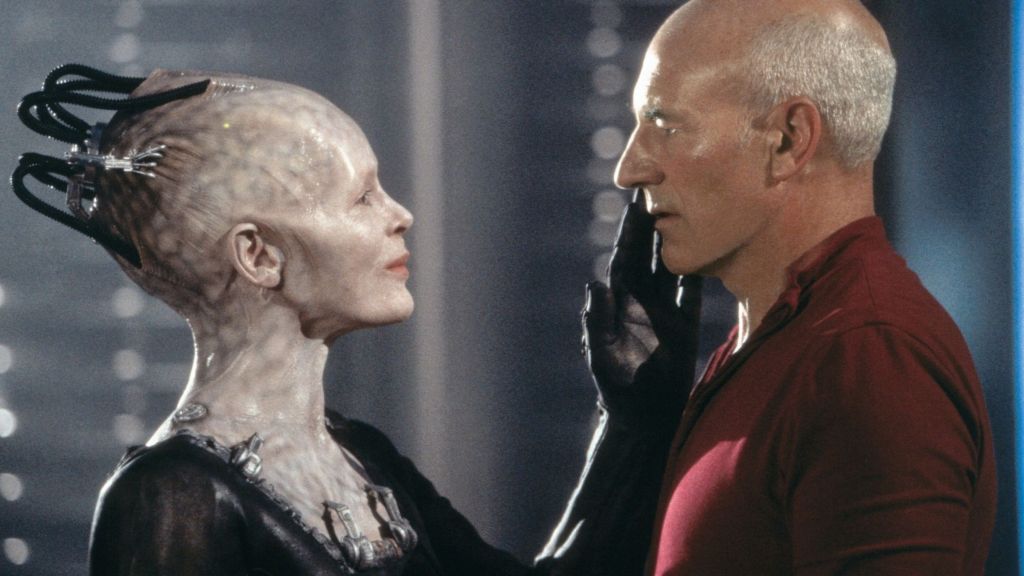
Looking back, one thing is abundantly clear: the very best Borg stories would have been impossible had the original plans come to fruition. This first vision of the Borg saw the aliens as an external threat, capable of infiltrating the Federation to undermine it, but nevertheless an “other.” At best, we’d have had something akin to the Dominion War, which used the Founders’ shape-shifting powers to create that same sense of infiltration. But the best Borg stories turn this upside-down, with humans joining the Collective, allowing Star Trek to explore themes of collectivism versus individualism.
Take, for example, Jean-Luc Picard’s experience as Locutus. This is easily one of Star Trek‘s all-time most compelling stories, and the key doesn’t lie in the fact Picard was used by the Borg; it lies in his absorption into the Collective, the suppression of his individuality that left a permanent scar on the Enterprise’s captain. Or, as another example, Seven of Nine; she’s someone who was once part of a whole, and needs to learn how to become human again. Neither of these ideas would have been remotely possible – even though the core concept, that of the hive mind, still remains roughly the same.
Even the Borg catchphrase takes on a new meaning in light of this. “Resistance is futile” for the original Borg would simply have been a declaration that their numbers were too great, and that they didn’t care how much they lost defeating their enemies. But for the “real” Borg, it’s a statement of intent: they will claim you, absorb you, make you one of them. And they don’t care how much you resist, because the outcome will be the same in the end.
The Borg serve as a surprising lesson that the practical realities of making a TV show – navigating writers’ strikes and production budgets – can be a vital part of the development process. In this case, the Borg would have been unrecognizable if not for real-world factors. Star Trek has a history of turning its limitations into strengths – transporters were created to avoid expensive shuttle scenes – and this is just another example.
What do you think? Leave a comment below and join the conversation now in the ComicBook Forum!
More TV Shows
-
Image Courtesy of Paramount -

Courtesy of Paramount+ -
Image Courtesy of Sci-Fi Channel