Collectors will pay money for items based on several factors but there is no clear reason why some items sell for much more than others. A new illustration of this is an actual piece of art from The Simpsons that sold for more than some classic Disney animation cels that have survived almost a century.
Videos by ComicBook.com
The latest auction from Prop Store, who specialize in selling iconic pieces of film and TV memorabilia, featured dozens of animation cels, hand-drawn sketches, and backgrounds from classic Disney movies including 1937’s Snow White and the Seven Dwarfs, anime, and popular shows like The Simpsons. One particular lot from the latter show became the star attraction of the auction, blowing away even the oldest Disney offerings.
Why The Simpsons Art Is Worth More Than Classic Disney Cels
Animation has changed a lot of the last 30 years, shifting from hand-crafted drawings brought to life through months of work to make just a short scene to computer-driven animations that generate the kind of visuals Walt Disney could only have dreamed of. For that reason alone, it would not be unfair to assume that piece of art used to create movies like Snow White, Alice in Wonderland, Pinocchio and more would he worth a huge amount considering the fragility of the material used in those early movie productions.
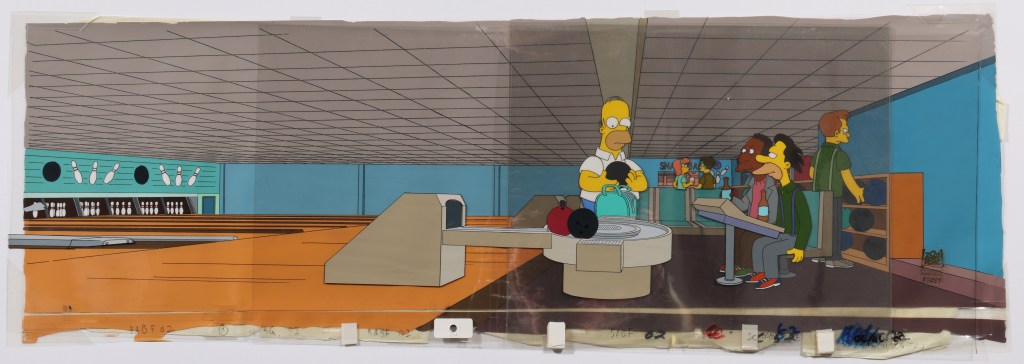
Yet, at the end of the auction, many pieces such as original productions cels of Bashful and Grumpy from 1937’s Snow White, one of Figaro the cat from 1940’s Pinocchio, and Alice in the Tulgey Wood from 1951’s Alice in Wonderland all went unsold, failing to attract the $4,000-$8,000 opening bids. Meanwhile, several The Simpsons cels from the show’s first 11 seasons all sold, mostly for that same price range. The exception was a panoramic piece from the episode “Hello Gutter, Hello Fadder,” which met its lofty estimate of just over $32,000.
The Simpsons cel in question is drawn for the Season 11 episode that first aired in 1999, and captures the moment Homer heads to the bowling alley with his friends before bowling a perfect game. On the surface, the item and even the episode is unremarkable. However, what the lot sold did not simply consist of a single cel, but a dying process of movie making that has survived intact for over 26 years.
The Simpsons lot is not a lone character cel but a complete production setup. It is a pan cel arrangement, with Homer, Lenny and Carl hand-painted onto their own cels and presented on the original key master hand-painted production background, the actual painted artwork used behind the Iconic Simpsons characters during filming. In animation collecting, the background is often worth more than the characters, and a piece that unites the original cels with their matching production background is one of the hardest to acquire as it shows an entire filmable moment rather than a small piece of it.
By contrast, the Snow White cels in the sale are individual character cels, and even the Pinocchio drawing is just a single piece. As beautiful and historic as they are, these like many other Disney cels have been separated over the years from their original production backgrounds.
There is a further factor working in the modern show’s favour. While older Disney movies were all hand-drawn and a large number of these cels have been collected and safely stored away for years, The Simpsons switched from hand-drawn to digital in the early 2000s. A 1999 setup uniting three beloved characters on their master background comes from the tail end of the hand-drawn era, and that alone gives it a special place in history.
Although the importance of Walt Disney’s first movies for animation cannot be understated, the scattered nature of art used in movie production of the time is partly the reason why it cannot make the same kind of money as The Simpsons’ full production set up. If someone were to come across an authenticated character and background combination from one of Disney’s classics, it would put Homer’s Bowlerama scene in the shade.
More Collectibles
-

Courtesy of Amazon MGM Studios -
Courtesy of 20th Century Studios -

Courtesy of The Walt Disney Company -

Courtesy of The Walt Disney Company