Contains spoilers for Clayface and Resident Evil (2026).
Videos by ComicBook.com
2026 has been the year of horror blockbusters. Most recently, the DCU’s Clayface has dominated the box office with its intense body horror, first glimpse at Gotham, and compelling characters. After making one bad decision — sleeping with a mobster’s girl — audiences watched Matt Hagan’s life fall apart. He lost his pretty face, lost his chance at a successful acting career, and in the end, his humanity.
The ending of Clayface shows a changed Matt Hagan, barely recognizable as the same guy who started the film. The nanobots that repaired his body have been destroyed, causing his relaxed form to resemble clay more than skin. Audiences watched Hagan destroy all of his relationships, and the final scene confirmed that the rekindling between him and Caitlyn Corr was nothing more than his own creation. Clayface is alone, and in keeping with how monsters on screen behave, his last action is to roar at the camera.
Clayface isn’t even the only man turned monster this year to do this. Zach Cregger’s Resident Evil ended in the same way, although with a totally different meaning. For Matt Hagan, his ending roar has cemented his descent into villainy. For Bryan Hodukavich, the descent has merely begun.
Protagonists Grappling with Monstrosity

Although both horror films with medical interests, Clayface and Resident Evil are working in different sub-genres. Clayface is closer to a Frankenstein story, emphasizing the dangers of untested medicine and injecting non-human entities into the human body. Corr is the doctor who becomes the object of her creation’s obsession and suffers for it with the death of her fiance, a man that Clayface tries to pass himself off as before Corr discovers the man’s body. Resident Evil is instead working in the zombie and mass medical outbreak genre. Hodukavich isn’t being tested on, but rather — for most of the film’s runtime — is trying to avoid those who have. Infection is spreading and Hodukavich is trying to deliver a package that could help.
Hodukavich succumbs to the disease in the end. He turns into a monster, kills the last remaining scientist, and fails at his mission. Hodukavich sends the cure plummeting off the roof of the building, dooming not only himself but everybody else. But unlike Hagan, it doesn’t ring as a moral failing.
His quest wasn’t for revenge or to gain the upper hand. The movie’s events are set off by his agreement to deliver a package, which is hardly a villainous motive. His choice though sets him in contact with those infected and although he’s able to fight his way through, he’s not able to do without getting infected.
While Hodukavich gets infected, it is a conscious choice Hagan makes. Hagan tracks down Caitlyn Corr after reading about her research and insists that she use him as a human guinea pig. Corr has already been testing on herself — after her funding was cut and her investors pivoted towards using Corr’s science for cosmetic purposes — and even her fiance agrees that testing on Hagan would be a better alternative than her current circumstances.
Corr is cautious but agrees, insisting on following what her research has deemed safe. Hagan, of course, is insistent on getting his face back. When his face appears to be malfunctioning, Hagan goes back to Corr. He takes the experimental procedure into his own hands and doses himself, taking his levels to double what Corr had worked out to be healthy. She’s amazed that he’s alive and for the first time, she hesitates at the idea of deleting the nanobots. Doing so, she believes, would kill him.
Hints at Different Futures
The ending of Resident Evil suggests another battle in progress. Bryan Hodukavich has succumbed to the disease and mutated, letting out a roar just as helicopters from the National Guard arrived. It is now up to the National Guard to take down Hodukavich along with the other infected. With the cure veering off the roof, it’s uncertain whether it can still be attained in one piece or if society is back to square one for curing the disease.
Clayface’s ending feels more existential. He and Corr share a kiss only for the camera to pan down and reveal that they are connected through clay. Corr isn’t there in reality, and instead, Hagan is creating a pantomime of her. He’s creating one that loves him when the real version does not. This is a monster that wants acceptance and love, not just to infect.
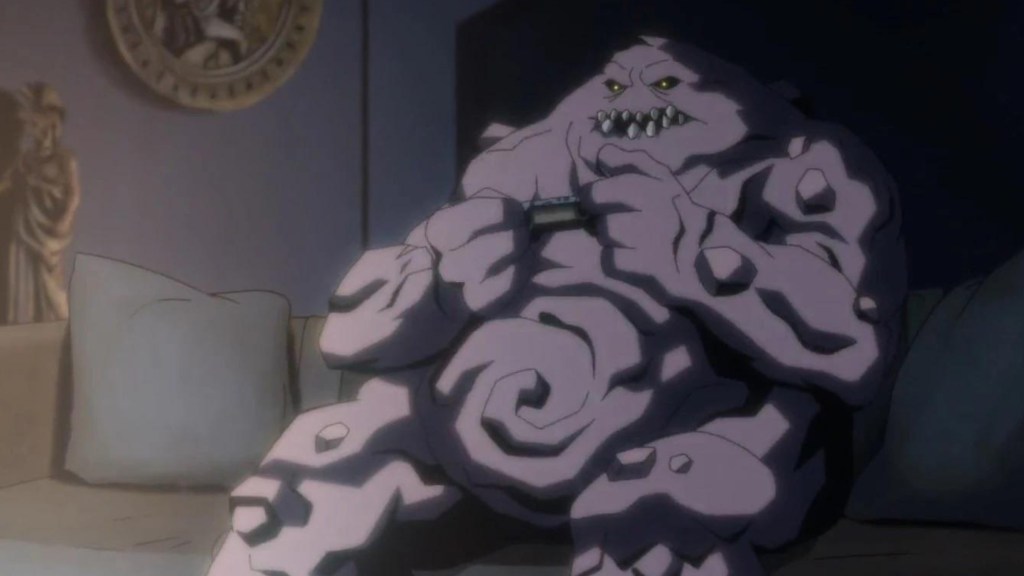
The future of Matt Hagan is also complicated by his ties to the expanded DCU. Clayface is present in James Gunn’s Creature Commandos, the animated series that is the first official entry in the DCU. While using the same voice actor as the Harley Quinn show, the Clayface in Creature Commandos is decidedly different and is meant to be the same character as the Matt Hagan that appears in Clayface. Because of this, Clayface is in addition to all of its other descriptors, a prequel.
By the time of Creature Commandos, Clayface is known publicly as a supervillain and one that is willing to be paid for his services. After committing murder and other crimes, he’s caught and imprisoned. He’s even seemingly dead by the end of the season. Additionally, the future characterization of Clayface is manipulative and sadistic, a far cry from the almost sympathetic Hagan found in Clayface.
What other connections have you made between these two blockbusters? Comment down below!