Few franchises recycle their villains with the same consistency as Star Wars. Darth Vader has anchored the Skywalker Saga across nine films while extending his reach into major Disney+ productions, most notably Obi-Wan Kenobi, where his psychological warfare against his former master became the dramatic center of the entire series. Meanwhile, Emperor Palpatine’s surprise return in The Rise of Skywalker remains one of the most divisive creative choices in the franchise’s modern era, widely criticized for undermining the emotional finality of Return of the Jedi without providing a satisfying narrative justification. Even Maul, despite a genuinely tragic arc across The Clone Wars and Rebels, is now receiving his own dedicated animated series, with Star Wars: Maul — Shadow Lord premiering on Disney+ on April 6, 2026.
Videos by ComicBook.com
The issue is not that these three villains are undeserving of their prominence. All three are among the greatest antagonists in the history of Hollywood. Yet, their gravitational pull consistently overshadows a supporting cast of antagonists whose complexity, visual distinctiveness, and narrative function rival the twisted feats of these legends.
7) Dedra Meero

Andor fundamentally reimagined what a Star Wars villain could look like by stripping away the robes, the lightsabers, and the supernatural gravitas. Dedra Meero (Denise Gough) operates entirely within the bureaucratic machinery of the Imperial Security Bureau, and her terrifying quality stems from the fact that she is simply better at her job than everyone around her. Where her colleagues dismiss the scattered Rebel activity across the galaxy as unrelated incidents, Meero recognizes the signature of a coordinated intelligence network, and her dogged pursuit of that thread drives Andor‘s most compelling Imperial storyline.
Gough’s performance captures the particular coldness of institutional ambition, a character who has internalized the Empire’s dehumanizing logic so completely that she experiences it as righteous purpose rather than corruption. Meero never wields a weapon, and her power comes entirely from the access she earns through competence and ruthlessness, making her one of the most realistic Imperial antagonists the franchise has ever produced.
6) General Grievous

After a breathtaking animated debut on Genndy Tartakovsky’s Star Wars: Clone Wars, General Grievous was introduced in Revenge of the Sith as a coughing, hunched cyborg whose theatrical presentation suggested a level of menace that the film ultimately failed to deliver on. Star Wars: The Clone Wars spent years correcting that miscalculation, rebuilding Grievous into one of the prequel era’s most formidable threats. The animated series established his tactical intelligence and physical lethality, depicting him as a relentless hunter of Jedi who had surgically replaced most of his organic body with combat-optimized machinery.
The grotesque tragedy of Grievous is that his transformation was not entirely voluntary, as the Separatist leadership and Count Dooku deliberately accelerated his cybernetic conversion to manufacture the ultimate Jedi-killing weapon, leaving the Kaleesh warlord permanently enraged by the body he no longer fully inhabits. That backstory reframes every encounter with the character, giving his violence a dimension of pathos that Revenge of the Sith never had the screen time to explore.
5) The Grand Inquisitor
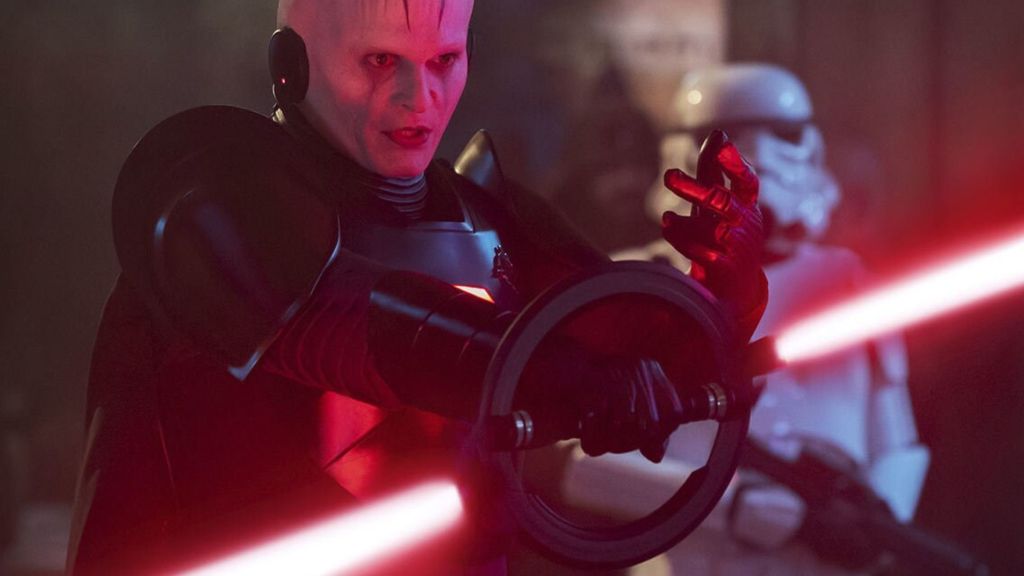
The Grand Inquisitor functions as the Empire’s answer to the vacuum left by Order 66, a former Jedi Temple Guard who defected to the dark side and was subsequently weaponized by Vader to hunt down the survivors of the purge. His genius as a villain lies in how The Grand Inquisitor studies his target’s combat forms and emotional vulnerabilities with the precision of someone who was trained to understand the Jedi mind from the inside.
Star Wars Rebels established The Grand Inquisitor’s menace across multiple seasons, portraying him as an adversary whose patience and analytical approach made him more dangerous than any opponent who simply relied on Force power. Obi-Wan Kenobi translated that threat to live-action with Rupert Friend embodying the character. The Inquisitor program, as a concept, represents one of the franchise’s most disturbing ideas, the notion that the most effective weapon against the light side of the Force is the Jedi themselves, turned inside out.
4) Director Orson Krennic
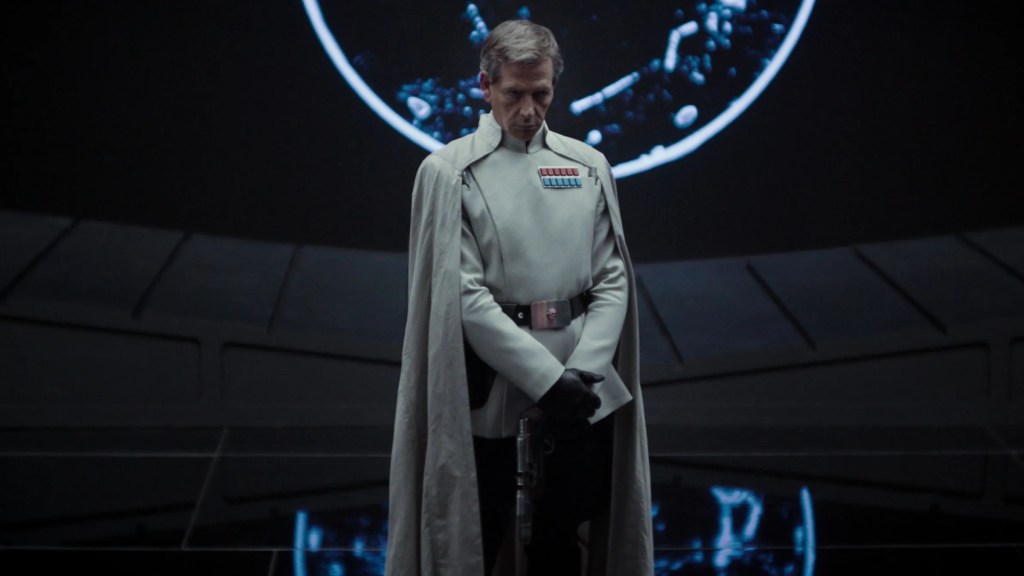
Rogue One distinguished itself from every other Star Wars film by centering its conflict on the ordinary political and bureaucratic machinery of Imperial power. Director Orson Krennic (Ben Mendelsohn) embodies that framework with the insecurity of a man who has sacrificed everything to build something magnificent and is being systematically denied credit for it. Krennic spent years overseeing the construction of the Death Star, navigating the treacherous politics of the Imperial hierarchy, only to find Grand Moff Tarkin (Guy Henry) positioning himself to claim the weapon’s legacy at the moment of its completion. Mendelsohn plays that professional humiliation with remarkable precision, making Krennic simultaneously threatening and deeply pathetic.
Andor Season 2 retroactively sharpened the character by presenting an earlier version of Krennic, one who lords his authority over subordinates, including Dedra Meero, with a strutting confidence that Rogue One never had room to explore. Seeing Krennic at the height of his ascendance, orchestrating the Ghorman Massacre to secure resources for the Death Star without a trace of moral hesitation, recontextualized every scene of his later humiliation.
3) Jabba the Hutt

Jabba the Hutt requires no supernatural power to project his authority. The crime lord who controls the criminal underworld of Tatooine operates through a combination of wealth, sadism, and a court of fearful dependents that functions as a miniature empire within the larger galactic conflict. His physical design—immobile and grotesque—echoes centuries of accumulated power, a creature so entrenched in its dominance that it no longer needs to move.
George Lucas used Jabba’s palace in Return of the Jedi as a concentrated distillation of the Star Wars universe’s moral rot, populating it with bounty hunters, entertainers, assassins, and hangers-on whose collective degradation illustrated the cost of existing under criminal authority. Jabba’s hold over Han Solo gave the opening act of Return of the Jedi genuine stakes independent of the Galactic Civil War, proving that the galaxy’s conflicts are often settled not in starship battles. His influence continues to reverberate across the franchise in The Book of Boba Fett, which structured its entire premise around the power vacuum his death created.
2) Asajj Ventress

Asajj Ventress began her arc in The Clone Wars as Count Dooku’s ruthless assassin, a dual-blade combatant whose raw ferocity positioned her as a persistent threat to Anakin Skywalker and Obi-Wan Kenobi across multiple seasons of the animated series. What elevated her beyond that functional role was the decision to trace her history as a Nightsister of Dathomir and a discarded apprentice, revealing the systematic betrayals that sharpened her into something the Sith were ultimately unable to control. When Dooku ordered her death and she survived, Ventress was freed from the narrative gravity of Sith allegiance and became a genuinely morally ambiguous survivor whose capacity for violence was no longer anchored to any institutional loyalty.
The animated film The Bad Batch revisited Ventress’s trajectory, and her main arc concluded in the canon novel Dark Disciple, which adapted an unproduced Clone Wars storyline. Yet, she returned for the Star Wars’ Tales of the Underworld anthology, meaning the franchise might not be done with her. Ventress remains one of the most fully realized characters in Star Wars‘ animated history, a villain whose complexity earned her a redemption that felt neither unearned nor predictable.
1) Grand Admiral Thrawn

Grand Admiral Thrawn is the rare Star Wars villain whose danger is entirely cerebral. First created by Timothy Zahn for the 1991 novel Heir to the Empire, a book widely credited with reviving public interest in the franchise during a decade without new films, Thrawn was canonically reintroduced in the third season of Star Wars Rebels as the Empire’s most sophisticated strategic mind. Thrawn studies the art and cultural artifacts of his enemies to map their psychological patterns, using aesthetic analysis as a military intelligence tool. That specific methodology translates into a villain who always appears to be three moves ahead, and whose defeats feel like tactical concessions rather than genuine losses.
The villain’s live-action debut in Ahsoka depicted a Thrawn who had spent years in exile on a distant world, refining his plans with the patience of someone who never doubted his own eventual return. No other Star Wars villain outside of the franchise’s iconic trio carries the cross-media legacy, the narrative sophistication, or the sustained fan devotion that Thrawn commands across novels, animation, and live-action television.
Which Star Wars villain outside of the big three do you think deserves a solo project of their own? Leave a comment below and join the conversation now in the ComicBook Forum!
Most Viewed
-
Sam and Dean Winchester in Supernatural looking out a window. -

©Toshiaki Iwashiro,Shueisha/PSYREN Secret Society -
image courtesy of Warner Bros.