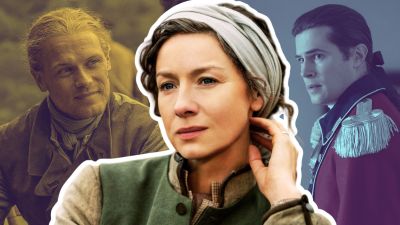
There are several sci-fi shows today, but have you really seen one that manages to blend the genre with romance in a meaningful way? Outlander is one of the very few that pulls it off, and does it with a surreal level of mastery. And even though part of the audience initially came in out of curiosity for the time-travel concept, a lot of people stayed because of Jamie (Sam Heughan) and Claire’s (Caitríona Balfe) dynamic. The series has always made it clear that their relationship is the real engine of the story. But that also creates a problem: when you spend many seasons building such an intense, almost mythic love that stretches across centuries, the ending naturally has to feel big. And that’s a tricky thing to pull off, since it needs to match everything that came before it and feel worthy of it.
Videos by ComicBook.com
Well, Outlander has finally come to an end, and its finale understood that pressure. The season as a whole might not have completely done justice to the main couple’s arc and had its weaker points. However, the conclusion of the overall story was still very beautiful and consistent with the show’s original premise since its very first episode back in 2014. At the same time, it did feel a bit confusing for a lot of viewers in its final moments because it doesn’t offer explicit explanations. But the truth is that this confusion is actually part of the experience itself, thanks to the sci-fi element. Let’s break it down.
Outlander’s Ending Is Confusing Because Its Story Is a Bootstrap Paradox

The Outlander series finale finally brings the infamous Battle of Kings Mountain to life, with patriots and loyalists facing off against each other. The patriots come out on top, which initially suggests to Claire and Jamie that Frank’s (Tobias Menzies) written account in the book was wrong. However, when Jamie tries to speak with Major Patrick Ferguson (Charles Aitken), he is shot by the British officer and dies. Claire feels the impact of that attack in her own body and rushes to Jamie, staying by his side through the entire night until sunrise. And that’s where the whole process begins, which left many fans confused.
The show’s intention to keep the ending very open was a deliberate creative choice, according to showrunner Matthew B. Roberts, which leaves room for multiple interpretations. And yes, it’s valid for each viewer to interpret it in their own way. However, it is strongly implied that the couple’s story is built around a paradox.
Right after Jamie dies and Claire seems to join him out of exhaustion and a broken heart, the audience is taken back to the very beginning of the show, to the 1945 scene where Claire is in Inverness with Frank during their honeymoon. Jamie’s ghost, appearing young and dressed as he was in Season 1 (since he is a specter and not bound by the rules of time), is standing outside the inn watching her. After Frank notices him and attempts to react, Jamie disappears, and in a transition, he is shown standing in front of the Craigh na Dun stones. He touches them, and the “forget-me-nots” flowers (the same ones that once drew Claire to the stones) bloom in the ground.
It’s all purely a visual explanation, but it suggests that Jamie was the one responsible for drawing Claire into 1743. But it’s still confusing, right? Well, the paradox at play here is the famous Bootstrap Paradox, where something exists because it caused its own existence. Essentially, when Jamie dies at Kings Mountain, his spirit is sent back to 1945 to see Claire one last time. However, we are shown that it’s because of his spirit that he leads her to travel through time, meet him in the flesh, and live out their entire story together. In short, Jamie had to die in that battle for the entire Outlander story to happen.
The Open Doors and Post-Credits Scene Perfectly Conclude the Series
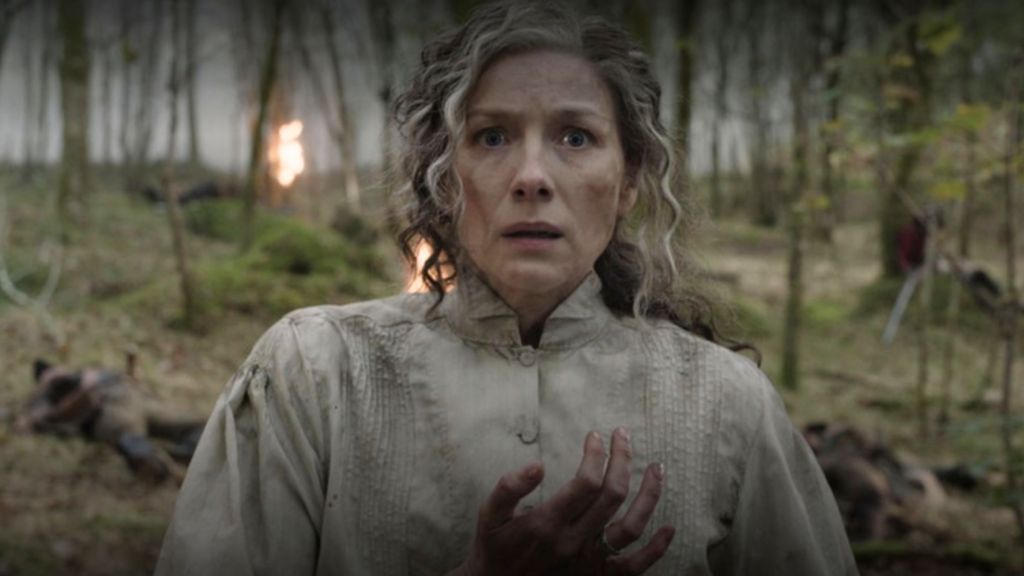
So, the temporal paradox is established, and after a flashback of memorable moments from the couple’s journey, the audience returns to the scene where Jamie and Claire are dead at Kings Mountain. However, this time, Claire’s hair is completely white, and both of them open their eyes at the same time, coming back to life. The show ends this way, without a clear conclusion, and leaves space for fans to imagine that a continuation could possibly happen. But that’s not exactly what we’re focusing on here — it’s about why this creative decision was the ideal way to close out the entire story after so many years.
The magic and essence of Outlander has always been mystery. Even though it explores real historical periods, it blends sci-fi and fantasy elements, but nothing is ever fully explained. Some things make sense (especially through the book series, which, although not yet complete, already answers many of the questions people might have), but the production chose to postpone resolving many of its mysteries until the very end. So, going into the final season, everyone expected that by the finale, all answers would be given and the story would wrap up cleanly. But doing that would risk stripping away the very ambiguity that defines the show. It’s not that explanations would have ruined the legacy, but keeping things uncertain is what gives the story its strength. It’s not interesting to kill what makes Outlander unique: its supernatural and emotional edge.

And another very special element that reinforces all of this is the post-credits scene, which is essentially a major tribute to the original author, Diana Gabaldon, who appears signing copies of the first book in the saga in the present day while being asked about the diary beside her. According to her, it’s something to give her a bit of inspiration. Well, that diary is the one Claire began writing throughout Season 8, documenting her time-travel experiences and her life with Jamie. It’s a scene that doesn’t really explain anything, because its purpose is to provoke even more mystery.
So in the end, Outlander delivers a perfect ending because it insists on showing that it’s not just about a couple moving through history, but about them existing as an anomaly within it. Closing everything with absolute answers would only diminish that (not to mention interfere with whatever Gabaldon is planning for the final book). There is room for interpretation, continuation, and theory exactly because the show has always been about that from the very beginning. That is its identity.
Outlander is available to stream on Starz.
What do you think? Leave a comment below and join the conversation now in the ComicBook Forum!
More TV Shows
-

Courtesy of 20th Television Animation