When it comes to sci-fi, a lot of themes and elements come to mind — and war is one of them. Conflict has always been at the center of the genre, but the truth is that very few movies actually treat war as anything more than a backdrop for big set pieces. Explosions, spaceships, and large-scale battles are easy to plug into a plot; what’s harder is showing wear and tear, bad decisions, and the kind of consequences that don’t just disappear in the next scene. Most of the time, those details are either glossed over or barely touched on. A strong sci-fi war movie, however, uses conflict to push its characters into genuinely uncomfortable territory and to reshape the world around them. In cinema, war isn’t just a spectacle.
Videos by ComicBook.com
With that in mind, here’s a selection of 7 great sci-fi war movies, ranked from worst to best in that specific category. Each of them succeeds by treating war as an active part of the story rather than background noise. But which one really makes war matter within its narrative?
7) Independence Day
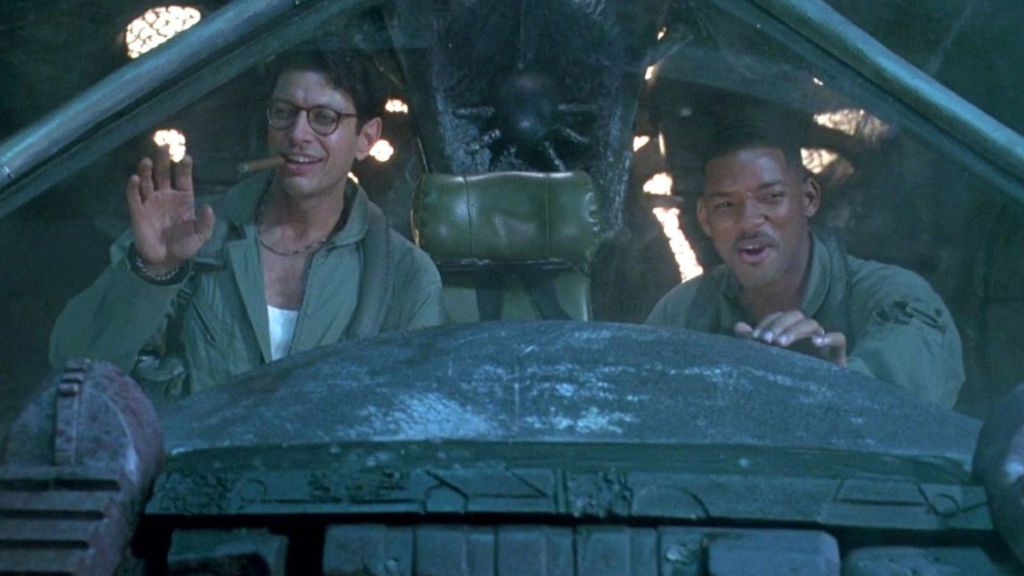
Independence Day is one of those movies pretty much everyone has seen at least once, since it’s a full-on classic. The story follows alien invaders who arrive, wipe out key locations around the globe, and force humanity to respond with everything it has. Overall, it’s a solid blockbuster, but honestly, the issue is that as a sci-fi war film, it never seems actually interested in the war itself. Most of the runtime is focused on catchphrases, slightly cartoonish characters, and large-scale destruction designed more to impress than to say anything meaningful. As a result, the film rarely takes the time to build real tension.
Because of that, Independence Day lands at the bottom of the ranking. Despite its massive scale, the war functions mostly as a backdrop for spectacle. There’s little in the way of meaningful strategy, and the emotional weight of the losses doesn’t really linger once the moment passes. It’s nostalgic and entertaining, but compared to the other productions on the list, it’s far more about explosions than about the conflict itself.
6) Avatar: Fire and Ash

Within the Avatar franchise, the first film was long considered the strongest example when it came to portraying war. Avatar: Fire and Ash, however, arrives to take that title. This is the point where the chaos on Pandora finally shifts from a constant looming threat to open, sustained conflict. The plot follows the escalation of violence between humans and the Na’vi, introduces new tribes, and presents a planet that feels increasingly fractured. There are more battles, heavier losses, and a noticeably more aggressive tone than in the previous installments.
Even so, it doesn’t climb much higher in the ranking because the sense of déjà vu is hard to ignore (and it’s not surprising that many viewers felt like they were watching the same story play out again). In short, the war grows in scale, but not necessarily in complexity. Motivations remain overly clear, sides are still sharply defined, and the conflict rarely offers anything unexpected. Fire and Ash is undeniably powerful on a visual level as a sci-fi war movie, but narratively predictable — and that weighs heavily when compared to stronger entries on this list.

5) Pacific Rim

Pacific Rim is a kaiju movie that’s widely praised by fans of the genre, and it doesn’t waste time setting things up: giant monsters are attacking the planet, so humanity responds with even bigger robots. That’s basically the entire premise, and the film seems proud of how straightforward it is. It presents a full-scale global war scenario where countries stop acting on their own and start operating as a unified force, complete with military bases, clear chains of command, and defined combat protocols. The threat is constant, time is always running out, and every battle has the feeling that extinction is a very real possibility. It’s direct, efficient, and hard to mess up.
On the other hand, despite this well-established structure, the war itself barely evolves. Each confrontation mainly exists to set up the next, bigger fight, without digging too deeply into emotional fallout, political consequences, or long-term strategy. That isn’t necessarily a flaw, because Pacific Rim never pretends to be a deep study of warfare. Still, it limits the film’s impact within the sci-fi war category. It excels at scale, design, and action, but deliberately stops short of going beyond the raw, visceral thrill of combat.
4) Edge of Tomorrow

Here, the war against aliens isn’t background noise — quite the opposite. It’s the story’s driving force from the very first minute, and that immediately works in the movie’s favor. Earth is losing badly, soldiers are dying by the thousands in desperate offensives, and humanity is already operating in full damage-control mode. Edge of Tomorrow takes place in this collapsed scenario, where recruitment is forced, training is rushed, and the battlefield feels less like a mission and more like a death sentence. And the entire plot revolves around the time loop that forces Major William Cage (Tom Cruise) to relive the same invasion over and over again.
It’s a great film overall and an obvious fit for this list, but when you really break it down, the war functions more as a narrative device than as a full portrait of a global conflict. The focus stays mostly on the protagonist’s personal arc, rather than on large-scale strategy, long-term consequences, or the broader human cost of the war. Still, the way the production uses the concept of warfare is genuinely compelling thanks to the time loop, the psychological toll, and the brutal trial-and-error logic. Edge of Tomorrow is a sci-fi war at its smartest and most efficient, but it’s ultimately too intimate to claim the top spot.
3) War for the Planet of the Apes

When you get to this entry in the Planet of the Apes franchise, it becomes clear there’s no postponing it anymore: the war has started, and there’s no way around it. War for the Planet of the Apes follows Caesar (Andy Serkis) as he tries to protect his people in a world where human civilization is already collapsing, and the remaining survivors are becoming increasingly violent and ideological. The entire premise is built around this unavoidable clash. Still, the central conflict goes beyond a simple species-versus-species fight, turning into a struggle over leadership, survival, and who ultimately deserves to inherit a planet ruined by humanity itself.
What firmly places this film among the top three of the ranking is how it treats war the way it should be treated: as a process of erosion, not pure visual flair. The battles leave real scars, every victory comes with losses that can’t be undone, and no decision feels clean or heroic. War for the Planet of the Apes understands that wars aren’t won through brute force alone, but through choices that slowly corrode leaders and redefine who they are. It may be more visually restrained than other films on this list, sure, but it more than makes up for that with dramatic weight and genuine emotional impact.
2) Rogue One: A Star Wars Story

Star Wars is a franchise that already says a lot just by its name, but when you look at the full slate of movies, war itself is actually handled best in the spin-off Rogue One: A Star Wars Story. Here, the idea is to follow a very specific military mission, with a clear beginning, middle, and end: stealing the Death Star plans. Everything in the film revolves around that objective, through scenes focused on strategy, infiltration, tactical decisions, and, above all, sacrifice. There are no prophecies, no heroes shielded by mystical destiny, and no convenient last-second twists; every step forward comes at a real cost (which is likely why the film resonates so strongly with fans).
Like War for the Planet of the Apes, this movie is first and foremost interested in talking about war, and only secondarily in being a chapter of a massive franchise. The conflict is messy, chaotic, and brutally expensive in terms of lives, with characters who are disposable in the best possible sense — because the mission matters more than the people carrying it out. Rogue One works brilliantly within an already established universe. However, it doesn’t redefine sci-fi war on its own. It refines, matures, and elevates the genre, but reaching the very top of the ranking requires something even more transformative.
1) Dune: Part Two

Do you know why Dune: Part Two sits at the very top of the list? Because it doesn’t use war as a climax, but as a starting point. The story follows Paul Atreides (Timothée Chalamet) as he steps into leadership among the Fremen and takes on the empire on Arrakis, but the film is quick to show that this conflict is anything but heroic or simple. The entire narrative is shaped by the protagonist’s transformation into a messianic figure, and every military victory comes with unavoidable political, religious, and human consequences that spiral beyond his control. War isn’t the goal here — it’s the mechanism that accelerates something far bigger and far more dangerous.
Dune: Part Two understands that sci-fi war isn’t just about who wins, but about what’s left behind after victory: collapsing systems, leaders warped by power, and conflicts that don’t magically end when the enemy is defeated. War is central to the story and drives everything forward, but it’s never the only thing that matters — and that balance is what gives the movie its weight. The action isn’t there just to grab attention; every battle reshapes alliances, radicalizes beliefs, and pushes the story toward an increasingly dark and inevitable outcome. Very few films use war with this level of thematic precision.
Have you seen any of these movies? Are you into sci-fi war stories? Leave a comment below and join the conversation now in the ComicBook Forum!
Most Viewed
-

Sony Pictures -

Image courtesy of The Pokemon Company -
Image Courtesy of Marvel Comics -

Image Courtesy of HIDIVE -

Courtesy of Crunchyroll